
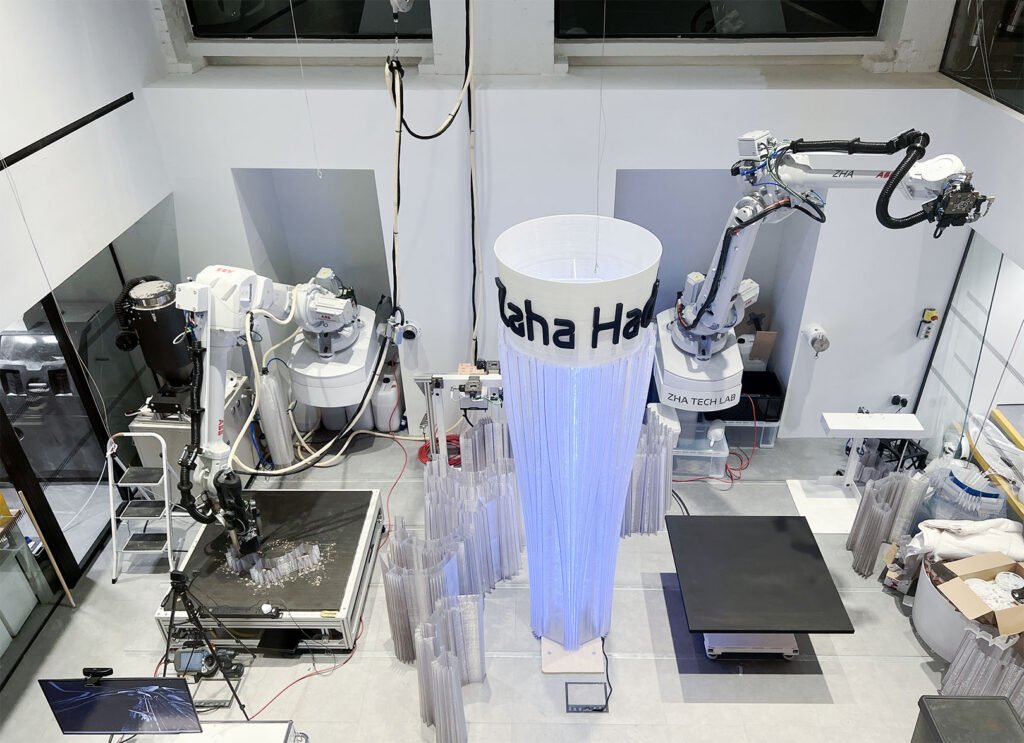
Zaha Hadid Architects (ZHA) have successfully used WASP 3D printers to make a 6-meter-tall model of an aircraft control tower. Zaha Hadid Architects’ Tech Lab made the tower in-house for the ZHAviation booth at Passenger Terminal Expo 2026. The design was created by ZHA and made out of PETG. The company used a WASP HDP XL Extruder. The model is not made out of one single piece, but out of 15 panels. The hefty panels measure 1 x 1 meter and took 270 hours to make. A fire-resistant PETG was used so that the model could go to the trade show.
The panel has LED lamps inside to make it pop. It’s not made of 3D printed parts alone, but the panels are mounted on a kind of metal truss structure. The whole thing was designed to be portable so it can be taken to other exhibitions. The Tech Lab now has two robots using the CEREBRO system, and both can work on parts simultaneously.

ZHA was the place where the founders of AIbuild worked before starting their company. So it’s poignant that this seems to mark a kind of move by WASP into AIbuild territory. Now of course, WASP isn’t like other companies. The mercurial Italian firm literally wants to save the world through making affordable, efficient homes out of natural materials. So its path and overall strategies are a bit confusing at times, but make sense if you take into account that the world wants to 3D print the future of humanity. And the company has been so chaotic but consistent that I’m inclined to believe them at face value.
WASP’s pellet printers have been used for boat interiors, it has made ceramic wall tiles, made an expo building out of natural materials, made a facade for Pacha, a residential home in Japan out of soil, and a 3D printed airport building. A lot of it is very design and architecture led. The firm also makes small delta printers, larger robotic ones, and Cartesian systems, all at many scales.

In terms of materials, they’re all over the place. The company works with pellets, filament, ceramics, clay, and more. It makes printers for small things, and some of the biggest 3D printers there are. The company also sells materials, and is now offering its CEREBRO system and extruders to others. WASP also sells the pumps separately, in case you want to make a concrete system, for example. You can also pair your printer with a recycling station. So if you’re a systems integrator or already have a robot, then you can go to WASP and get the parts to turn that robot into a 3D printer.
The WASP HDP XL Extruder is an FGF pellet extruder meant for PLA, ABS, PP, TPE, TPU, and PETG with a 2, 3, or 5mm nozzle. It comes with a hopper and a material detection system, and has a nifty mobile heated chamber that it takes with it as it prints. So there’s no need to heat the room or put a lot of additives in something so it doesn’t warp: the heated chamber gives you better adhesion when it matters. The system has a brushless motor and brushless cooling fan. CEREBRO meanwhile helps you integrate your robot with your WASP extruders. The system works for LDL (screw or Liquid Deposition Modeling) for liquid ceramic materials, or other continuous feed systems for ceramics as well as pellet heads.

It comes with an app that lets you monitor builds, send toolpathing to the machine, simulate head movements, and actually move the head. Simultaneous control over the robot arm and extruder makes them work in concert. WASP says that it works with “any robotic system.” Helpfully, the firm also helps customers with application development support. The system is in use at several universities, like Eindhoven University of Technology (TU/e). It always seems like WASP is working flat out in all directions.
It’s of course great to have an open platform product. This will let WASP cater to researchers, inventors, and companies at the cutting edge. Through this, it will find out if boat printing is growing, if people are making formwork, and if companies want to do prints combining polymers and cement. So in terms of catering to the bleeding edge of the market, this is a smart move. There are many robotics integration companies worldwide as well, and helping them could be a great business. We know that WASP wants to do it all, but can the firm do it all well?
Images courtesy of WASP