
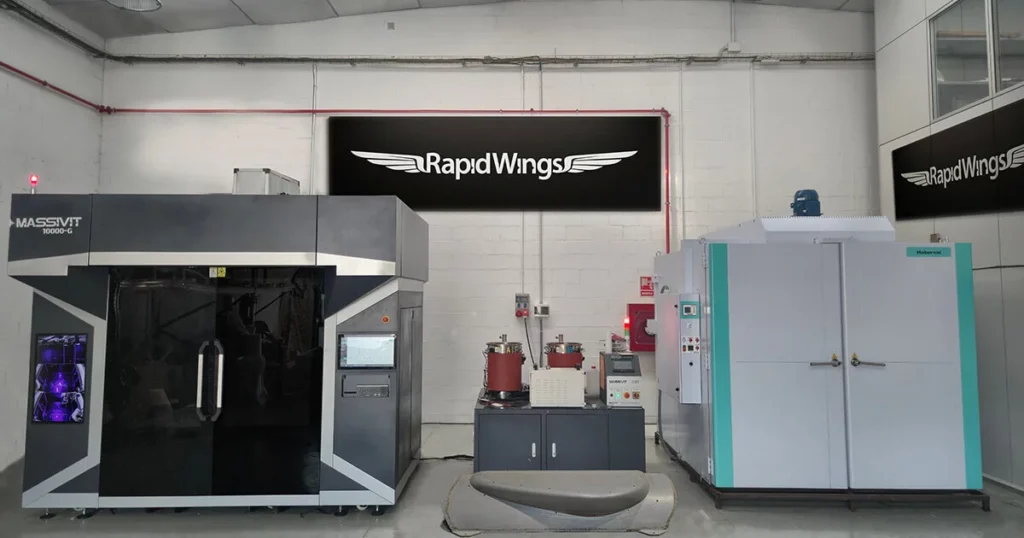
In this weekend’s 3D Printing News Briefs, Massivit has opened its first European Service Center to support its RapidWings platform, and nScrypt was granted a patent for its high-viscosity material dispensing technology. Titan America launched a commercial concrete product line for automated construction, and Empa researchers are investigating how to use 3D printing to extend the service life of steel components.
Massivit Announces Opening of First Europe-Based RapidWings Service Center

Recently, as part of its increased focus on aerospace and defense, Massivit announced the launch of its RapidWings turnkey composite manufacturing platform. Now, the company has opened its first Europe-based Service Center to support RapidWings. The Service Center, located in Barcelona, Spain, functions under Massivit’s Europe entity, and will produce and deliver on-demand tooling for aerospace and defense manufacturers. The heart of the center is Massivit’s Cast In Motion (CIM) digital technology, which will help reduce traditional lead times for tooling, like molds, mandrels, masters, and jigs and fixtures, by allowing users to get around current bottlenecks and supply chain constraints. According to Massivit, based on the defense projects the RapidWings platform has already completed, manufacturers can expect a tooling lead time reduction of up to 90%.
“The establishment and operation of the service center in Spain is a milestone in Massivit’s business transformation and in the transition to the implementation of our international expansion strategy. Europe, led by the sovereign aviation and security markets, is currently facing unprecedented bottlenecks in supply chains. With our technological manufacturing platform, we enable customers to shorten tooling production times from months to just a few days, while maintaining full operational control and cost savings,” said Yossi Azarzar, CEO of Massivit.
“The Barcelona Service Centre is just the first step in building a global network of service centers and manufacturing facilities in other dominant markets, and we are confident that it will be a strong growth engine to establish us as a key and important link in the international supply chain in the coming years, while creating value for all stakeholders in the company.”
Sciperio Gets U.S. Patent for High-Viscosity Material Dispensing Technology

Ken Church and Vanesa Listek at nScrypt headquarters. Image courtesy of 3DPrint.com.
Florida-based nScrypt designs and manufactures next-generation, high-precision microdispensing and 3D manufacturing systems for industrial applications. Its research and development arm Sciperio was awarded U.S. Patent No. 12,654,396 B2, titled “Pump for Additive Manufacturing.” Direct write manufacturing often use difficult materials, like adhesives, conductive inks, biological materials, and epoxies. Traditional dispensing systems can have a difficult time maintaining consistent flow with these materials, which can negatively impact product performance and quality. Sciperio’s patented technology, which is integrated into nScrypt’s advanced manufacturing systems and forms the basis of its QuantiHelix dispensing platform, makes it possible to precisely dispense highly viscous materials. It combines a servo-controlled progressive cavity pump with a high-precision valve controlled by servo motor. The system is able to dynamically regulate material flow in real time, delivering high-accuracy volumetric dispensing of viscous materials while also improving consistency and reducing common printing defects.
“This patent reinforces our commitment to advancing the capabilities of direct digital manufacturing and additively manufactured electronics. By enabling precise control of highly viscous materials, this technology provides industry and government partners with new capabilities to manufacture and repair complex, high-performance products with greater accuracy, consistency, and reliability. It also reflects our continued investment in U.S.-developed advanced manufacturing technologies that expand what is possible in digital manufacturing,” said Dr. Kenneth Church, CEO of Sciperio and nScrypt.
Titan America Launches Commercial 3D Printable Concrete Product Line

U.S.-based Titan America, a vertically integrated producer of cement and building materials, recently launched a commercial 3D printable concrete technology line called xForm3D. The patented solution was developed specifically to support automated, digital construction technologies, like additive construction (AC), across commercial, infrastructure, residential, and coastal environments. The idea is to address some of the issues facing the construction industry, like labor constraints, faster project delivery, and the need for more affordable, efficient housing. The xForm3D technology uses automated concrete placement, and offers multiple advantages to the construction value chain, including optimized material use, improved job site safety, more creative freedom through customized forms and complex geometries, and better schedule reliability. The product family is made up of xForm3D Standard for general automated construction; xForm3D Marine for underwater and marine applications; and xForm3D RMX with larger aggregate sizes for ready-mix truck delivery.
“This solution underscores how Titan America is investing in innovation that drives long-term growth. Our xForm3D technology builds on our core materials expertise while opening new, scalable markets in automated construction, infrastructure resilience, advanced manufacturing, and manufactured and modular housing solutions. As demand continues to grow for faster, more efficient construction, innovations like xForm3D will help expand what’s possible for the built environment,” said Titan America’s CEO Bill Zarkalis.
Empa Using Metal 3D Printing to Extend the Life of Steel Components

The WAAM pilot plant at Empa. Image: Empa
Support structures, bridges, and industrial steel construction endure stress for many years, which results in unsafe fatigue cracks. But it’s expensive, and often impractical, to fully replace these kinds of permanently installed components. So researchers at Empa are using metallic 3D printing to see how steel components can be repaired and redesigned to extend their service life. In wire arc additive manufacturing (WAAM), a robotic arm uses an electric arc to print a welding wire onto defective areas, creating a single weld seam and reinforcement in one. By locally reinforcing the damaged parts of structures like bridges, the entire defective component doesn’t have to be replaced, which saves money and is much more efficient. The key is an optimized geometry, which, as Hossein Heydarinouri of Empa’s Structural Engineering laboratory explains, “distributes stresses in such a way that the propagation of existing cracks is stopped or significantly slowed down.” Tests showed that steel plates, filled with two-layer, stepped metal reinforcement geometries and subjected to repeated loading, had a much higher fatigue life than control plates with no repairs.
“Using 3D printing, we can apply metal reinforcements exactly where they are structurally needed. Repairs save material, energy, and costs,” said Heydarinouri.
“3D printing gives us enormous geometric freedom. We can specifically optimize structures – for example, to reduce weight while maintaining or even optimizing load-bearing capacity.”
Heydarinouri’s team is also working on other concepts, like combining metal 3D printing, intelligent geometries, and new materials to create metal structures that yield under extreme loads, absorb energy during the process, and return mostly to their original shape, or at least without permanent damage. This has major potential for applications like metallic damping elements in earthquake-prone areas.