
Across several universities in the U.S., more programs are adding hands-on learning into how they teach, often using tools like 3D printing. Instead of relying only on lectures and theory, students are getting more chances to work directly with technology.
In different settings, from outreach programs to advanced science classes to student-led clubs, 3D printing is used to turn ideas into something students can actually see and handle. Three recent examples show how this is happening in different ways.

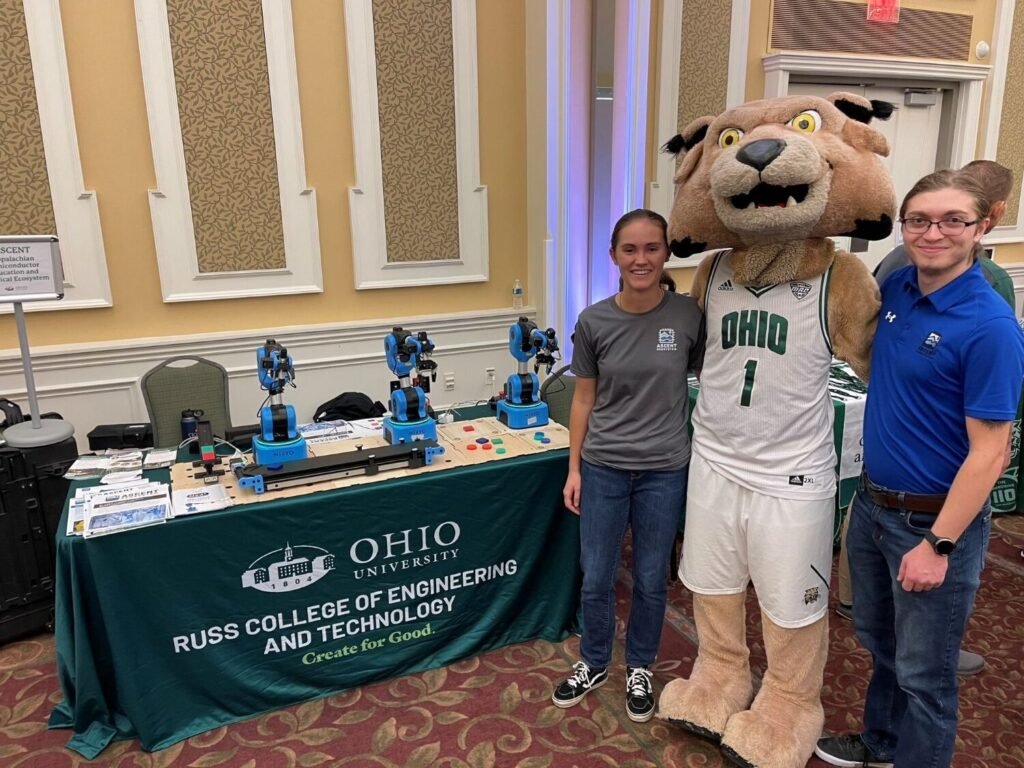
Petrie with the Niryo Ned 2 robots and a K12 student during an outreach event. Image courtesy of Ohio University/Ohio Today.
At Ohio University, engineering technology and management student Brandon Petrie is helping local K-12 students get an early look at manufacturing and technology. Petrie, a senior in the Russ College of Engineering and Technology, started leading outreach sessions after giving a campus tour to a group of students. Since then, he estimates he has connected with more than 1,000 K-12 students from nearby communities.
During those sessions, Petrie introduces students to tools they likely have not seen before, including Niryo Ned 2 robots and 3D printers. The Niryo Ned 2 is a small, desktop robotic arm, similar to the ones used in factories, but scaled down for learning. Students can program it to move, pick up objects, and sort them.
The outreach also comes from Petrie’s own experience growing up in Southeast Ohio. Petri explains that the point is not to turn every student into an engineer right away; it is to show them that this kind of future exists, and that they can ask questions, try things, and imagine themselves in it.
“These are things that I’ve never seen when I was younger,” he says. “So I’d like to get that out there and show it to people, give them the opportunities that I never got when I was younger.”

Petrie stands with the Niryo Ned 2 robots during an outreach event. Image courtesy of Ohio University/Ohio Today.
In one example, the robot is set up to sort circular and square pieces, showing how a simple manufacturing process works. It also reacts to basic signals, which engineers call inputs and outputs, so students can see how machines “communicate” and respond to instructions.
3D printing adds another part to that process. Students can design an object on a computer and then watch the printer build it layer by layer. This helps connect what they see on a screen with how real parts are made.
For Petrie, that part matters because it makes manufacturing easier to understand. Students can design their own creations using online tools, including Minecraft, and then see those designs turned into printed objects. Instead of just hearing about how something is made, they get to watch an idea move from the screen into the real world.

Petrie created a 3D printed electric guitar. Image courtesy of Ohio University/Ohio Today.
Outside of school and outreach, Petrie also works on his own 3D printing projects. One of his recent builds was a fully 3D-printed acoustic guitar, made almost entirely from plastic except for the strings and a few metal parts. He has also started working on an electric guitar, which will require wiring and soldering. Beyond bigger projects, he uses 3D printing to solve small, everyday problems. For example, he is designing a custom holder to keep bolts and tools organized while working under cars, so he does not lose them while repairing parts.
“I work on cars, so I go underneath them a bunch and right now I’m about to design and print out a thing to hold bolts and different things on my crawler when I go underneath the car, instead of dropping it on the ground and losing it 24/7. I can now just have an easy storage place to save me time and headaches,” concluded Petrie.

Jarrod Cecere, Dr. David Calianese, and Scott Bergenfeld at the Biosymposium. Image courtesy of Seton Hall University.
Meanwhile, at Seton Hall University, David Calianese, an assistant professor in the Department of Biological Sciences, is using virtual reality (VR) and 3D printing to help students better understand structural biology. His students are studying molecules such as hemoglobin and proteins linked to metabolic disorders, including diabetes and heart disease.
The work grew out of a collaboration with Seton Hall’s Teaching, Learning and Technology Center. Students in Calianese’s Biochemistry of Metabolism course visited the university’s Innovation Hub Exploration Studio, where lectures took place inside Nanome, a VR platform for exploring molecular structures. Using Meta Quest Pro headsets, students could move around molecules, examine them in 3D, and see details that are harder to understand from the traditional flat images in textbooks.
The 3D printing part happens through Seton Hall’s Maker Studio. After studying the molecules in VR, students create 3D printed versions of those same structures. This lets them first explore the molecules in a virtual space and then hold them in their hands.
“Regardless of whether they had the VR goggles on or off, the classroom was buzzing,” noted Calianese. Many students continued exploring molecular structures outside of class using Nanome’s desktop version. “This was a completely student-driven project, and it was incredibly rewarding to see how engaged the undergraduates became. During their first visit, students also toured the Maker Studio, where they learned how molecular models are prepared and produced using 3D printers.”
The project also became part of their coursework. Student groups studied assigned molecules and later presented their work at Seton Hall’s Biosymposium during the Petersheim Academic Exposition, using Nanome screenshots, avatar images, posters, and 3D-printed molecular models to explain their research.


At the University of Maine, the focus is on giving students a space to work with 3D printing outside of class. The university’s 3D Printing Club brings together members interested in designing and making parts, whether for fun, coursework, or future careers.
The club is led by president Jack Bernado, a mechanical engineering junior, and meets weekly at the Ferland Engineering Education and Design Center, with support from fellow mechanical engineering student Tim Goodell, who helps oversee the space and equipment. Members come from diverse backgrounds, mostly in engineering and computer science, but the group is open to anyone interested in learning.
Every Wednesday during the fall and spring semesters, the group meets to design and produce a wide range of items, including figurines based on movie characters, toy cars and boats, mechanical hands, bowls, and vases. About a dozen members create digital designs and use industrial printers to produce parts ranging from very small components to large-scale models. At the club, there is no fixed curriculum. Instead, learning happens through projects, print requests, and managing real workflows.
“It has made me better at leading a team and being part of a team,” Bernado said. “It has helped me be more organized with all the different prints being submitted, as well as all the people to reach out to.”
Club members are currently planning a pinewood derby race with cars made from 3D printed parts for the fall 2026 semester.
The club is also planning activities that make the work more engaging. One example is a planned pinewood derby-style race in which students will design and build cars using 3D printed parts. The idea is to give students a project, let them design it, and then see how it performs. This gives students real experience with 3D printing. They learn how to use the machines, work in teams, and develop their ideas.

3D printing club working in the lab in Ferland Hall. Image courtesy of the University of Maine.
As more institutions adopt similar approaches, tools like 3D printing are likely to remain part of that mix. Not as a standalone solution, but as one of several ways to make learning more practical and easier to grasp.