
In this weekend’s 3D Printing News Briefs, we’ll start off with a multi-laser metal powder bed fusion 3D printer and post-processing news. We’ll end with research into soft robotics and boosting the quality of 3D printing plastics with agricultural waste. Read on for all the details!
Eplus3D Announces Launch of Ultra-Large-Format Metal 3D Printing System
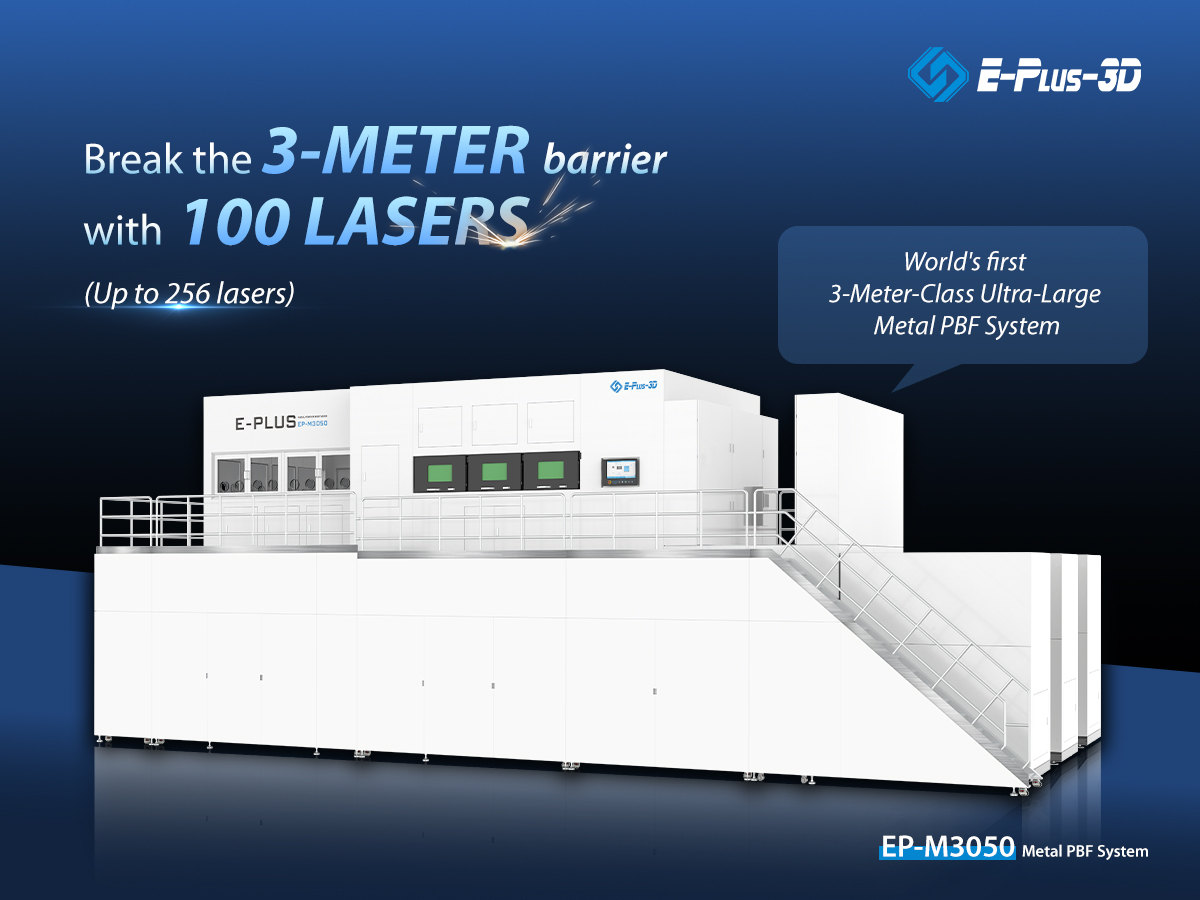
Figure 1 – EP-M3050 Metal PBF System
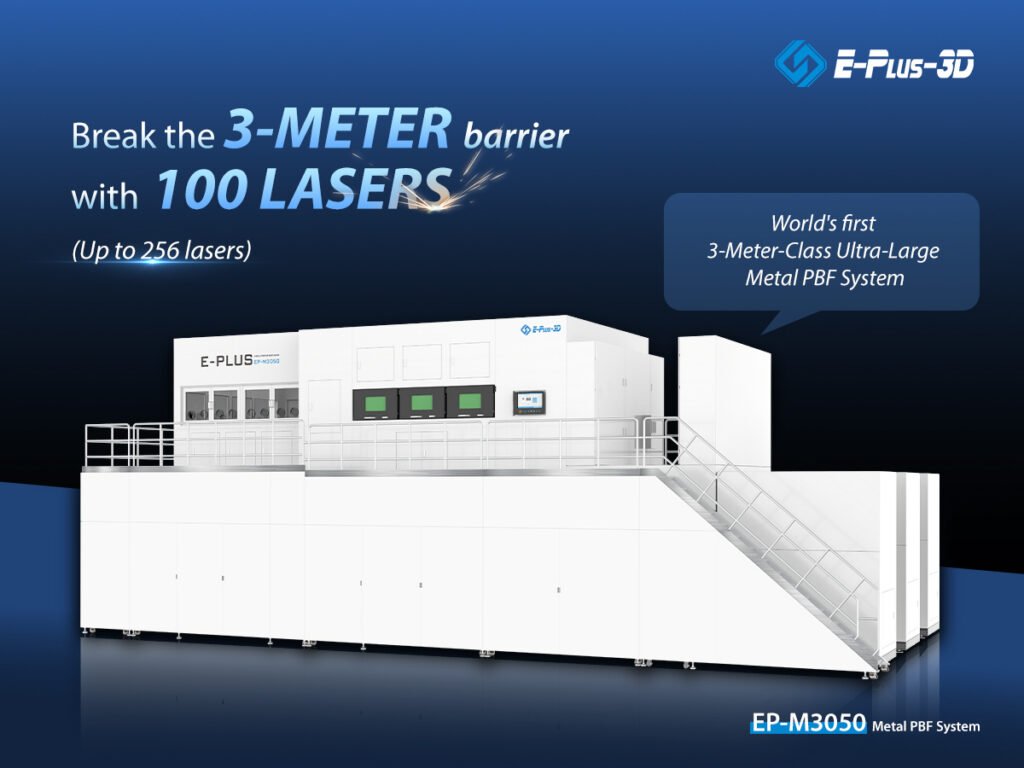
Chinese metal additive manufacturing (AM) solutions provider Eplus3D announced that it has broken the three-meter AM barrier with its new EP-M3050 ultra-large-format metal powder bed fusion (PBF) system, complete with 256 lasers. The company reports that its new system features standard X and Y dimensions of 3050 mm x 3050 mm and a Z-axis customizable up to 5000 mm, which makes it possible to achieve one-piece manufacturing of ultra-large structural components. It has square, cylindrical (Φ3050 mm), and optional ring-shaped build chambers to meet a variety of application needs, which improves “material utilization for complex geometries such as casings and ring-like structures.” Plus, the company didn’t just throw lasers at the problem: it’s built around a high-efficiency, multi-laser architecture, and includes 100 lasers, so you can scale up to 256 if you need all of them. The EP-M3050 has coordinated scan strategies, path planning, and real-time process control, to make sure that parts uniform quality across the whole build area. It works for applications that require large, high-performance, integrated components, like aviation, energy, industrial manufacturing, oil & gas, and more. One example is a 2.8-meter casing printed integrally on the printer, which is the featured image of News Briefs today.
“Scaling metal PBF beyond three meters is not just about making the machine bigger,” reported a spokesman from Eplus3D. “It requires solving airflow stability across a giant build chamber, managing fume and spatter during multi-day prints, and maintaining optical cleanliness at an unprecedented scale. Eplus3D has achieved all of this.”
FORMRISE Optimizes SLS Post-Processing with AM Solutions S1
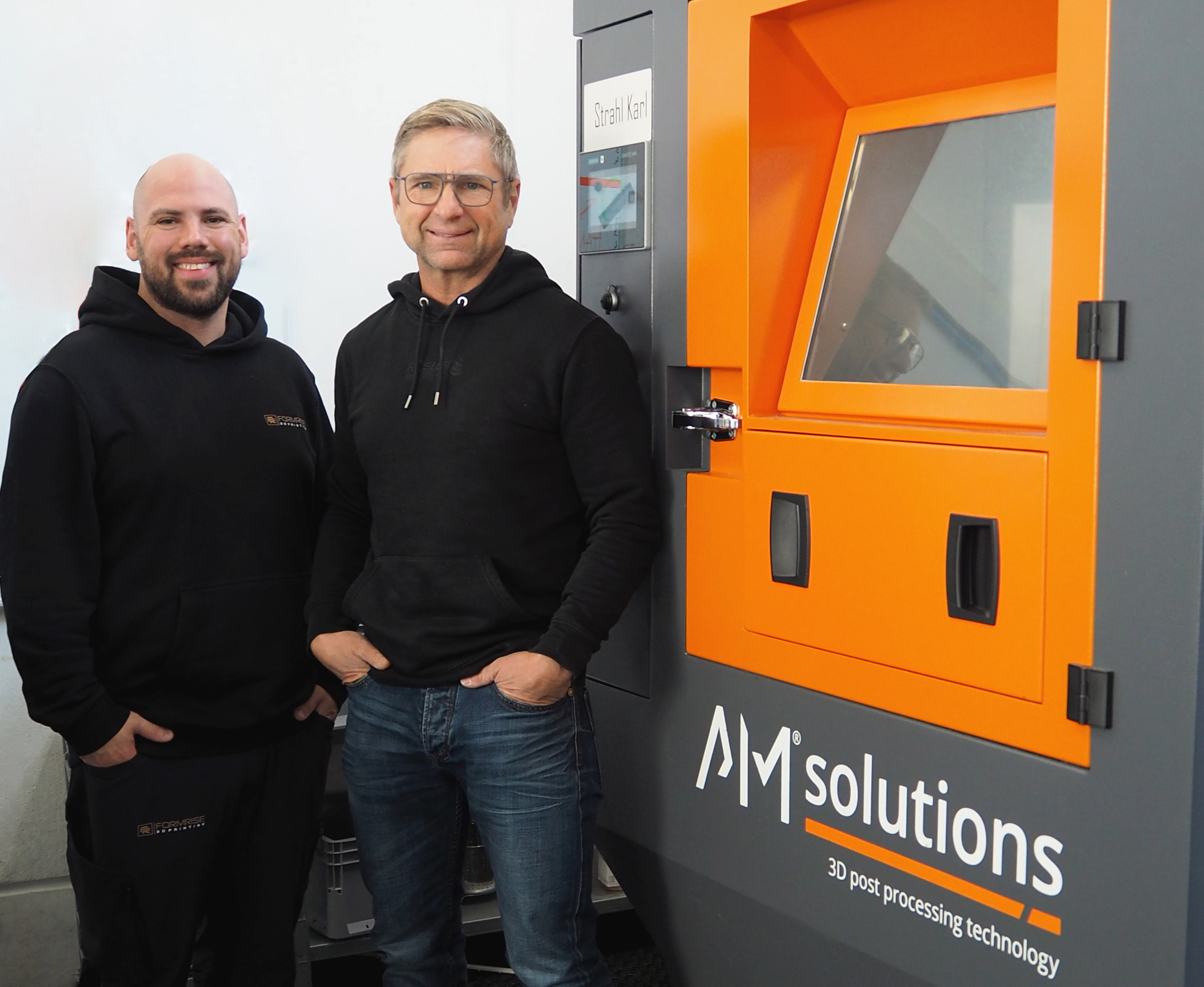
R: Peter Spitzwieser, Managing Director of FORMRISE
German 3D printing service provider FORMRISE has improved the efficiency of its SLS post-processing by adopting the automated S1 blasting system from AM Solutions. The company has worked with AM for over 20 years, serving companies in the aerospace, automotive, jewelry, luxury goods, and medical industries. FORMRISE previously used a multi-stage blasting process for its SLS components, but it was distributed across several systems and required manual processing as well. There were also a multitude of issues with the glass bead process, and it was nearly impossible to accommodate last-minute changes to orders. So FORMRISE started looking for a new post-processing solution that would provide a reliable, high-performance media preparation system and combine cleaning and surface finishing. The S1, with its large cyclone and integrated vibrating screen, offers an automated 2-in-1 process for cleaning and surface finishing, and FORMRISE now operates three of them, reporting an annual cost savings of about €35,000, reduced post-processing time of approximately 50%, and decreased CO₂ emissions of more than 12 metric tons annually.
“For the post-processing of SLS parts, AM Solutions offers a solution with the S1 that is absolutely unmatched in the market and has convinced us in every respect,” said Peter Spitzwieser, Managing Director of FORMRISE. “It is clear here exactly what potential lies in the optimal alignment of the blasting process with the requirements of additive manufacturing, particularly in blasting media preparation. AM Solutions recognized and fully leveraged this potential – and in doing so, provided us with the opportunity to optimize our post-processing in ways we could not have previously imagined.”
Researchers Develop Soft-Rigid Robots that Move with Electric Current
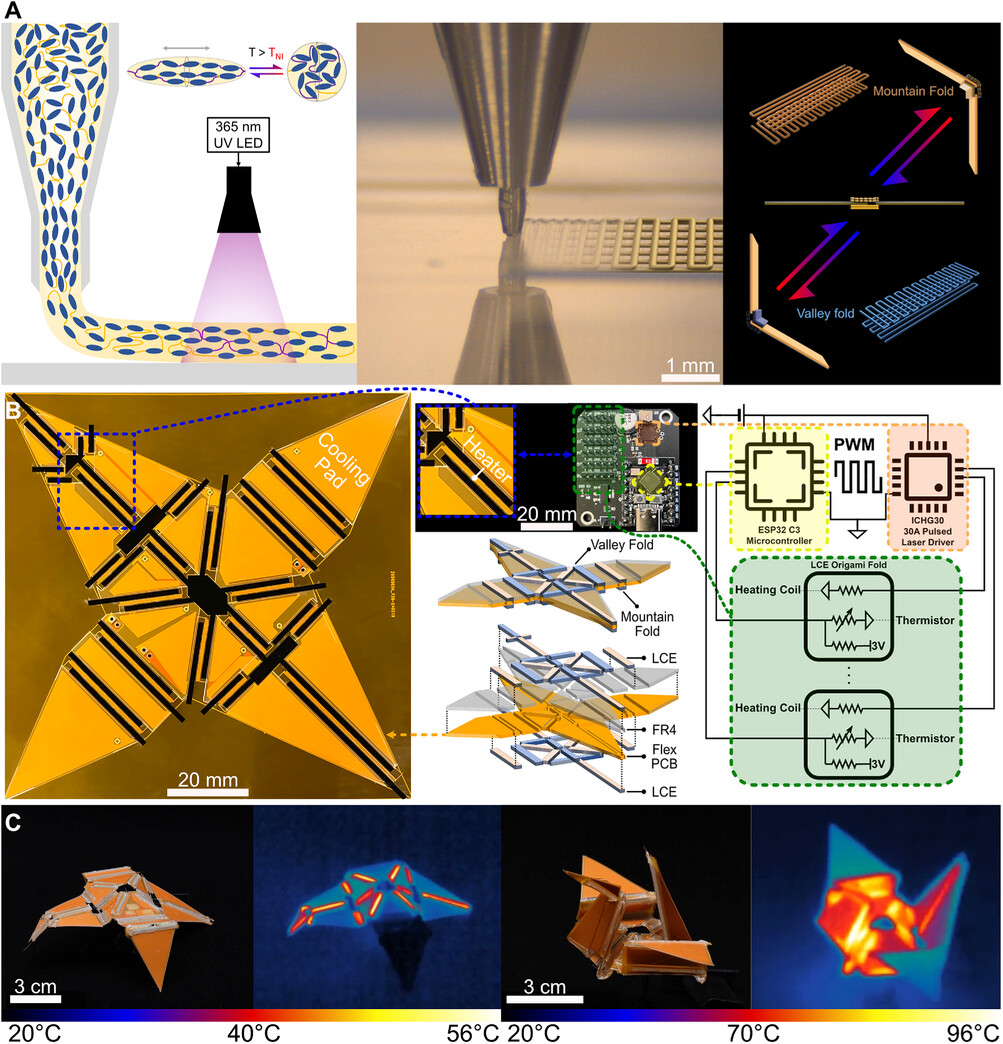
Origami structures: Printing, Design, and Actuation. (A) Direct ink writing of liquid crystalline oligomers creates aligned liquid crystal elastomers along the print direction (left). Sequential layers with orthogonal filaments allow different crease configurations (middle). Mountain and valley folds are defined by the layer ordering (right). (B) Self-folding and programmable actuation is imparted via a flexible printed circuit board (Flex-PCB) (left). The Flex-PCB is embedded within the printed LCE as a structural layer with integrated electronics for Joule heating of individual hinges (middle). A constant current laser driver and microcontroller are used to regulate the power delivered through each hinge, enabling programmable feedback actuation control (right). (C) A self-folding crane is shown going from the unfolded (left) to the folded (right) configuration using integrated Joule heaters. Thermal imagery is pictured in the right subpanel of each figure.
Soft robots can shape-shift and manipulate delicate objects, so they have plenty of potential in the medical field, but they’re limited by rigid mechanical parts or the external systems that help them move. A team of researchers at Princeton University combined a 3D printed liquid crystal elastomer with flexible electronics and origami-like folding techniques to build soft-rigid hybrid robots that can move without external pneumatic controls or motors…just targeted electric current. A customized printer was programmed to change the internal orientation of the polymer’s molecular structure while it prints. Then, the patterned zones in the printed material were stacked and joined in different ways in order to create hinges that bend and move the robot when the material is heated up. The heating that drives the robot’s motion is controlled through printed circuit boards (PCBs), and software uses embedded temperature sensors within the origami to compensate for any small errors as the robot continues to change shape; that’s what makes it so durable. To demonstrate their work, the team built a soft robot in the shape of crane, and it flaps its wings when powered with electricity—no motor required.
“I think the big contribution is we showed integration of a complex system where we have local heating control. We can control activation depending on where we heat,” said David Bershadsky, who began to develop the robotic system for his undergraduate thesis project at Princeton. He is now in graduate school at the University of Texas, Austin.
To learn more about the electric current-powered soft robot, you can read the research team’s paper here.
International Research Team Improves Sustainability & AM Performance with Biochar
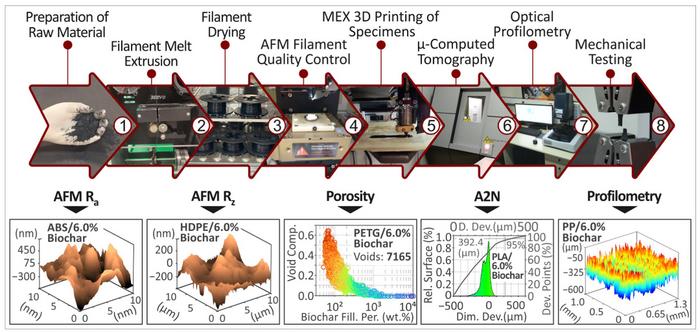
Enhancing biocomposite critical quality indicators (CQIs): the impact of biochar content in additive manufacturing.
Researchers from Hellenic Mediterranean University, International Hellenic University, and National Technical University of Athens in Greece, and Harbin Engineering University in China, published a study that shows you can improve sustainable manufacturing practices, as well as the performance and quality of 3D printed plastics, by adding small amounts of a carbon-rich material called biochar that’s made from agricultural waste. The team investigated how biochar, which has a porous structure and chemically active surface, can positively affect the performance of popular 3D printing polymers like ABS, PLA, PP, PETG, and HDPE. One of the most important things they discovered was the strong relationship between mechanical performance and internal structure of these 3D printed plastics. Better dimensional accuracy and lower porosity were linked time and again to higher tensile strength, which meant that biochar composites could produce more reliable and stronger parts. Additionally, biochar is a renewable and low-impact alternative to fillers derived from fossil resources, so it’s a much more sustainable option.
“Our findings show that biochar is not only a sustainable filler but also a highly effective way to improve the quality of 3D-printed components. By optimizing the amount of biochar, we can enhance mechanical strength while reducing defects such as porosity and dimensional inaccuracies,” the study’s corresponding author said.
“As industries move toward greener solutions, biochar-based composites offer a promising pathway. This approach allows us to transform waste into high-value materials while improving the performance of next-generation manufacturing technologies.”