
The entry-level laser powder bed fusion (LPBF) polymer space is heating up. Whereas in metals it’s Chinese vendors offering breakthrough low-cost products, in polymer it’s HP and Formlabs enabling easier, lower CapEx entry into the market. For traditional low-cost sintering companies, this offers up a bit of a strategic conundrum. What to do? Do you meet the bigger firms at their chosen price point ($60,000 for a complete system including unpacking station for HP or $84,000 for just the X1 from Formlabs), or do you continue to offer lower-cost smaller systems? Or perhaps do you do something lateral such as making a system for healthcare or prosthetics? I’d personally opt for a strategy like that and make a medical kind of Sprintray kind of an offering for hospitals.
Likewise, all these moves on the market have no doubt made the DyeMansion team put on their thinking hats. With Formlabs doubtlessly going to offer a full solution and HP already offering an unpacking station, it stands to reason that these firms will, alone or with partners, offer sieving, resurfacing, and more. A friend once told me that he reckoned that Markforged was once one of the largest vendors of industrial ovens worldwide for its bound metal technology. Given the volumes we expect for the X1 and 1200, thousands and then tens of thousands of systems, the peripherals market should grow rapidly. On the one hand, this is an opportunity, but DyeMansion risks being left out in the cold if the vendors bypass it and offer dying, blasting, or other products directly or with approved partners.
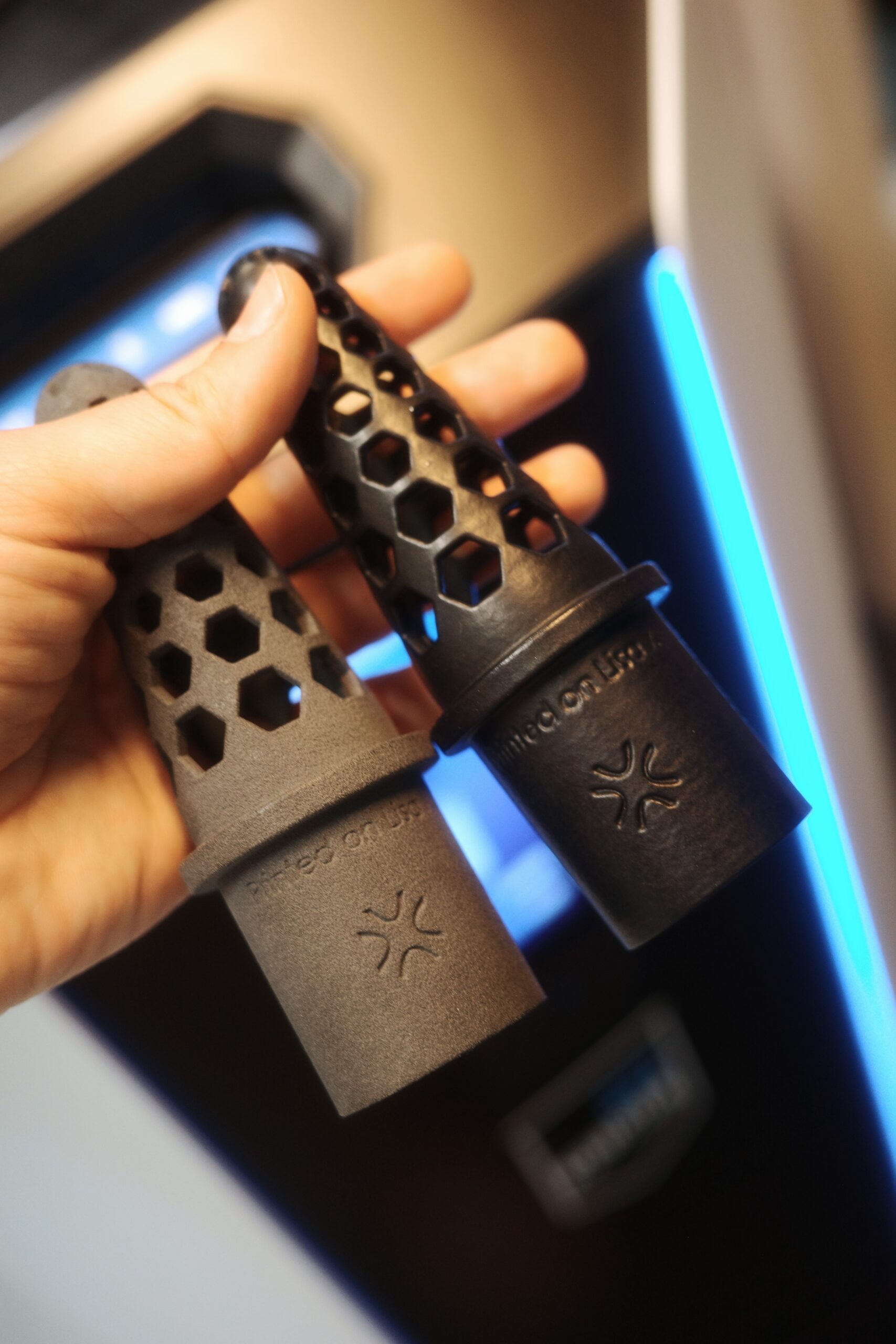
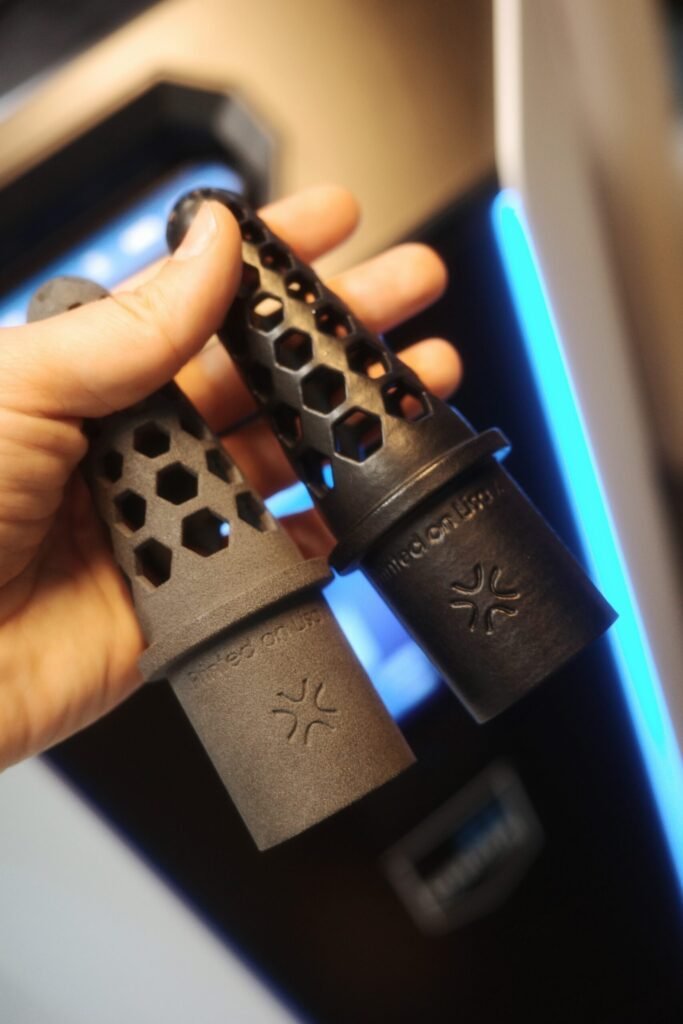
Grey Sinterit parts printed on Lisa X & finished with the DyeMansion VX1. Image courtesy of DyeMansion.
DyeMansion’s opening move in this chess game is to partner with Sinterit. Sinterit’s BIANCO2 system is an open system offered at 47.000 Euros. The 30 W RF CO2 laser system (RF lasers use mirrors instead of fiber to guide light, have a larger spot size, and typically a shorter lifespan than fiber lasers) has a 130 x 180 x 330 mm build volume, a four-heat-zone 150-kilo system, and is priced aggressively. The big advantage the Bianco has is that not everything is chimney sweep grey. The printer can make white parts as well as handle flexible materials. If you’d like to make red parts or some other color, the printer can more easily take different colored powders directly. If you want to output green or whatever parts all the time, you should really look at Sinterit. And if you’re doing development work, want weird powders, or want the absolute lowest cost per part, then the open powders could help you also. White parts are also easier to dye well, repeatably.
Sinterit will now offer the VX1 vapor smoothing system and DM60 coloring system. The DM60 is really good, and as a compact system, it can give you reliable, consistent coloring. The VX1 came from DyeMansion’s acquisition of VSM. It’s super compact, can effectively seal surfaces with a 24.6-liter process chamber, and works with PA12, PA11, and TPU. DyeMansion states that the VX1 uses a solvent designed to be safer to handle than some other vapor-smoothing systems. Unlike some systems that use more hazardous solvents, DyeMansion says the VX1’s solvent reduces risks for operators while also avoiding concerns associated with customers handling finished parts.
Sinterit CFO Łukasz Adach said,
“This partnership brings together Sinterit’s accessible and flexible SLS 3D printing ecosystem with DyeMansion’s leading industrial post-processing technologies, enabling companies to configure complete manufacturing solutions tailored to their specific needs. From printing to surface finishing and coloring, Sinterit customers now gain complete access to professional post-processing capabilities that were previously only available in large industrial environments through a seamlessly integrated workflow”
Meanwhile, DyeMansion CEO Felix Ewald stated,
“Sinterit has built an impressive customer base across over 80 countries in the last 10 years, and this partnership opens up a significant opportunity to bring DyeMansion’s post-processing quality to those users. With the VX1 and the compact Powershot — launching at Formnext 2026 — we make industrial-grade surface quality accessible to every customer, regardless of production scale”
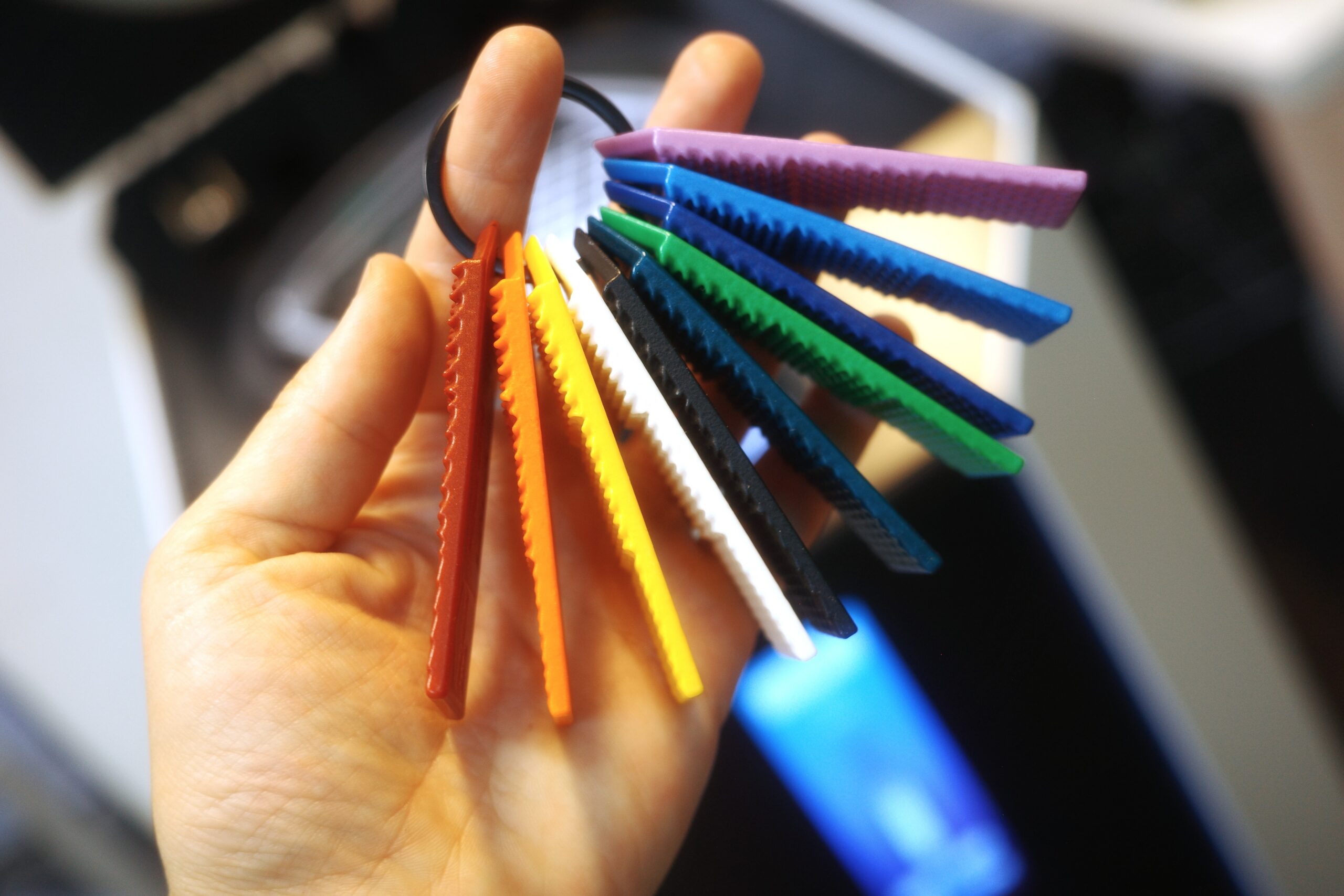
White Sinterit parts printed on the new BIANCO2 (left) & finished with the DyeMansion VX1 and DM60 – first colorful parts for Sinterit users ever. Grey raw part using PA12 Industrial material on the right. Image courtesy of DyeMansion.
The compact PowerShot will be a key development for DyeMansion. If it’s accessible in price and easy to use, it could become the default for entry-level sintering operators. This is a huge opportunity for DyeMansion and opens them up to competitive threats at the same time. The two firms also think that, as well as the entry-level systems, Sinterit customers could buy higher-volume systems later on. This is an important partnership for both firms. Making more consumer-friendly parts could enable Sinterit to forge ahead amidst its grey competition. It could also enable their development of complete workflows and solutions. Here is where I believe their future lies. If they came up with a printer for hospitals and O&P that met their needs, their certifications, and their worries, it could grow quickly in that market. If it then designs and makes specific time-saving software workflows with partners, the firm can cement a lead in this space. It could be a much more nimble, specific solution competitor to the larger firms that will grow through applications and vertical-specific systems later on.
For DyeManion, this could be good, but it would be better if it partnered with everyone who is not Formlabs. Formlabs seems set to make its own stuff, but I mean if they can partner with them, they should as well. If the company empowered all the entry-level firms to grow, offer more complete solutions, and extend their functionality, then it will be well positioned for the coming significant growth in polymer sintering.