
If 2026 has a theme in bioprinting, it may be blood vessels. Researchers can already print incredibly sophisticated tissues. The harder part is keeping those tissues alive. Without a network of blood vessels to deliver oxygen and nutrients, larger tissues quickly run into trouble. That challenge is at the center of a growing collaboration between the University of Notre Dame and Harvard Medical School.
In recent months, researchers led by Yanliang Zhang, an associate professor in the Department of Aerospace and Mechanical Engineering at the University of Notre Dame, and Yu Shrike Zhang, a professor at Harvard Medical School and associate bioengineer at Brigham and Women’s Hospital, have focused on one of regenerative medicine’s biggest obstacles: recreating the vascular networks that support living tissue. Their latest work, published in Nature Chemical Engineering, builds on a broader effort that also includes a recently announced National Institutes of Health (NIH)-funded project to advance organ engineering and tissue fabrication.
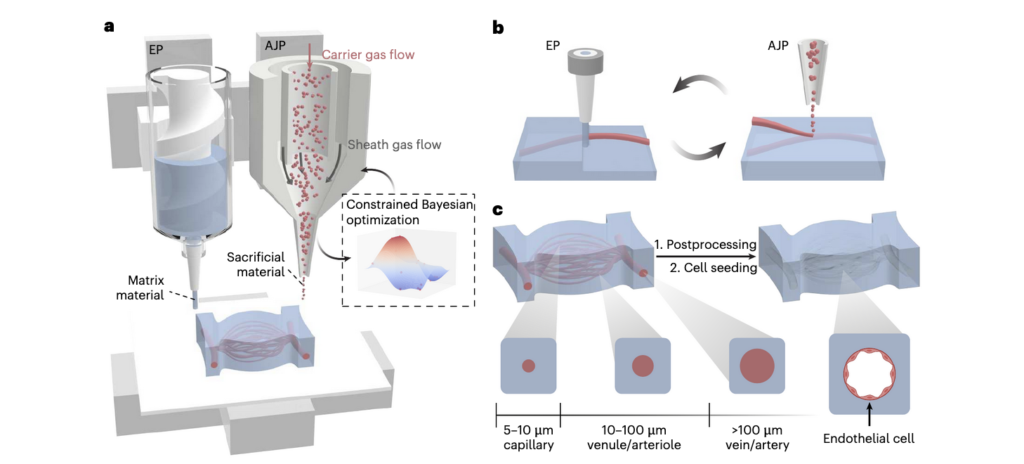
In the study, the researchers developed a new way to 3D print tiny blood vessel-like structures. The approach combines two printing methods, one for building larger tissue structures and another for creating extremely small channels that can later act like blood vessels. According to the study, titled Hybrid bioprinting of hierarchical vascular networks at capillary-scale resolution, the technique pairs conventional extrusion bioprinting for larger tissue structures with high-resolution aerosol jet printing, which creates tiny sacrificial channels that can later be converted into blood vessel-like networks. The system was built around a custom-designed hybrid printer developed by the research team, combining aerosol jet printing and extrusion printing into a single platform. So instead of relying on a commercial bioprinter, the researchers engineered a hybrid system that integrates two manufacturing technologies, one optimized for building larger tissue structures and another capable of producing capillary-scale features.
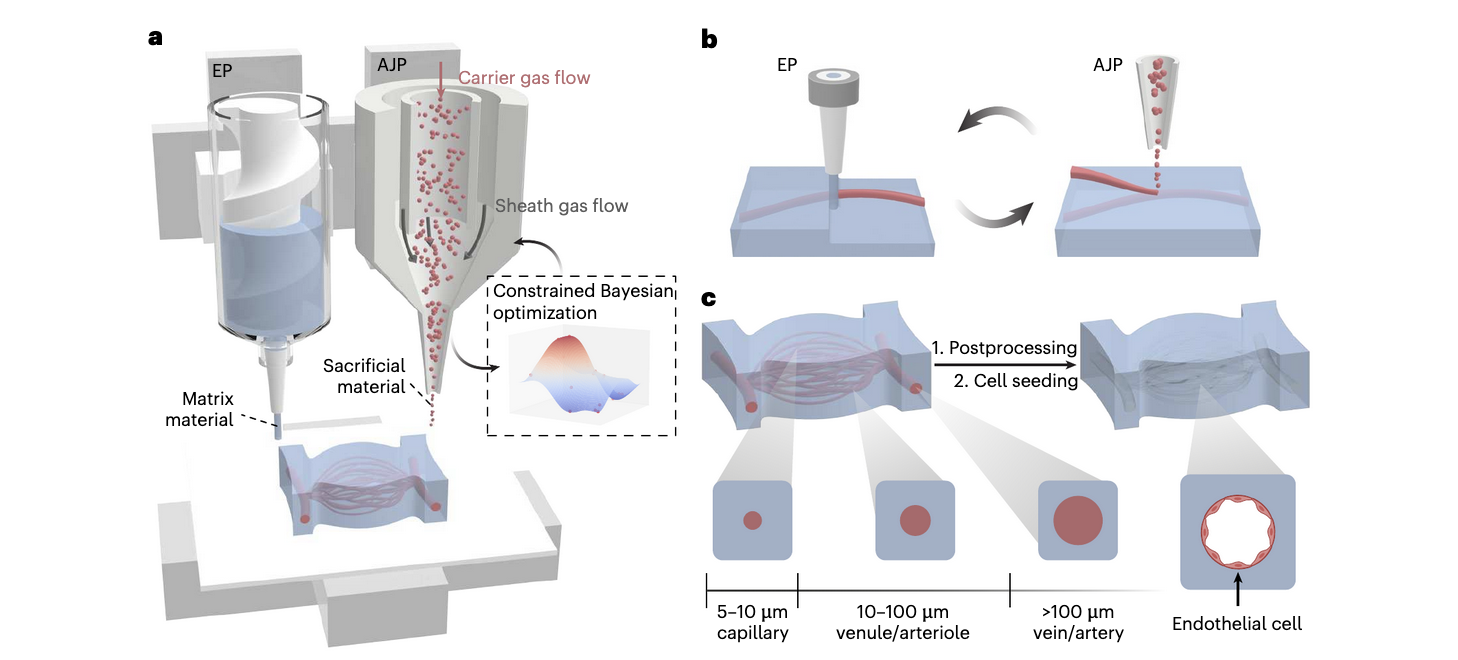
Machine learning-enhanced high-resolution hybrid bioprinting approach. Image courtesy of Yuxuan Liao et al., Nature Chemical Engineering (2026).
Using the technique, the team created channels smaller than 10 microns in diameter, close to the size of the body’s smallest blood vessels, known as capillaries. In some cases, the researchers produced channels approaching 5 to 6 microns in size. They explained that they can also adjust the size and shape of these channels as they print, so they can create more realistic vascular networks. It is important to note that the technology is not limited to a single vessel size. The team demonstrated networks that range from larger vessel-like channels down to capillary-scale structures, creating branching hierarchies that more closely resemble the body’s natural vascular system.
The system is also supported by machine learning. In particular, it uses Bayesian optimization, a method that helps researchers quickly find the best printing settings for creating blood vessel-like channels of specific sizes. That reduces the need for more time-consuming trial-and-error experiments and speeds up the development process. According to the study, the optimization system was typically able to identify the required printing parameters in about eight rounds of testing while maintaining high printing quality
In laboratory experiments, cells lining the channels formed continuous vessel-like layers and remained healthy as they grew, suggesting the approach could support the development of more realistic engineered tissues. The cells did more than survive. According to the paper, “they attached to the channel walls, spread throughout the structures, and formed linings that behaved more like those found in natural blood vessels.” That’s important because the goal is not just to print small tissue samples in the lab, but to help bioprinted tissues become larger, more stable, and more useful for medicine. As tissues grow, cells deeper inside need ways to receive oxygen and nutrients and remove waste. Without a way to support that exchange, larger engineered tissues can fail.
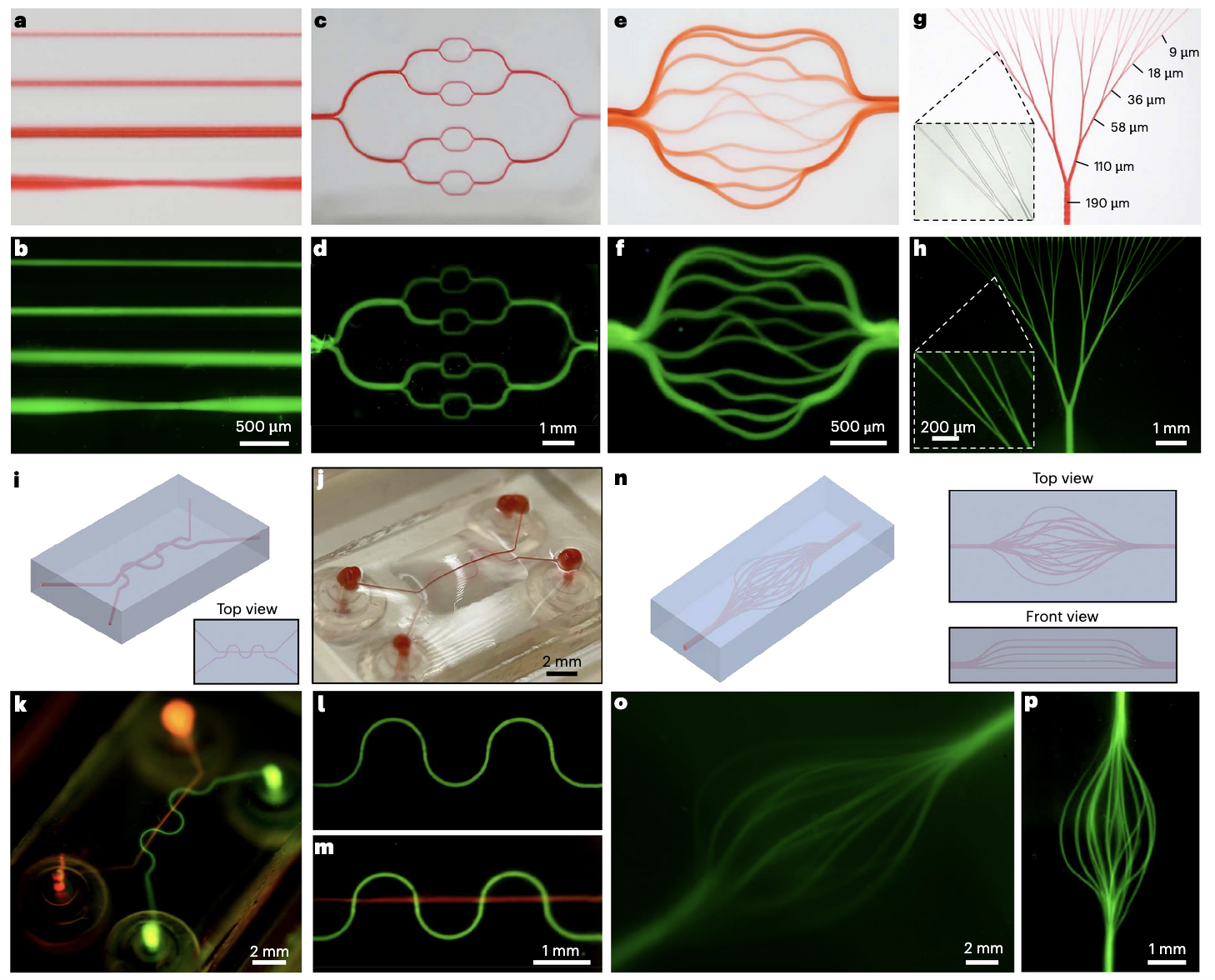
Bright-field and fluorescence images of printed 1D, 2D and 3D vascular networks. Image courtesy of Yuxuan Liao et al., Nature Chemical Engineering (2026).
The work is part of a broader NIH project announced earlier this year. The four-year, $2.6 million effort is focused on creating vascularized tissues, or tissues with the blood vessel networks needed to survive and function over time. The goal is to move beyond small laboratory tissue samples and toward larger, more clinically relevant engineered tissues.
The team says the combination of machine learning-assisted optimization, real-time control over vessel size, and capillary-scale resolution could make the technology useful for tissue engineering, regenerative medicine, and drug discovery.
According to the authors, the near-term impact could be in drug testing and disease modeling. More realistic vascularized tissues could give researchers better ways to study human disease and test therapies in the lab before moving into animal studies or clinical trials. In the longer term, the same work could help move the field closer to larger engineered tissues and, eventually, lab-grown organs.
To demonstrate the technology, the team printed simple channels, branching vascular trees, and more complex 3D vascular networks embedded within soft tissue-like materials. They also showed that fluids could flow through the networks, and that endothelial cells could successfully line the channels, an important step toward creating functional vasculature.
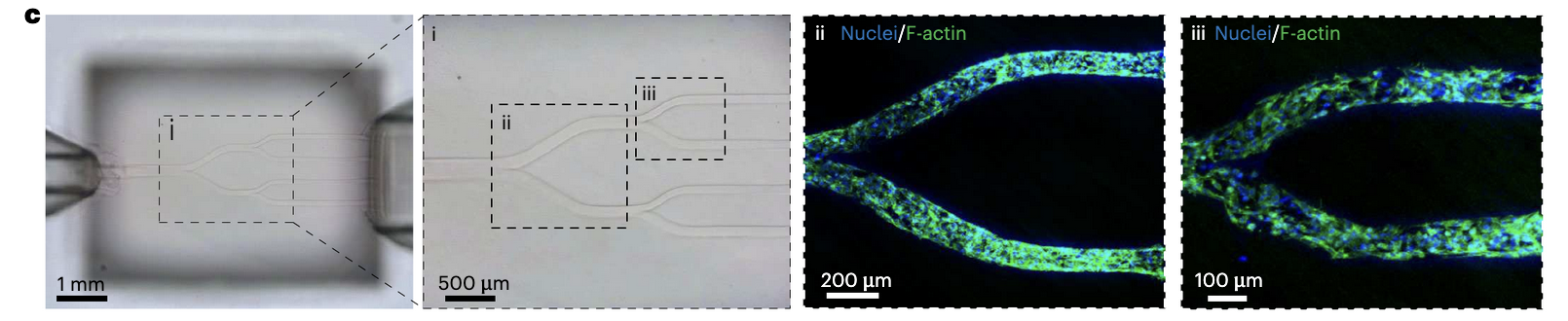
Endothelialization and cell seeding of the printed channels: 3D-printed branched-like structures with continuous channel width reduction from 200 µm to 120 µm and down to 80 µm. Image courtesy of Yuxuan Liao et al., Nature Chemical Engineering (2026).
One of the biggest challenges in bioprinting is keeping living tissue alive. Cells need a steady supply of oxygen and nutrients, which in the body are delivered through an enormous network of blood vessels. The Notre Dame-Harvard team believes its hybrid approach offers a path toward overcoming those limitations.
Scientists have been working on this problem for years. Researchers such as Jennifer Lewis, Mark Skylar-Scott, Adam Feinberg, and others have advanced methods for creating vascular structures inside engineered tissues. The latest work takes another step toward creating blood vessel networks that look and behave more like those found in the human body.