
GKN Aerospace and RTX unit Pratt & Whitney will collaborate on additive manufacturing for the F135 engine. This is an important engine. The turbofan powers the F-35 Lightning II, but has been beset by quality issues. Cracked blades, incorrect titanium, micro cracking, fires, and slow production have plagued the program. So GKN and Pratt can really make waves if they use additive to scale and perfect future programs.
GKN Aerospace in Norway and Pratt & Whitney have now signed a Technology Development Agreement. Together, they want to look at making an Additive Manufacturing demonstrator, and deliver certified parts in 2028. The two would work together with the Norwegian Defence Materiel Agency (NDMA) on the project. This could really see the Norwegians increase their AM capacity and knowledge significantly.
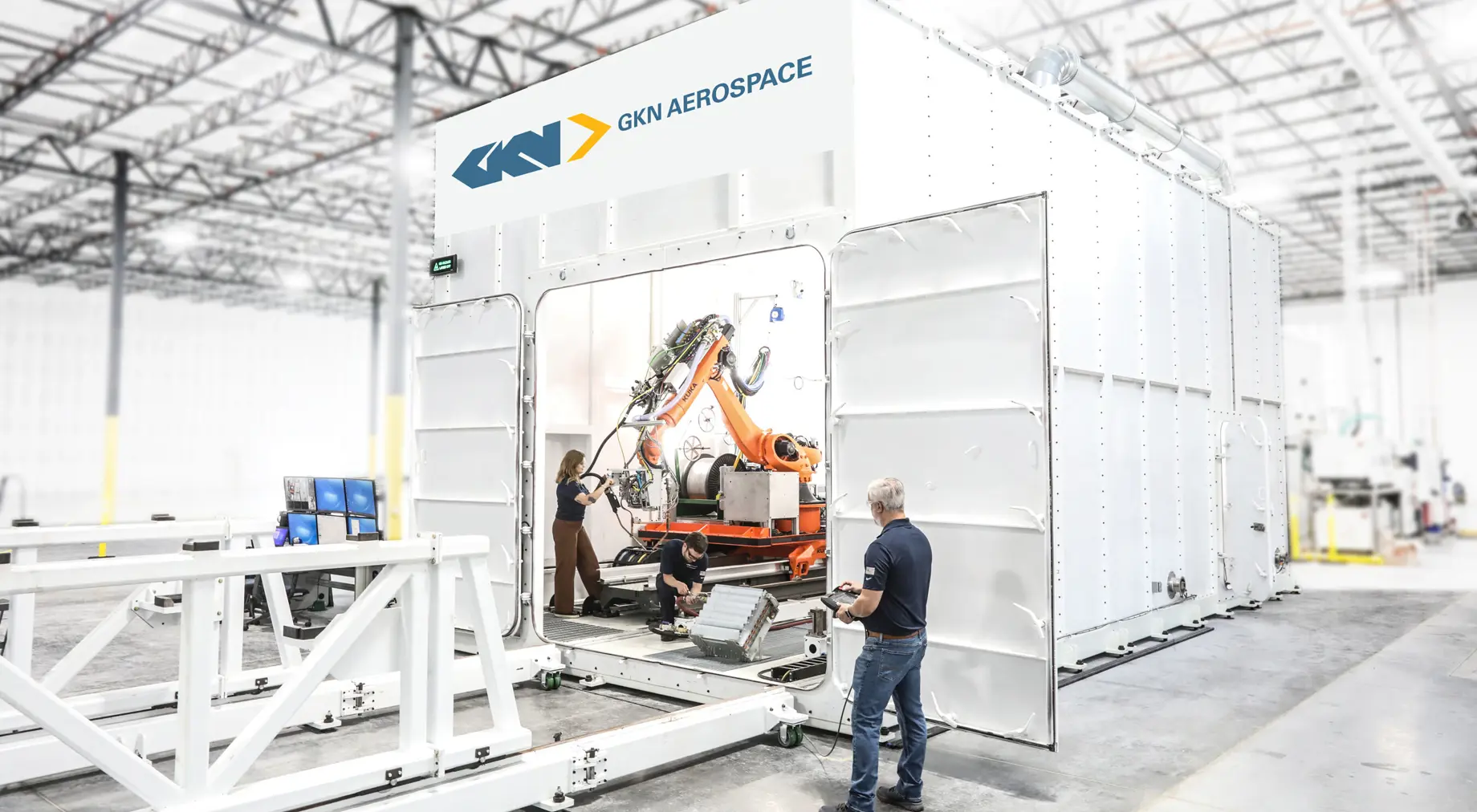
Rather than LPBF, the companies will be using GKN’s own DED process. GKN has three DED centers, and one is at Trollhättan in Sweden, while the others are in Bristol and Fort Worth. I don’t know if they’ll now open a fourth center in Sweden. GKN started work on DED in 2017 during a five-year Cooperative Research and Development Agreement (CRADA) with ORNL and spending $17.8 million with them.
The large cell-based system could make parts of up to five meters. The wire-fed machine uses a 20Kw laser and floods the entire cell with Argon, which is wonderful news for Linde and co. I continue to be flabbergasted that it seems like the GKN system still uses Kuka robots. Look, they’re all fine and dandy if you want to paint a car, but Kuka is owned by a Chinese firm. Especially for defense applications, I would never use a Kuka robot. I’m sure that they have promises, but if I’m a Chinese firm and my government wants something from me, I’ll comply.
This agreement is a bit of a slap in the face to Norsk Titanium. That company has a distinct American feel to it, but is nonetheless largely Norwegian. The firm has a plasma DED process that has been qualified for Boeing, Airbus, and Northrop Grumman. The press release states that the “development work will be led from GKN Aerospace’s facility in Kongsberg,” which makes me think that the printing is taking place in Sweden or the US. If I were Norwegian, I’d much rather spend my hard earned oil money on learning to print these parts on machines I have access to in my own country.
One can only hope that there is some technical reason to go for GKN. Perhaps they want to make Inconel components, for example, and Norsk Titanium of course only does titanium. The idea is to make a large part such as a casing. The duo hopes that there will be better efficiency in buy to fly, costs, lead times, and supply chain resilience.
GKN Aerospace Senior Vice President Sébastien Aknouche said,
“I am pleased to see this collaboration bringing together strong industrial capabilities and advanced manufacturing expertise. This initiative reflects our ambition to further develop and industrialise additive technologies for demanding aerospace applications.”
Chris Johnson, vice president of the F135 Program at Pratt & Whitney, stated,
“This agreement reflects our continued focus on advancing technologies that support the long-term needs of the F135 program. We appreciate the collaboration with GKN Aerospace as we explore new manufacturing approaches that contribute to future engine readiness.”
I’m going to go on a limb here and guess that this is part of a defense offset agreement whereby indirect offsets are being funded as part of Norway’s recent purchase of 52 aircraft. Kongsberg, as a direct offset, got to build wing leading edges, panels, rudders, and more for all F35s. Furthermore, Kongsberg made the JSM missile for the fighter. It’s of course kind of hilarious to use offset more for supply chain resilience. Due to every partner company wanting local production and offset, a large fighter program becomes a puzzle, and every one of the 20 countries receives a piece. In this case, furthering Norway’s local production prowess could maybe have been better if it involved making parts in Norway.
GKN is also involved already in contracts in Norway for the F35 and other platforms. This therefore is an important thing for Norway´s defense industry. Kongsberg is doing very well, with revenue up a third compared to last year. Its excellent radar systems and missiles are in high demand. But, Norway will have to more broadly stimulate its defense industry in a world more fraught with risk and uncertainty.