
Drones have changed everything. Case in point: with the aim of preventing Iran from developing a nuclear weapon, the US and Israel initiate airstrikes on the Gulf nation. A couple of months later, Iran is using low-cost weapons systems centered around cheap drones to halt a fifth of the world’s energy flows, creating a far greater practical advantage for itself than possession of a nuclear weapon would imply.
Another (related) example: since Russia invaded Ukraine in February 2022, Western powers have been providing Ukraine with expertise to help counter Russian aggression. Now, precisely because of the drone disadvantage the US finds itself in amidst the war in Iran, the US and NATO seek Ukraine’s advice based on its drone expertise.
This has evolved into far more of a two-way relationship than a traditional dynamic whereby a major power arms a minor one, though Ukraine still of course needs significant Western assistance, primarily in the form of financing. At the end of last year, the EU announced a €90 billion loan package for Ukraine, and now that it has finally been approved, the first tranche of that funding will be released this quarter. A third of the money will go towards Ukraine’s general budgetary needs, and the other two-thirds towards defense. Of the defense funding, no less than €6 billion (~$7 billion) from the first tranche—around twenty percent of the defense funding—will go towards drones, which, among its many consequences, should be a major boon to Ukraine’s additive manufacturing (AM) capabilities.
While Ukraine’s use of AM to back its drone production progress is virtually common knowledge at this point, one still can’t emphasize enough how AM has transformed both the technological and logistical bases that determine Ukraine’s ability to arm itself. In a 3DPOD episode from August 2025, 3DPrint.com’s Joris Peels interviewed Jake Volnov, the founder of DrukArmy, which draws upon volunteers from all over Europe who use desktop 3D printers to make and donate non-explosive components to Ukraine’s military. Meanwhile, through more formalized channels, Ukrainian forces have already been transferring 3D printed drone know-how to elite Western units.

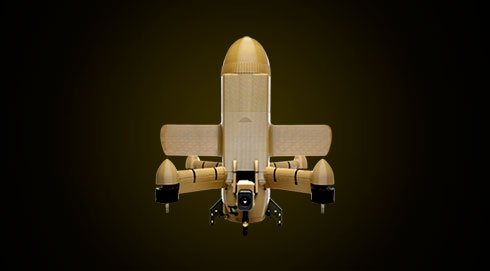
The Sting interceptor, produced by Wild Hornets. Image courtesy of Wild Hornets
At present, what the US, and nations in the Gulf, most desperately need from Ukraine is expertise related to interceptor drones, most notably the Sting interceptor made by Ukrainian company Wild Hornets. Earlier on in the Iran conflict, Wild Hornets noted that the company wouldn’t sell Gulf countries the Sting or other products without Ukrainian government approval. Just before the EU officially approved the loan package, President Zelenskyy of Ukraine said that he would allow sales of Ukrainian weapons, including drones, to foreign nations, so long as they don’t cooperate with Russia. Given President Trump’s track record in that context, it will be interesting to see how potential cooperation surrounding drone defense unfolds between Ukraine, the US, and the Gulf nations.
In any case, the EU (aside from nations like Hungary and Slovakia, which held up the loan vote due to their continued reliance on Russian oil) certainly appears poised to benefit from all the expertise that Ukraine can deliver, and not just thanks to the loans. It has also just been reported that the European Defence Agency (EDA) will provide €35 million to Ukraine to support the second phase of BraveTech EU, a joint EU-Ukraine defense accelerator, which reportedly “…gives the EU a more formal mechanism for converting wartime innovation into tested defence applications.”
Along those lines, Ukraine is in the curious position of serving as a de facto open-air R&D lab for Western weapons tech, operating under live conditions and in real time. Under such circumstances, one would think that the funding should take the form of a grant rather than a loan, although perhaps the EU anticipates that the funds will be paid back in expertise.
Above all, the takeaway from the latest developments in EU-Ukrainian relations demonstrate how contemporary military alliances are based on completely different premises than were thought to be the case even just a few months ago, and 3D printing is one of the most significant pieces of the explanation why. Direct operating experience is now obviously so much more important than theoretical advantage that the most well-funded powers are at the mercy of those who are more or less scraping to get by.
Again, this is a logistical shift just as much as a technological one. As with all situations where technology and logistics converge, the key to success is strategy. Anyone interested in learning directly from those working firsthand at the intersection of 3D printing and drones should register for our UAS Additive Strategies webinar, which will take place on June 30 from 11 AM-2:30 PM Eastern time. Even if your firm isn’t planning on printing drone components, the dynamics shaping the world of 3D printed drones have relevance to the entire state of global manufacturing.
Featured image courtesy of DrukArmy