
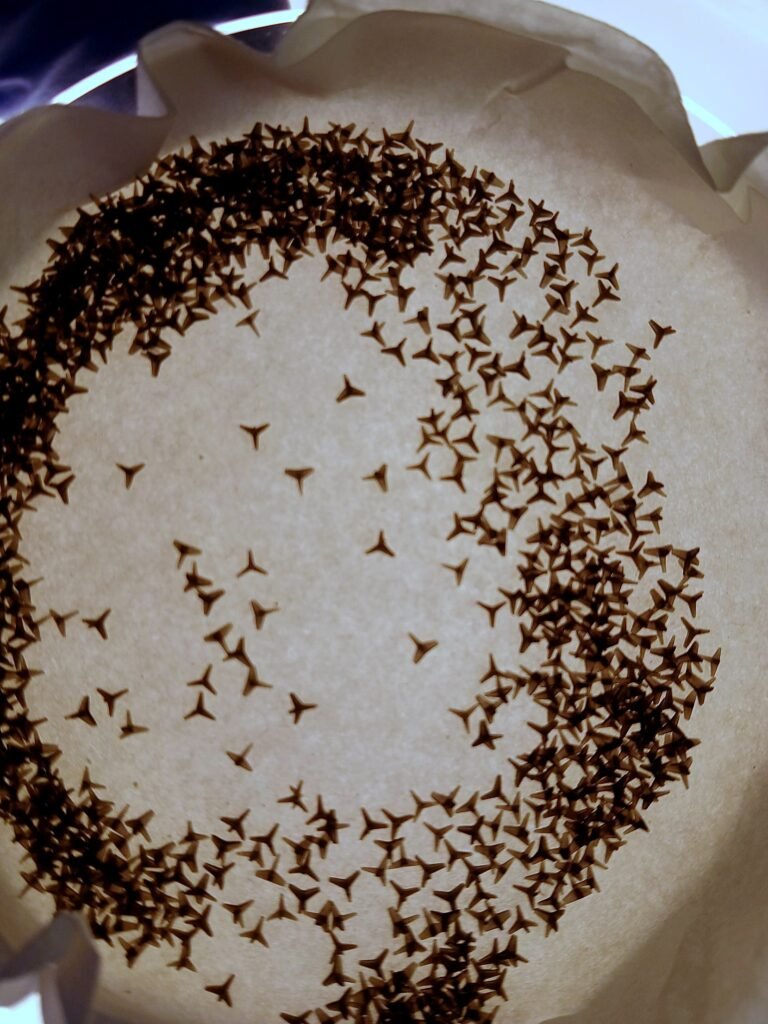
Researchers in Finland have found a way to make a soft material nearly 13 times stiffer using 3D printing without having to print the material itself. Instead, they printed more than 150,000 tiny plastic particles, some shaped like cubes and others like four-armed stars, and embedded them in silicone. What made the biggest difference was not simply how much plastic they added, but the shape of the particles.
The research, led by Adel Badria, a postdoctoral researcher at Tampere University, offers a different way of thinking about 3D printing and materials development. Rather than using the technology to manufacture finished products, researchers could use it to make the building blocks that determine how other materials behave. Eventually, this could help engineers develop materials for soft robotics, flexible medical devices, and tissue engineering.
Published on November 5 in the journal Materials & Design, the study looks at what the researchers call “architected fillers.” These particles have 3D shapes deliberately designed before they are manufactured.
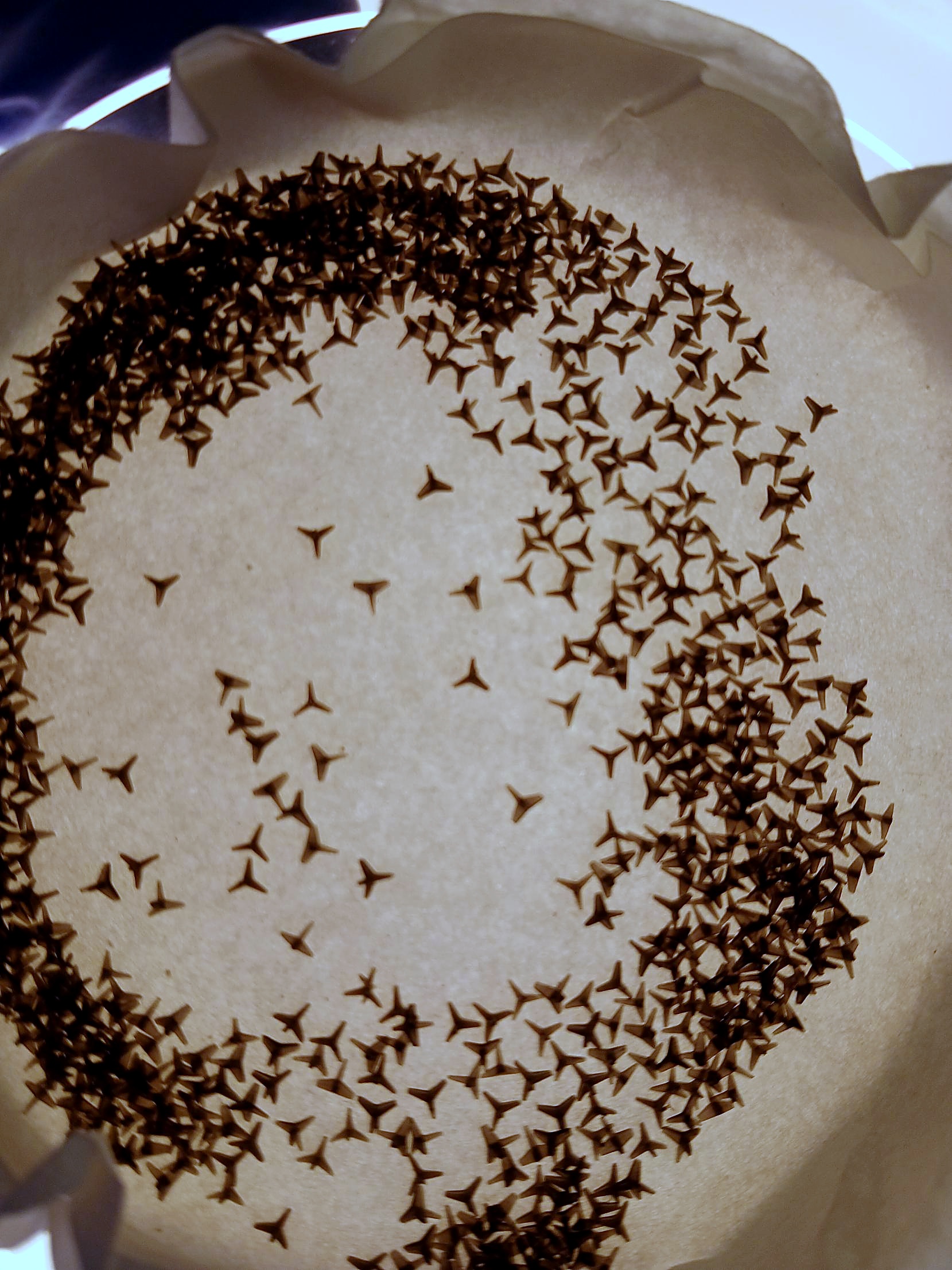
Tiny 3D printed polymer tetrapods, each smaller than a millimeter, scattered in a Petri dish. Image courtesy of Adel Badria, Tampere University.
Manufacturers have long used fillers, such as small particles or fibers, to change the properties of plastics, rubber, and other materials. But they often have little control over the shape of the particles they add. Badria and his colleagues used digital light processing (DLP) to produce particles in batches. The team printed cubes and tetrapods, which have four arms extending from a central point, in two different size ranges. Some of the cubes measured just 0.31 millimeters across.
The researchers then embedded the particles in three types of silicone with different levels of stiffness and tested how the resulting composites behaved under compression. Across 51 test specimens, the tetrapods proved to be particularly effective, increasing the material’s stiffness more than the cubes did, even when less filler material was used.
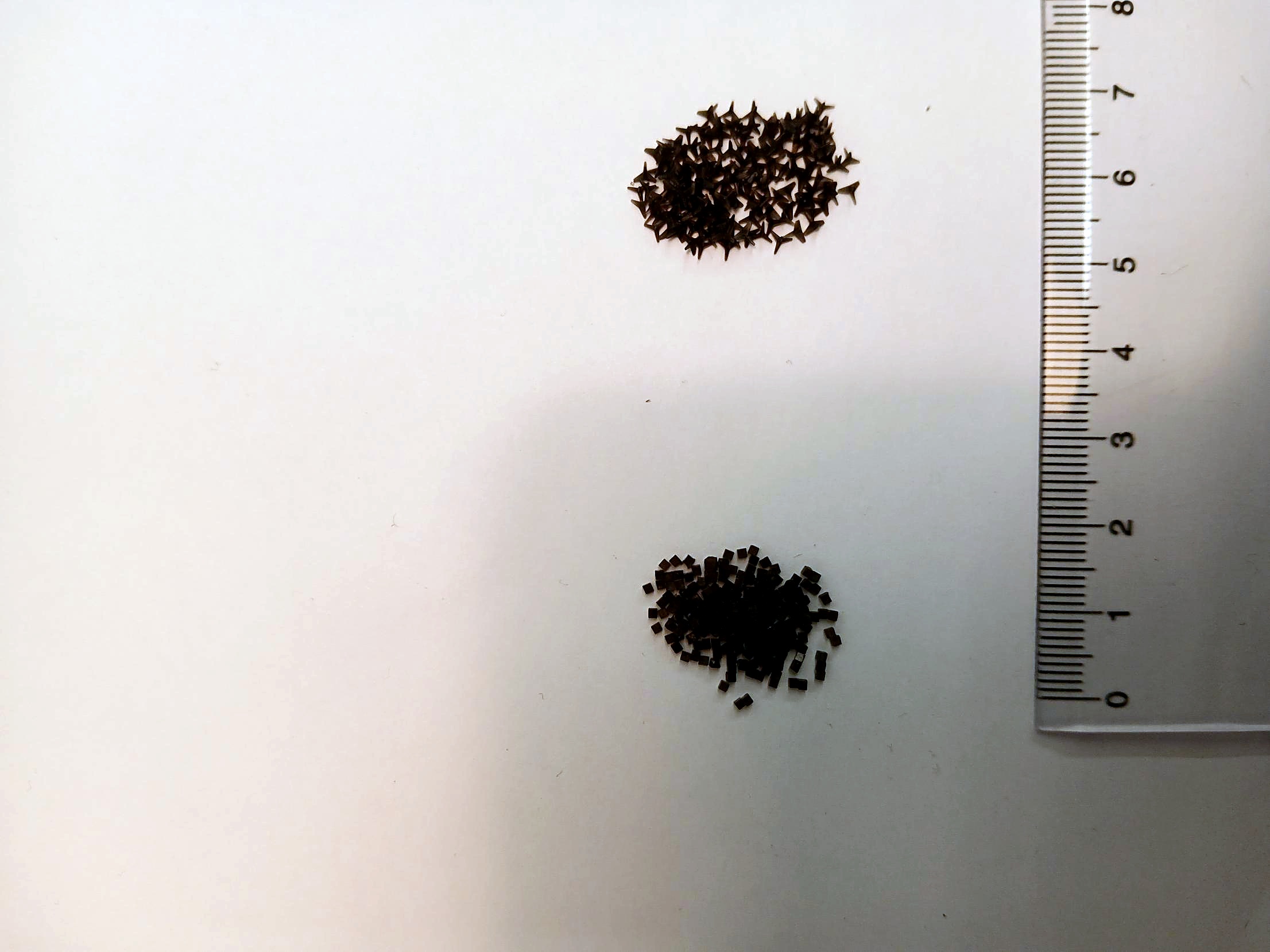
3D printed polymer tetrapods (top) and cubes (bottom), shown alongside a ruler for scale. Image courtesy of Adel Badria, Tampere University.
“For decades, composites have mostly been tuned by how much filler you add. 3D printing lets us ask a different question: what shape should each particle be? Our results show that in soft materials, geometry can matter more than quantity,” Badria told 3DPrint.com. And when asked whether the results surprised him, Badria said: “So the honest answer is: no, not by the fact that shape mattered, but yes by how much.”
Badria also made a point of using materials that other researchers could easily obtain, making it easier for them to reproduce and build on his findings: “I deliberately used a commercially available matrix and resin, so the work could serve as a reproducible cornerstone for others.”
The experiments also revealed that different particle shapes influenced how the composites broke apart under pressure. Materials containing larger cubes continued to deform without requiring substantially more pressure, while those containing tetrapods were better at holding together after sustaining damage. As Badria noted, the idea behind the research originated years earlier with a completely different problem: how to repair severe bone injuries in regions affected by war and conflict.

The four types of 3D printed polymer fillers used in the study, from left to right: cubes (1 mm³), tetrapods (1 mm³), cubes (0.05 mm³), and tetrapods (0.03 mm³). Image courtesy of Adel Badria, Tampere University.
During his doctoral research as a Marie Curie fellow at the University of Patras in Greece and Hannover Medical School in Germany, Badria began looking for a practical way to grow and store bone in a laboratory.
“My idea was a LEGO-like system: small bone pieces that could be grown in the lab, kept as off-the-shelf products, and easily assembled when needed, without highly sophisticated facilities,” Badria recalled.
In 2019, he presented the concept, which he called “3D Printed Bone Lego,” at the European Society for Biomaterials conference. Later, while working at KTH Royal Institute of Technology in Sweden, he explored using bone glue to hold printed pieces together. He eventually moved away from assembling individual pieces and began experimenting with mixing printed particles into other materials.
That earlier interest in bone repair is still part of his research. At Tampere, Badria is now investigating 3D printed particles made from hydroxyapatite, a mineral naturally found in human bones and teeth. In a separate project, which he says is already at an advanced stage, he is also studying three-armed, star-shaped aluminum oxide ceramic particles produced by a collaborator using a new manufacturing technique.

3D printed polymer particles (black) from the published study alongside ceramic particles (white) developed for ongoing research. A pin provides a sense of scale. Image courtesy of Adel Badria, Tampere University.
The hydroxyapatite work, some of which is already available as a preprint, examines how producing large quantities of ceramic particles affects their quality, density, and manufacturing cost. Neither ceramic project was part of the published silicone study.
“Before any medical use, we would still need cell studies, then animal studies, consistent and sterile production at scale, and regulatory approval. That is a path of years, not months,” Badria explained.
Beyond medicine, the approach could be useful in soft robotics, where engineers often need materials that are flexible enough to move but stiff enough to perform certain tasks. Badria wants to investigate whether different particle designs could also help engineers control how materials absorb energy, resist damage, and eventually fail.
“What happens with a stiffer matrix, or stronger interfacial adhesion? With tetrapods made of stiffer or more ductile materials, or with different arm sizes and configurations? With cubes of different aspect ratios, or entirely different shapes? There is a whole space still to explore and discover,” he noted.
The approach could also make things easier for manufacturers. Instead of printing an entire lattice, they can print individual particles and mix them into other materials using existing manufacturing methods, such as casting and molding. This could also help them combine materials that are difficult to 3D print together, like hard ceramics and soft polymers.
The trade-off is that engineers have less control over the exact position and orientation of each particle once it is mixed into another material. The cost of producing these particles in the quantities needed for industrial use is another major challenge.
“When it comes to real applications, the limit is scalability and price. For now, that could restrict the approach to critical applications until more practical production techniques are developed,” Badria explained.
Simpler particles with volumes of around one cubic millimeter or larger may already lend themselves to larger-scale manufacturing.
For Badria, getting the technology out of the lab will also require researchers and manufacturers to work together. As he put it, “this work sits between design, manufacturing and application, and no single lab covers all three.”
His longer-term ambition is to develop a library of particle shapes that engineers could draw from when designing materials for different applications. Rather than starting from scratch with a new material formulation every time, they could select particles based on the properties they need.