
Ask most people why additive manufacturing is fast, and they’ll point to the printer. A part that would take weeks to machine or mold comes off the build plate overnight. That’s true, but it’s not the whole story, and it isn’t the part of the story that’s changing how programs get to market.
The real advantage isn’t how quickly a single part gets made. It’s how quickly a program moves from prototype to full-rate production without stopping, retooling, or starting over. Additive manufacturing can be more than a way to make parts faster. It’s a production strategy that keeps projects moving as designs mature, demand grows, and requirements change.
In sectors like defense and unmanned systems, where fielding timelines have collapsed from years to months, that continuity can determine how quickly customers deliver products, respond to emerging requirements, and scale production.
From Prototypes to Production Without Losing Momentum
In traditional manufacturing, the transition from prototype to production can bring a program to a standstill. Once a design is validated, work may pause while steel tooling is designed, cut, sampled, and corrected. For injection molding, this process can add months before production parts are ready to ship. After tooling is cut, design changes become more complicated and costly, potentially delaying delivery and limiting flexibility.
Additive manufacturing offers a more continuous path. The same digital design and manufacturing process used for prototypes can carry into production, using the same material and process as volumes increase. There’s no tooling phase to interrupt the schedule or require a transition to an entirely different manufacturing method.

For customers, that means a shorter path from validated design to usable hardware. Parts can reach testing, integration, and field deployment sooner, while teams maintain continuity in material selection and manufacturing. Instead of planning around a major production handoff, they can focus on advancing the program.
Capacity That Keeps Pace With Demand
Speed at prototype volume means little if it disappears when production ramps up. A supplier that delivers ten parts quickly may struggle when demand jumps to thousands. Limited capacity can create backlogs, force supplier changes, or require additional process validation just when a program needs to accelerate.
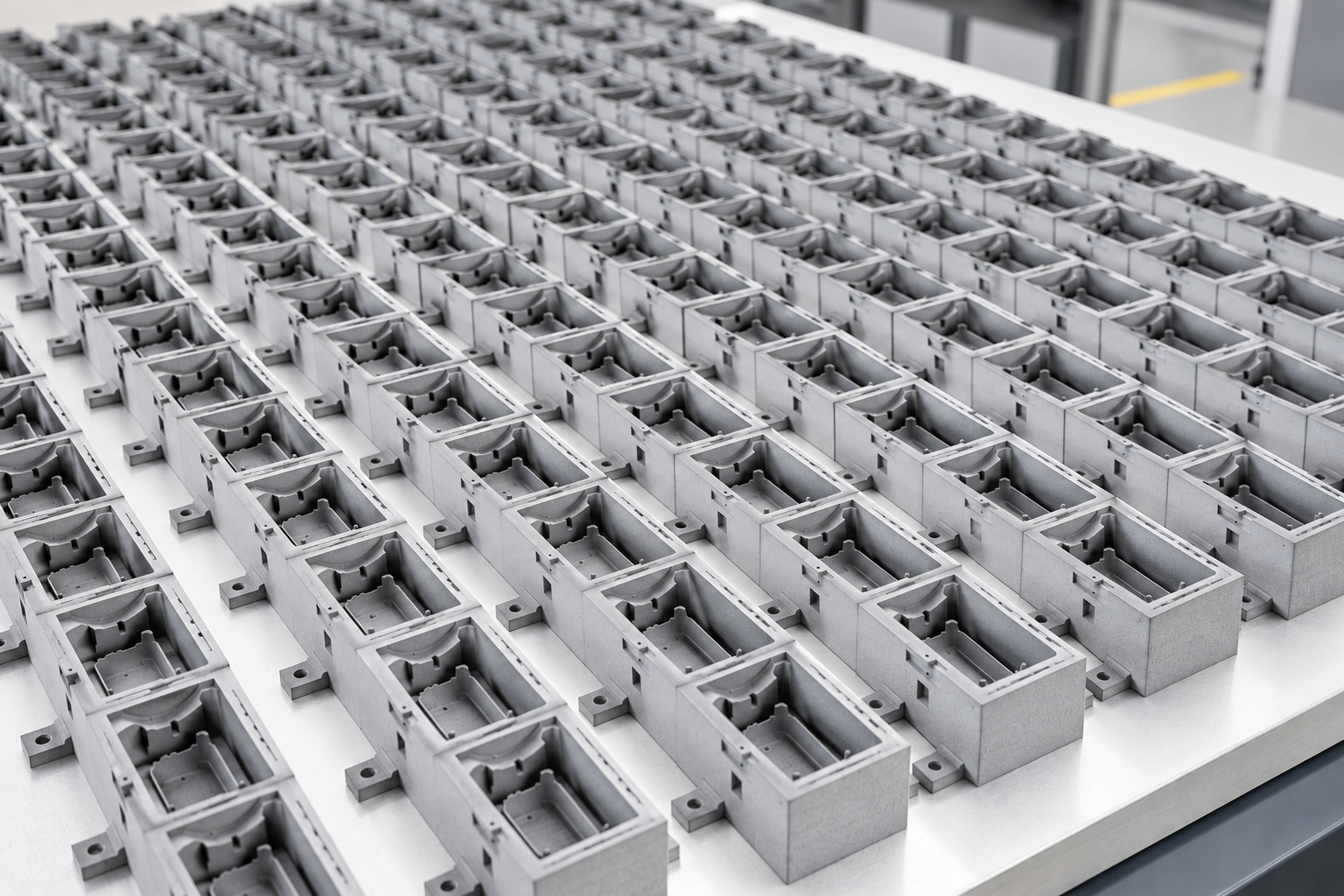
Scaling production requires more than adding printers. It takes sufficient capacity, repeatable processes, effective post-processing, quality controls, and production planning to maintain consistent output as volumes increase.

When these elements are in place, manufacturers can expand production while maintaining a consistent manufacturing approach. For customers, that means greater confidence in delivery schedules, more flexibility to respond to demand spikes, and a clearer path from initial development to sustained supply.
When Requirements Change, Production Changes With Them
Few programs reach production without evolving. Testing reveals opportunities for improvement, field conditions expose new challenges, and operator feedback drives design revisions — even after production begins.
In a tooled environment, even a small design change can require mold modifications, additional sampling, and another wait for updated parts. With additive manufacturing, revisions can be incorporated into the digital design and carried into a subsequent build.
That flexibility allows engineering teams to respond to new information without disrupting the entire manufacturing strategy. Customers can refine designs, address performance issues, and incorporate lessons learned while maintaining a path to production.
Speed Is a Manufacturing System, Not a Machine
The fastest printer in the world won’t get a program to production if tooling delays, capacity constraints, inconsistent processes, or design-change bottlenecks interrupt the process. What compresses timelines is a connected manufacturing environment where prototyping, bridge production, and scaled manufacturing are supported by repeatable processes, sufficient capacity, and the expertise to manage each stage.
For customers, that continuity means shorter development cycles, earlier access to production-ready parts, greater responsiveness to changing requirements, and a more dependable path to meeting demand. It also reduces disruption as programs mature and production needs evolve.
Ultimately, additive manufacturing’s greatest speed advantage isn’t measured in hours per build. It’s measured in how quickly customers move from an idea to a validated product, from initial orders to sustained production, and from evolving requirements to hardware that meets them.
That’s what makes additive manufacturing a production strategy — not just a faster way to make a part.