
In 3D printing, the printer determines how a part is made — the material determines what can be made. Rather than another general-purpose material, the new ANTINSKY lineup answers specific requirements: heat resistance, chemical resistance, flexibility and print efficiency.
The launch covers two categories: engineering filaments PPA-CF30HT and PPS-CF; flexible TPU filaments TPU85A and TPU95A-HS; and new dental resins for splints, denture bases and models.
PPA-CF30HT and PPS-CF: Carbon Fiber Filaments for Demanding Parts
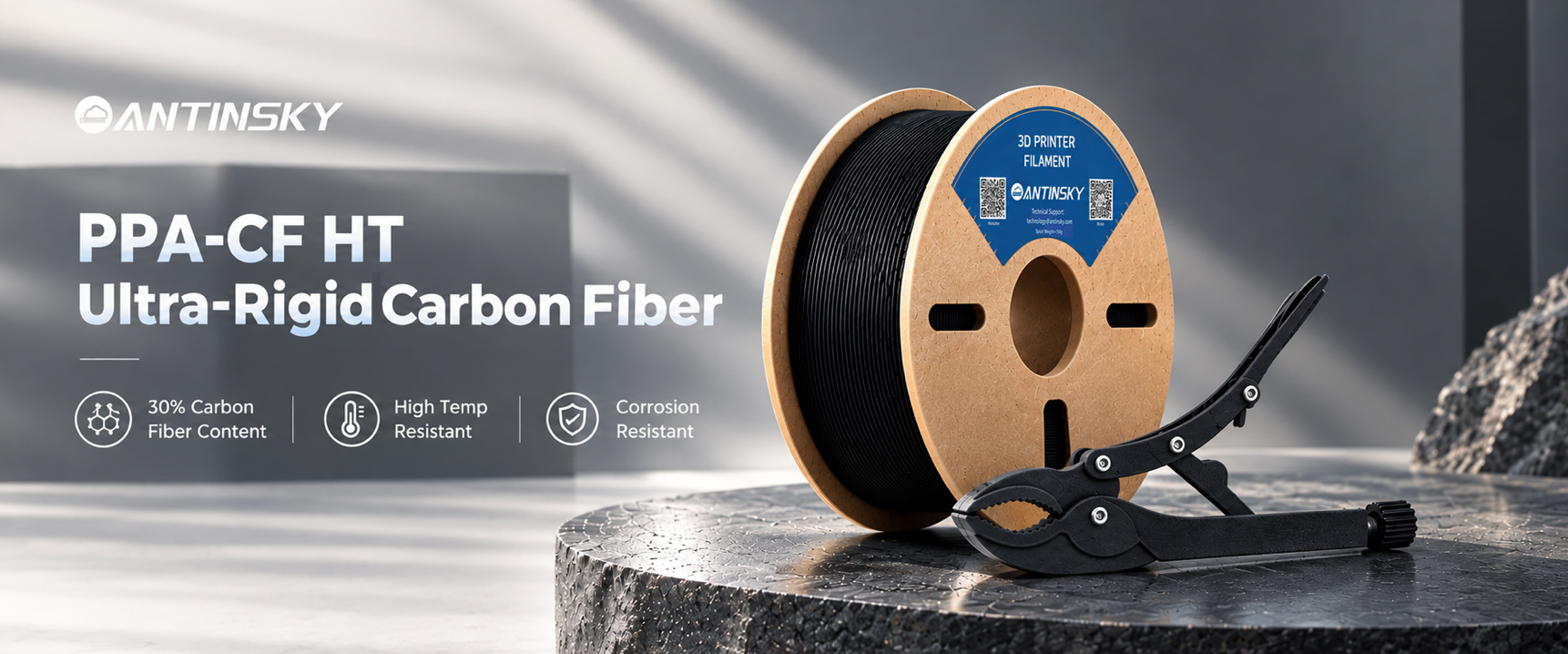
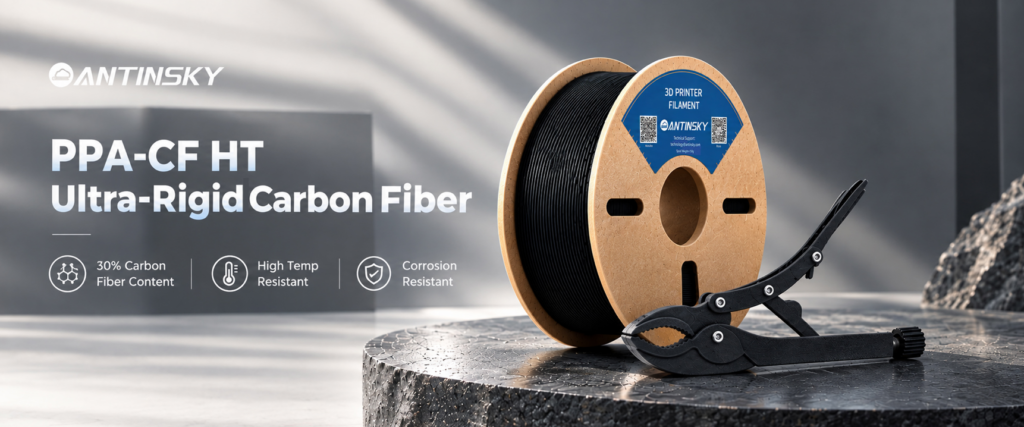
PPA-CF30HT is an ultra-rigid carbon fiber filament: a high-temperature PPA reinforced with 30% carbon fiber, with a flexural modulus of 12,136 MPa — among the stiffest FDM materials available. It is built for engineering-grade 3D printing that demands stiffness, strength and heat resistance. Density is 1.26 g/cm³, XY tensile strength 122 MPa, flexural strength 208 MPa, heat deflection temperature 176°C and melting point 280°C. Recommended printing temperature is 270–300°C at 120–150 mm/s with an 80–90°C build plate, a wear-resistant nozzle and thorough drying. (Parameters are based on Bambu Studio with a 0.4 mm nozzle; other nozzle diameters may differ.)
Where metal machining is expensive, geometry is complex and iteration must be fast, PPA-CF30HT is a direct alternative: an automotive supplier iterating on a sensor bracket can adjust the CAD model and reprint instead of rescheduling CNC work. It runs on widely used machines such as the Bambu Lab H2D and H2D Pro.
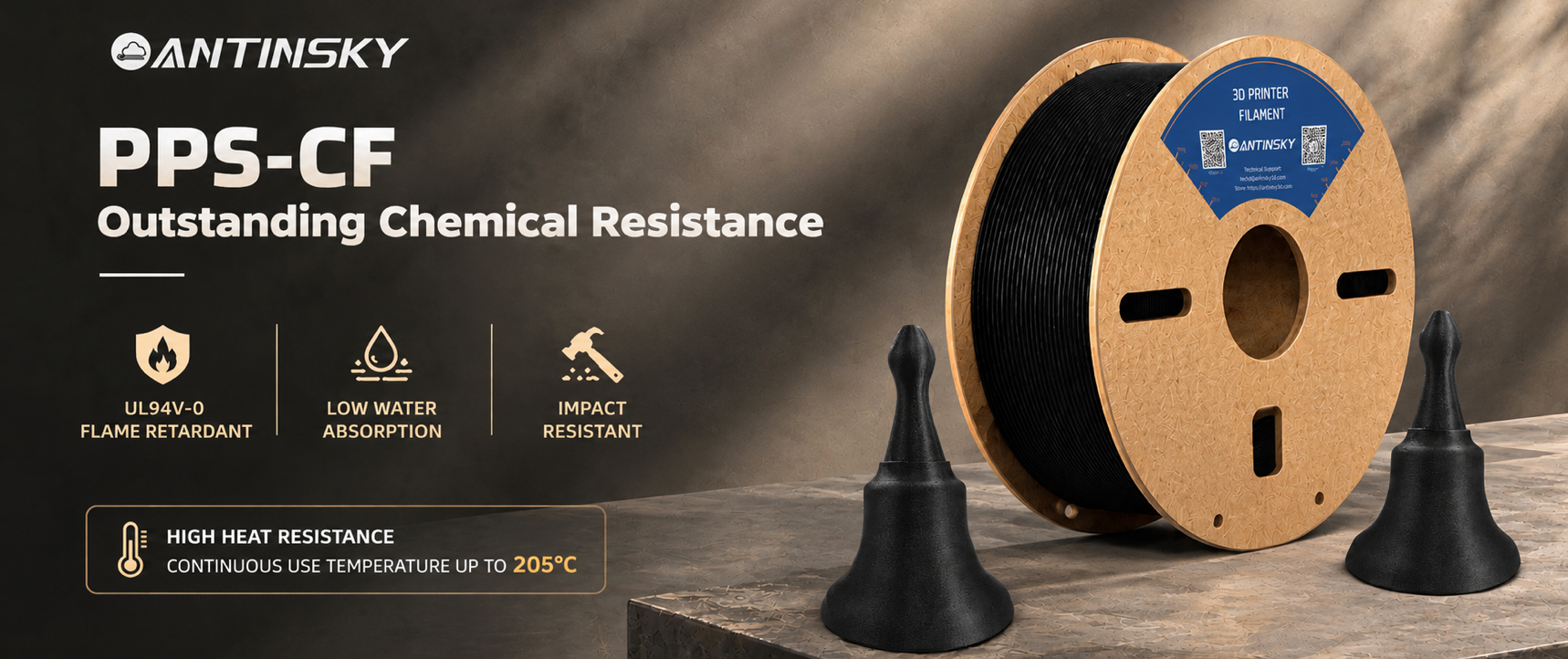
PPS-CF is a flame-retardant carbon fiber filament with outstanding chemical resistance — highly resistant to acids, bases, fuels, oils and solvents, with an inherent UL94 V-0 flame-retardant rating. It also withstands a continuous service temperature of up to 205°C, while water absorption of ≤0.08% keeps parts dimensionally stable in humid conditions. Density is 1.32 g/cm³, XY tensile strength 52 MPa, flexural strength 71 MPa and flexural modulus 3,612 MPa. Recommended printing temperature is 300–310°C at 120–150 mm/s with a 100–120°C build plate. Store and use it at low humidity, and anneal parts at 120–150°C to improve strength.
Its value is in parts with higher demands for heat, chemical media, flame retardancy or dimensional stability: brackets near an engine bay, clips, sensor structural components, pump and valve parts, structures around connectors, insulating structural components, heat-resistant fasteners, high-temperature fixtures, and functional parts that must withstand repeated thermal cycling.
Flexible TPU Filaments: Softer, Faster, and Lighter
Softer, faster, lighter and more durable — these are the current trends in flexible materials. ANTINSKY has launched TPU85A, TPU95A-HS and TPU-LW for these application scenarios.
TPU85A is the softest grade, made for parts that have to give: phone cases that absorb a drop, wearable straps that stay comfortable against the skin, and damping structures that flex without cracking. It prints on a direct-drive extruder at low speed and should be dried before use.
TPU95A-HS improves flowability while maintaining equivalent flexibility, and its printing speed and stability for flexible parts are superior to those of standard TPU. It targets the stage where flexible parts move from one-off prototyping to volume production—at which point throughput and interlayer bonding become decisive factors. It also needs a direct-drive extruder, low speed and drying.
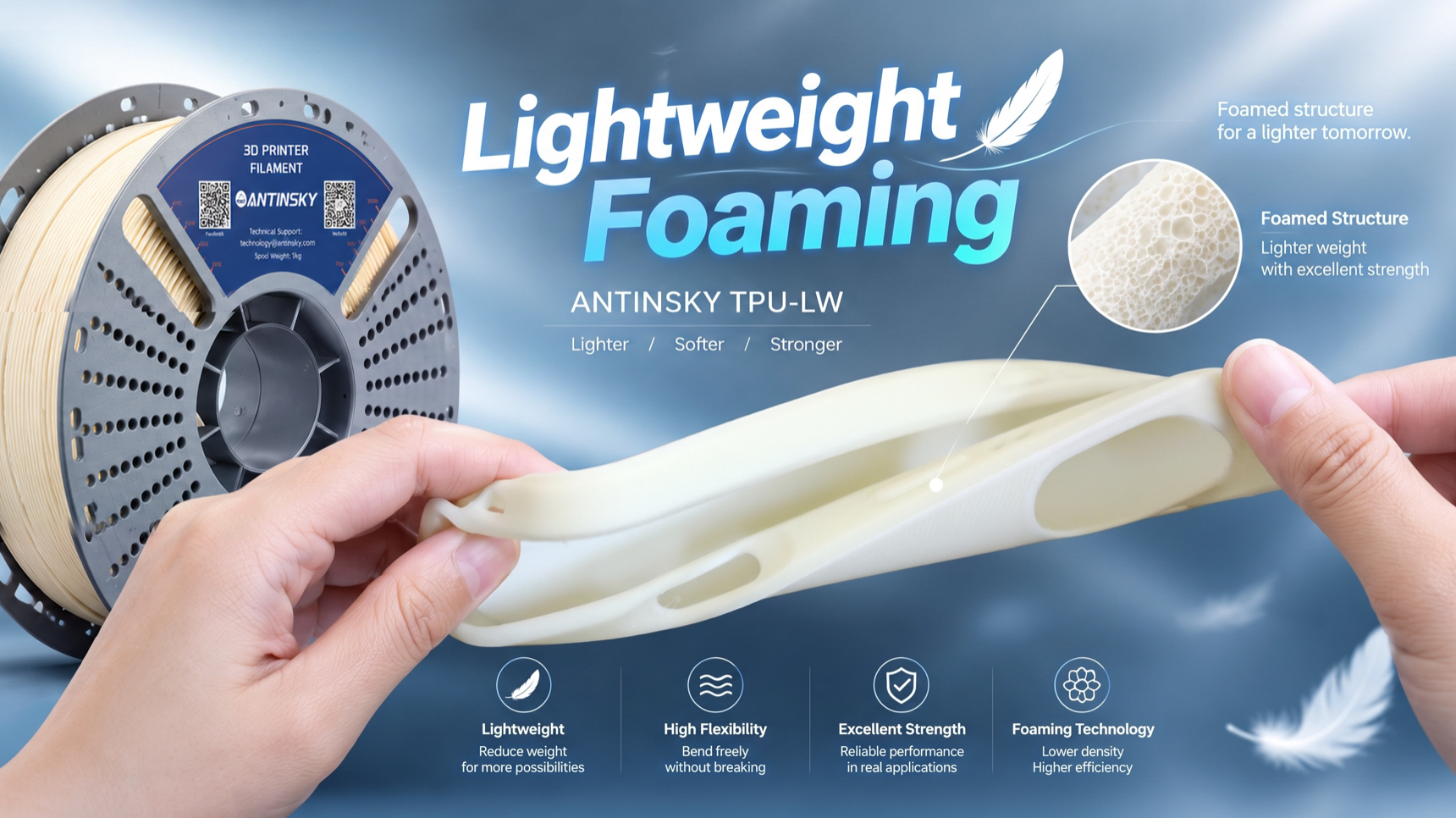
TPU-LW is a lightweight foaming TPU developed for printing wearable products, where low weight is the priority. Besides, ANTINSKY’s production line can already produce TPU65A, and we support batch customization orders.
Dental Resins for Splints, Denture Bases and Models
ANTINSKY launched three dental resins — Occlusal Splint Resin, Flex Denture Base Resin and Tray Resin — ahead of Formnext 2026, completing its dental resin line and strengthening the one-stop shopping experience.
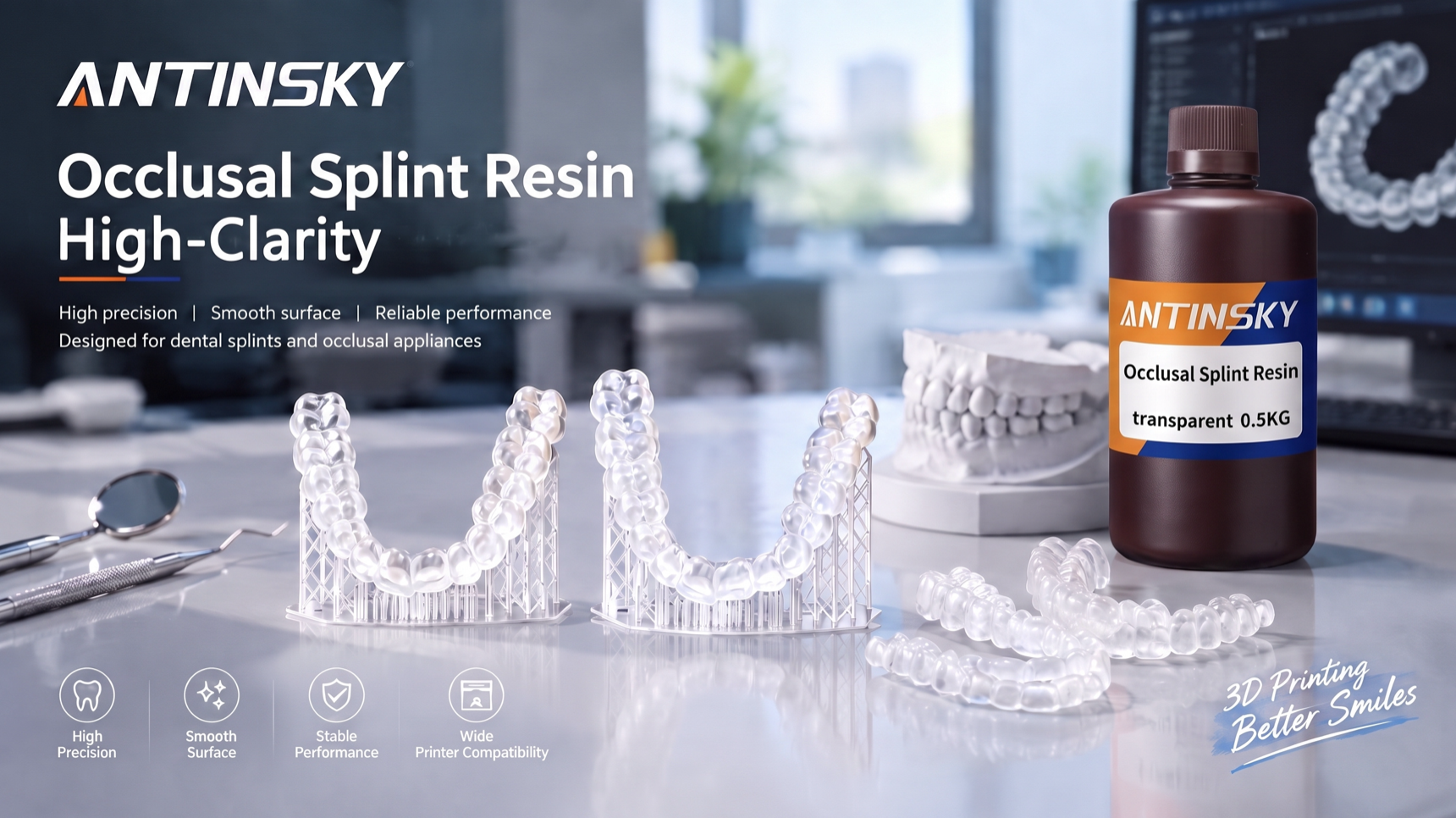
The Occlusal Splint Resin is highly transparent and cures quickly without deformation, giving a smooth, high-precision surface that is easy to clean and polish. It suits implant surgical guides, orthodontic guides, occlusal splints and bite guards. After forming, tensile strength is 52.26 MPa, maximum flexural strength 62.69 MPa and Shore hardness 83–87D, with shrinkage of 0.2–0.5%. Recommended exposure is 20–30 s for bottom layers and 4–6 s per layer at 385–410 nm.
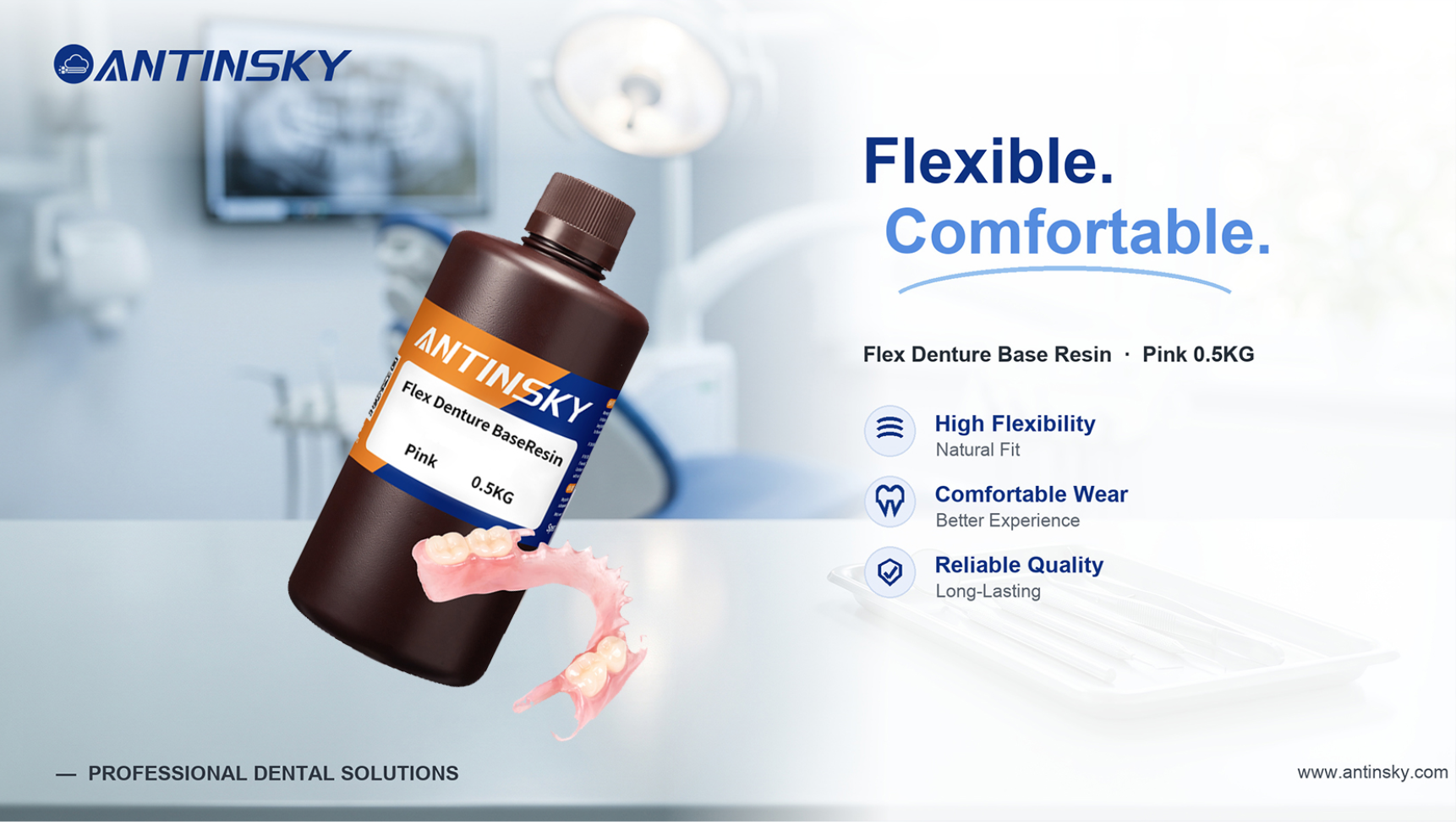
The Flex Denture Base Resin delivers a better tactile experience than its first generation — flexible and comfortable, adding softness while maintaining very low shrinkage (0.2–0.5%). Its 143.10% elongation at break provides the resilience, toughness and fatigue resistance a flexible denture base requires, so parts keep their shape over repeated use. It is designed for flexible denture base models and for temporary transitional restoration of edentulous areas before implant or fixed treatment.
The Tray Resin focuses on strength, precision and post-processing capability. It offers a fine surface finish, high strength and precision, good toughness and impact resistance, with a tensile strength of 38.36 MPa and a maximum flexural strength of 44.15 MPa.
A Clearer Material Selection System — Meet ANTINSKY at Formnext 2026
Against increasingly intense competition in 3D printing materials, ANTINSKY is investing in R&D rather than homogenized products. In November 2026 we will showcase a wider range of 3D printing products at Formnext 2026 (17–20 November, Frankfurt; Hall 12.1, Stand F29). We welcome you to explore new possibilities together.