
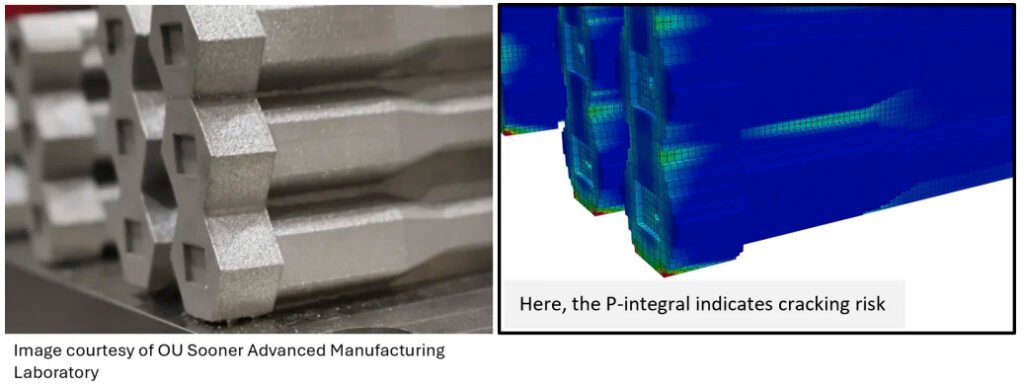
Published in the International Journal of Advanced Manufacturing Technology, a paper titled “Part scale prediction of residual stress through thermomechanical modeling of additively manufactured Ti-6Al-4V” seems to point to the benefits of using PanOptimization. So named for founder Pan Michaleris, and not for the goat-legged god of shepherds, or indeed the cooking utensil, PanOptimization is an FEA optimization tool that can be used to predict errors and simulate parts. Their software PanX comes in an LPBF and DED flavor, and can be used to optimize tool paths, check for distortion, and more.
The paper was written by Emmanuel De Leon of the Air Force Life Cycle Management Center, Tinker Air Force Base; Rodolfo Villa of the Oklahoma City Air Logistics Center at Tinker Air Force Base; Alex Riensche, Benjamin D. Bevans, and Christopher Billings of the Sooner Advanced Manufacturing Laboratory, University of Oklahoma; Jay Waterman of the Air Force Research Laboratory (AFRL); and Zahed Siddique and Yingtao Liu of the Sooner Advanced Manufacturing Laboratory, University of Oklahoma. That’s a lot of candle power for one paper.
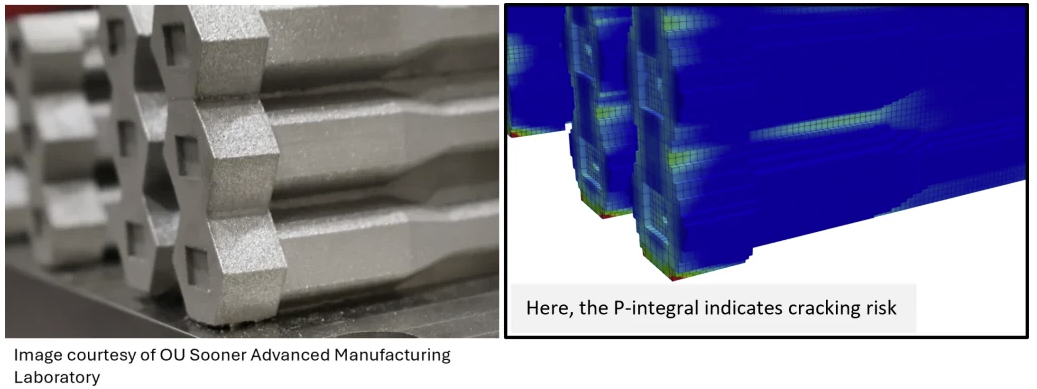
In the paper, this very experienced team looks at using PanX to predict outcomes in LPBF builds. The research was supported by $8.7 million AFRL grant FA8650-23-C-5701, related to additive manufacturing and sustainment. The company said that the significant thing going on here was moving “beyond trial-and-error builds and toward physics-based models that support qualification, certification, and production reliability.”
PanOptimization Chief Engineer Erik Denlinger said,
“There is growing recognition across industry, government, and regulatory bodies that AM cannot reach full industrial maturity without physics-based models that can be trusted. If simulation can predict the outcome of a build quickly and accurately, it becomes a way to identify and mitigate risk before material, machine time, and production schedules are put at risk. That is exactly where PanX is focused.”
The research looked at full build volumes of parts, measured how the parts fared in real builds, and compared the results to what PanX predicted. If you look at the stress on one part you may learn some things. But, parts can heat and warp one another, so the distance between them, powder packing, and flow really matter.
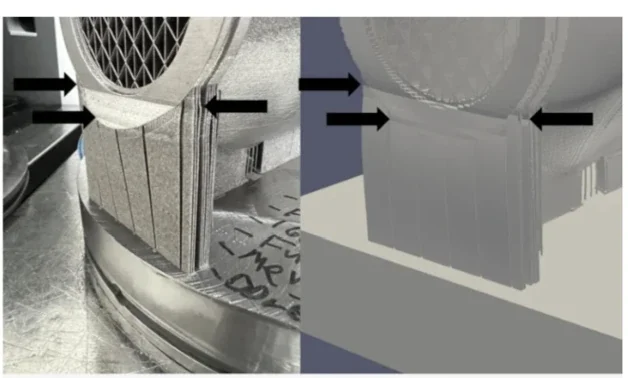
The paper demonstrated that the interlayer temperature was measured well, potential crack sites were found, and that the software worked with different parts and types of builds.
Denlinger stated,
“The accuracy of simulation needs to be validated for it be applied and trusted. The In situ interlayer temperature measurements for full build volumes used in this study are the gold-standard for thermal validation. The work should be extended to include actual energy input and machine timing, which PanX can already integrate with, and which our internal validation efforts have shown this to be critical to further accuracy improvement. PanX’s ability to accurately compute these temperatures is a competitive advantage for us and it enables the optimization of process timing, compensating distortion for tight-tolerances, and many other applications.”
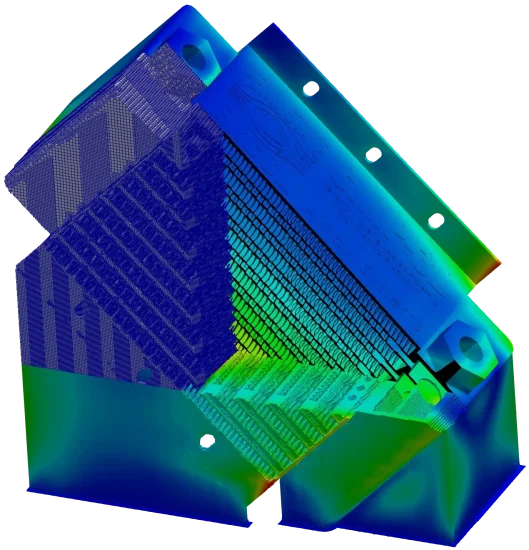
This is a hell of a proof point for PanOptimization. The work took three years, and the contract included a GE M2 Series 5L, a particle characterizer, a boatload of stuff from Mitutoyo, microscopes and more from Keyence, a materials testing system, and CMM. Basically, the research must have been so tedious that they gave the University of Oklahoma a 3D print lab in return for it.
Testing PanX so rigorously is invaluable for the firm. I’m not thinking now that the Air Force is looking at this as something they may use casually. PanX isn’t something they’re kind of interested in. It seems like it may play an important role in the Air Force’s future. And even if they never again use it, this kind of real world validation is priceless. On top of that, the data is a goldmine for the PanOptimization team and will help them improve their solution. This is excellent news for PanOptimization, and will help people to measure twice and print once, saving us all a lot of time and money.