

Many dynamic, interactive objects change their appearance through the use of electronics, like LEDs and screens. But if the object is squished, twisted, or pressed too hard, or exposed to chemicals or water, those electronics won’t work properly anymore. Surface optics can change the appearance of an object without delicate electronics, but their interactivity is fairly limited, as static labels like stickers or curved lenses create visual effects based only on where the user is looking.
A team of researchers, based at MIT, have created a new 3D printing system for making interactive objects that can change their appearance not with electronics, but when they are turned, pressed, or slid. Their ShiftLens design and fabrication system uses small, controlled mechanical shifts, combining built-in mechanical parts with specially arranged optical layers so the object’s surface appearance changes based on user interaction, like flipping a switch or screwing on a lid. The resulting objects, such as packaging that alerts users if any fasteners have come loose, can be printed on a multimaterial machine, and don’t require electronic circuits to operate.
“With our system, an object can tell you whether you are using it properly, without the need for sensors or any complicated electronics,” explained Yunyi Zhu, a graduate student in the MIT Department of Electrical Engineering and Computer Science (EECS) and lead author of a paper on ShiftLens. “The interactive display is mechanical, so you can create a self-contained, multistate, interactive device that a user can control very intuitively.”
Her co-authors include Dingning Cao, an MIT undergraduate; Jeremy Mrzyglocki, a graduate student at the Technical University of Munich; Stefanie Mueller, an associate professor in EECS and the Department of Mechanical Engineering at MIT and a member of the Computer Science and Artificial Intelligence Laboratory (CSAIL); and Narjes Pourjafarian, a postdoc at Northeastern University.
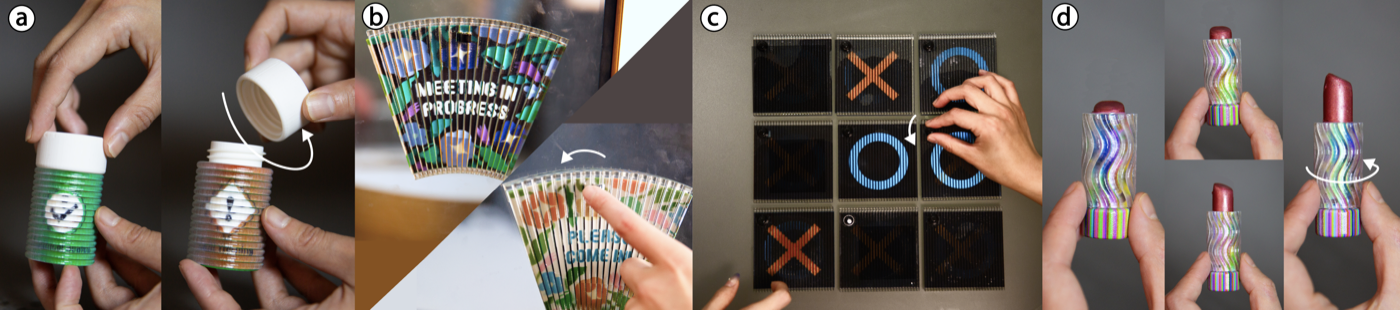
Figure 1: ShiftLens uses a mechanically actuated optical surface to create switchable appearances on 3D objects without electronics, demonstrated through (a) a chemical bottle that displays a safety warning when the cap is loose, (b) a door sign that toggles between two messages when flipped, (c) a tic-tac-toe board whose cells are controlled by knob for electronic-free interactions, and (d) a lipstick tube that shifts through a color gradient as the barrel rotates.
Their system will automatically convert a design into a 3D printable model of an object with “a mechanically switchable surface appearance.” It does so by combining two optical layers on the surface of the object, putting a layer of tiny lenticular lenses on top of a patterned backplane. These are curved lenses that, depending on the user’s viewing angle, steer light differently. The patterned backplane holds strips of images, which “correspond to multiple appearances of the object surface.”
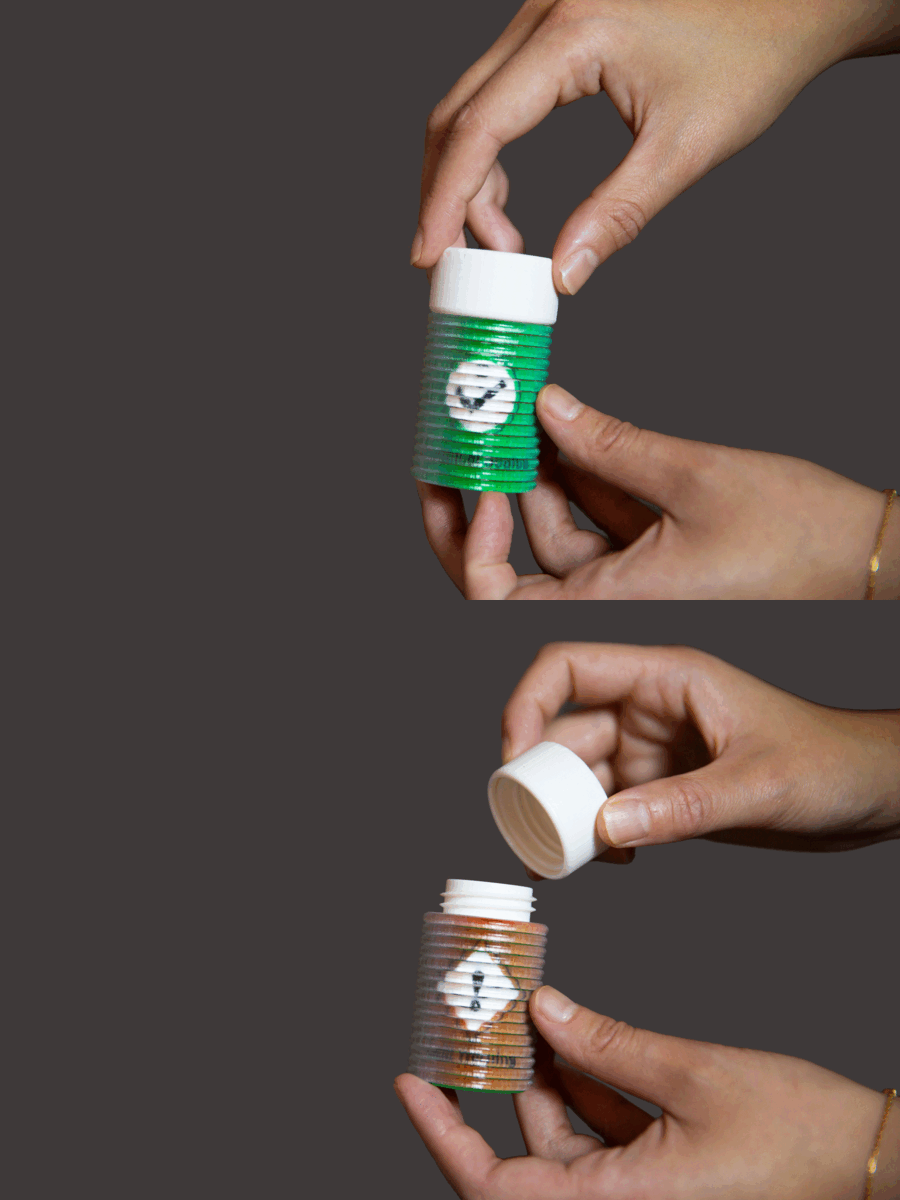
When the top lens layer is shifted, different parts of the underlying backplane are displayed. The lenticular lenses magnify these displayed parts, which changes the object’s surface appearance. One example is a door sign that switches between two messages when it’s flipped. Another is a bottle of chemicals that changes color when the lid isn’t on correctly. I cannot begin to articulate how helpful something like this latter example could be at the end of a long day in the lab, when you’re so tired you’re practically sleepwalking, and completing your final tasks on autopilot. That is exactly when mistakes happen. So having a bottle that physically changes color when the dangerous materials inside aren’t properly secured could be a game-changer.
According to Zhu, the hardest part of the project was ensuring that the moving optical effect, computational graphics, and mechanical linkages aligned. To make this easier for others, the team developed a user-friendly tool that does the hard work. Based on just a few inputs, like the desired curves and shape of the object and images of the desired visual states, the tool will automatically create the optimal ShiftLens structure.
“To make these transitions reliable, we introduce actuation mechanisms that translate inputs such as pressing, sliding, and rotating into repeatable surface changes. We also contribute a computational design tool that takes 3D geometry, desired appearances, and actuation types as input, and automatically generates the lenses, patterns, and actuation mechanism geometry for single-pass multi-material 3D printing,” the team wrote in the abstract of their paper.
It was also difficult to explain the ShiftLens design tool’s limitations to users.
Zhu said that, “Another challenge is to communicate to users who are not familiar with optics or mechanical structures and let them specify and achieve what they have in mind.”
Because the tool requires a shifting motion to cause interaction between the layers of the object, ShiftLens isn’t compatible with all objects. It’s best for designing an object, like a rotating lipstick tube, that has the desired interaction already built in, or to integrate an actuation mechanism, such as knob, roller, or switch. As Zhu explained, ShiftLens users “can control what an object looks like while they are using it.”
To prove the system’s potential, the researchers 3D printed a variety of interactive objects, including that color-changing bottle.
The ShiftLens system was developed to make the fabrication process easier for makers, but it could one day be scaled up to create adaptable, interactive objects for architectural, commercial, and industrial applications. An example Zhu gave was using the platform to design 3D printed piping that changes its appearance to highlight where a leak is coming from; again, just like the color-changing bottle of chemicals, this could be a very useful application indeed.
The researchers, who are presenting their work at the ACM Symposium on User Interface Software and Technology in Detroit soon, are also planning to develop an algorithm to simplify the ShiftLens design process by requiring fewer user inputs.