
Mobility goes Additive (MGA) is an organization exploring collaborative implementation of additive manufacturing. Based in Berlin, MGA staffers work in defense, rail, and medicine while exploring urban transport, lifestyle, and construction. Through working groups, members share results, discuss roadblocks, and work on solutions. I really like MGA and think this approach is proving very successful. I was at their MGA Annual Conference. There were Women in 3D printing
Stefanie Brickwede, Head of Additive Manufacturing at Deutsche Bahn and Managing Director of MGA, reviewed the network’s work over the past year. She highlighted the technical white papers, technical data sheets, and standards MGA worked on throughout 2026, along with its participation in industry events such as Additive Manufacturing Strategies, Formnext, and rail-related events such as InnoTrans. She also maintained her leadership role in ISO additive manufacturing standardization efforts.
I also gave a presentation on the AI bubble and how artificial intelligence could be used in 3D printing. Generally, I argued that rightsizing parts was more important than AI-driven CAD design and that AI’s greatest potential lies in alloy discovery, unique settings divination, and process parameter optimization.
Brickwede then passed the mic to Jens Abromeit, a Deutsche Bahn board member and head of its 8,000-person maintenance division. He said he thinks in terms of the “flow of ideas or the flow of materials.” He congratulated Brickwede on “spreading out ideas to industry” and praised MGA for “being a network, showing what is possible in new technologies. Everything is possible, and I challenge you to take additive manufacturing out of the lab.” He was particularly interested in reducing lead times, improving productivity, and increasing efficiency. He also told us, “The driver for innovation is always business,” and that additive has brought about 20 million euros in cost savings and cost avoidance at Deutsche Bahn.
Signify‘s Annette Steinbush then spoke about using material extrusion at scale to make tens of thousands of custom luminaires. She pointed out that, “Our objective in using 3D printing is about making the product that you make.” The company purchases filament but also operates two production lines to make its own. Signify has developed its own printer management software and offers on-demand colors to match customers’ branding. The materials must also withstand high temperatures, as fire safety is particularly important for lighting fixtures.

Annette Steinbush at MGA 2026. Image courtesy of 3DPrint.com/Joris Peels.
Signify has two printer models, Large and Small, both designed to operate 24/7. The factory even prints at night with the lights off, which Steinbusch says is weird for a lighting company. Each printer can automatically eject finished parts and switch filament reels, and the facility has a complete exhaust system. Signify also developed its own printer management software to schedule and optimize print jobs, along with a configurator that lets designers and lighting specialists make custom lamps.
Steinbusch explained that Signify initially used small consumer printers but struggled with software limitations and auto-eject part removal. They had to make their own printer manager and management software because nothing was available to meet their needs. Commercial solutions couldn’t meet the company’s needs, while high-end printers and materials were too expensive. Signify began exploring 3D printing in 2012, relaunched the project in 2017, and eventually spun off an internal startup and scaled it into a larger operation. Today, it serves warehouses, factories, offices, government buildings, schools, and retailers. The company also produced 3D printed lamps for a recent McDonald’s refurbishment. Deutsche Bahn’s Abromeit lauded Signify’s implementation, saying it was exactly what the industry needed.
Tom Thorvaldsen of the Norwegian Army then spoke of the Operationalization of AM in the Defense sector. Norway, in effect, wants to set up an Allied production network. They are working on a digital warehousing solution across Norway. Local commercial businesses and the Army itself can then 3D print MRO parts. They also want to deploy an Allied Production network with NATO and other allies. The Norwegians started doing additive R&D in 2005 and played with it until 2025.
The Norwegian Army now wants to synchronize its capabilities, establish a competence center, and build capacity. During the discussion, Bart Van der Schueren, Chief Strategy and Technology Officer (CSTO) at Materialise, asked whether the Army reverse-engineers parts or works directly with OEMs. Thorvaldsen explained that for newer vehicles, the Army works with OEMs, particularly to address quality assurance and warranty concerns. For older vehicles, it also reverse-engineers parts that are no longer available.

Svenja Pestotnik at MGA 2026. Image courtesy of 3DPrint.com/Joris Peels.
Liebherr‘s Svenja Pestotnik described aerospace as “the perfect playground for additive due to weight and space constraints.” She recalled a test build in which a room-temperature build platform deformed, leading the company to increase the platform temperature to 200°C. She explained that Liebherr uses a fixed, or “frozen,” production process, meaning it avoids changes to machines, software, or individual process steps once they have been qualified. The company also maintains tight control over much of its supply chain.
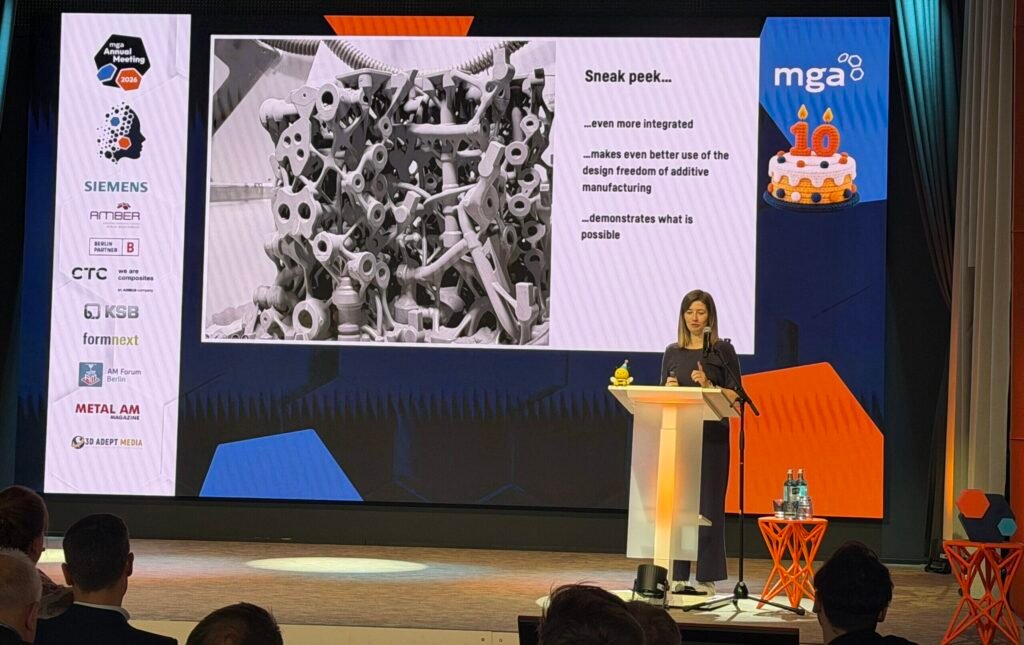
Turning to production applications, Pestotnik said Liebherr also controls a lot of its own supply chain. The company has had a serially produced part on the Airbus A350 since 2018. Its first part, a landing gear proximity sensor, wasn’t necessarily economically attractive but was more about passing muster with regulatory bodies. Later, they made parts that made more sense. One example is the A350 Lower Deck Cargo Door Actuation System Manifold, which made a lot of sense because it was a lightweight integrated design. The part is in serial production for the A350, with production reportedly supporting 12 aircraft per month. Pestotnik also showed a manifold for the main hydraulic system, which looked like a super complex part and got a lot of excitement.
Then there was an AI panel with FIT Additive Manufacturing Group‘s (FIT) Charlie Fruth and Matthias Brueck of Fraunhofer IAPT and an AI guy from KI Park. It was super entertaining and very thought-provoking. How will we survive without jobs? What will we do? Will government people be the only people with jobs? And what does this mean for companies and startups?
I really like the MGA events. They’re always well organized, thoughtfully so, and a joy to go to. I explained to friends that my MGA presentation was worrying me because I was speaking before peers, people who know their stuff, and this is why it makes sense to be in the room here. You can learn a lot here and meet some very useful people. I hope to be back.