
The Pentagon, along with deep-pocketed collaborators in the private sector, is urgently coordinating the buildup of all the elements necessary for a domestic US drone supply chain. Even so, those in the department most directly responsible for accelerating innovation have cautioned that it would take quite some time for the US to catch up to Ukraine’s drone production capabilities.
From a business perspective, the most obvious takeaway is that the new procurement environment should add value for any company that can help American drone capacity evolve more rapidly. Chicago’s Impossible Objects, which makes 3D printers that leverage the company’s Composite Based Additive Manufacturing (CBAM) technology, and also offers print services using its CBAM printers, says that it can help the US Army’s Rock Island Arsenal in Illinois to build up to 10,000 drone bodies a month, an amount that would certainly move the needle with respect to the Pentagon’s output objectives.
That number comes from an announcement tied to the $40 million Series B round that Impossible Objects recently closed, and the company also made the 10,000 drones a month claim the centerpiece of its RAPID + TCT ’26 booth back in April. $40 million is a nice number for a Series B, though by no means unusual these days for a company with a real value proposition for the US drone market.
What is more unusual is the fact that Impossible Objects’ Series A round, worth $6.4 million, closed back in 2017, although it ultimately added about $4 million to that round in 2019, bringing the company’s total VC funding, prior to this — including a seed round — to around $13 million. Even in the much slower world of hardware development, and even considering the context of the current VC era, when the time between funding rounds has generally gotten longer, seven years requires patience from all parties involved. You probably won’t find investors more patient than those backing Impossible Objects, with lead Series B investor Inflection Equity Partners, also based in Chicago, counting among Impossible Objects’ original Series A backers.
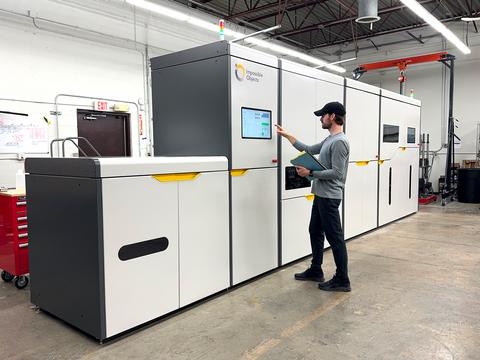
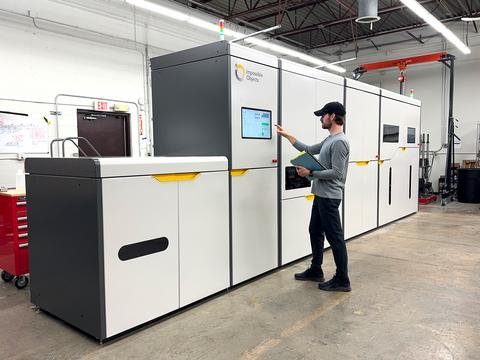
Impossible Objects’ CBAM 25 industrial additive manufacturing system in operation. Image courtesy of Impossible Objects.
One explanation for why the company has survived despite not having closed another funding round until now is that, over its lifetime, Impossible Objects has been awarded $20 million in US government contracts and grants. Again, that’s not an astonishing amount, but it also has only around 30 employees now, and it had barely half that in 2017. Meanwhile, the company told Axios that it’s aiming to bring in another $30 to $50 million over the next 12-18 months.
Finally, Impossible Objects currently sells a single 3D printer model, the CBAM 25, compatible with materials like carbon fiber and fiberglass, and the straightforward differentiator is the speed advantage that the company claims to have over its competitors. So Impossible Objects has worked towards doing one thing extremely well for carefully identified applications, which, in addition to drones and lightweighting for industries like automotive and aerospace, include electronics tooling. It may be that the company really has just opted for a different way of building its capacity when contrasted with its competitors. The competitors may have made headlines over the years that were far more attention-grabbing, but, by and large, they haven’t produced results more tangible than what Impossible Objects demonstrated over the same timeframe.
The most relevant takeaway for me, for both US manufacturing companies and their investors, is that the landscape seems to have undergone a subtle shift in 2026 that looks poised to carry into the years ahead. Demand for drones is a big part of it, but it’s definitely not the only catalyst, and different leading catalysts are likely to emerge at various points in what has the potential to be a broader reconsideration of investing in US manufacturing capacity. This is along the lines of what I discussed in my recent post about Apple’s use of 3D printing on the Duo. American corporations seem to have resigned themselves to the fact that, at the very least, they need to hedge their bets on reshoring, and they may be preparing to go well beyond hedging.
Any version of respiring that’s for real will take a very long time, which is to the advantage of a company like Impossible Objects. It has shown that it is committed to the slow and steady wins the race mindset.
Featured image courtesy of Sarah Saunders/3DPrint.com