
At this point, most people in additive manufacturing (AM) agree on one thing: the industry has spent years talking about potential. After years of promises and future-looking concepts, companies are now trying to prove that 3D printing can reliably manufacture real products at an industrial scale.
That was a major focus of a recent 3DPrint.com interview with Arvind Rangarajan, Global Head of Product and Strategy for HP’s additive manufacturing business. Rangarajan repeatedly returned to the idea of moving AM beyond a novelty and making it a dependable production technology.
“I think that’s basically the key theme inside HP now,” Rangarajan said. “We have been talking about additive as a novelty. But what we want now is to think about it as a real tool for production. So it sits on par with other traditional manufacturing technologies, and when designers are designing their products, they think about additive as a manufacturing process and not as prototyping.”
For HP, that means moving beyond prototyping and small pilot programs. The company wants AM to become a regular manufacturing option alongside processes like injection molding and other traditional production methods.
“When designers are designing their products, they think about additive as a manufacturing process and not as prototyping,” he said. “And for that, we need to make additive work at scale. When we think about true scaling, we are talking about a production facility that is running 10 plus printers that are actually producing parts for end-use products. We are moving from tooling and prototyping to series production.”
One of the best examples, he said, is orthotics and prosthetics, where 3D printing is already producing large volumes of customized parts. HP customer organizations are now manufacturing hundreds of thousands of end-use products through distributed production facilities using multiple printers.
“You could print the same design anywhere and expect the same product quality,” Rangarajan said. “That’s how you start thinking about it from a production and scale perspective. Many of these distributed manufacturing sites now operate multiple printers producing end-use parts continuously.”
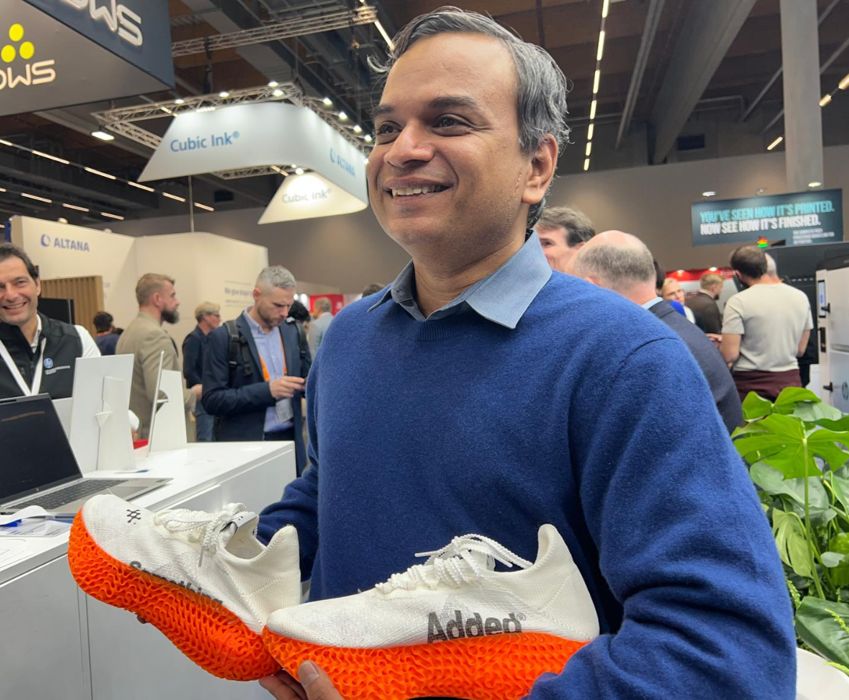
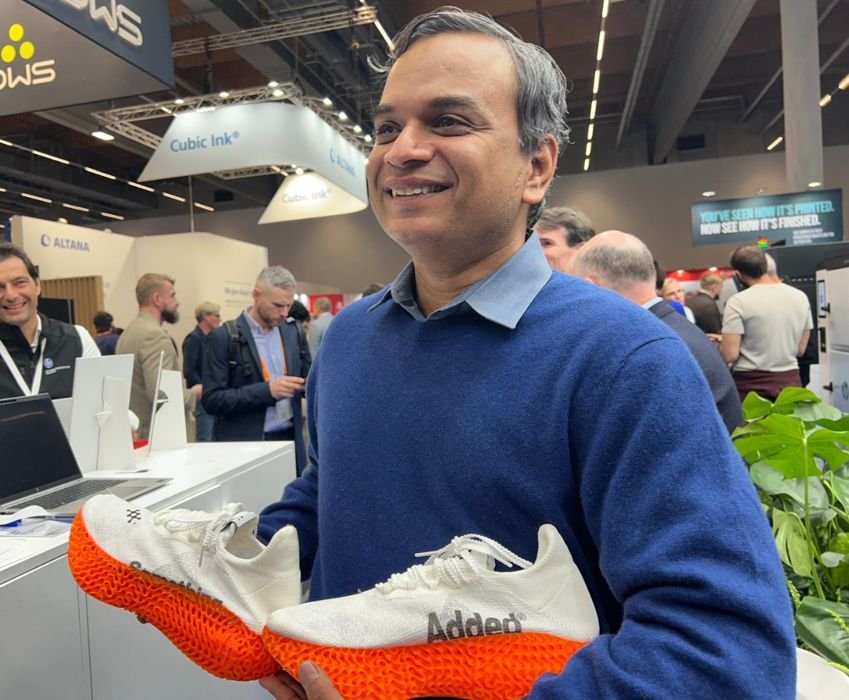
Arvind Rangarajan at RAPID + TCT 2026. Image courtesy of HP via LinkedIn.
That matters because repeatability has long been one of AM’s biggest challenges. HP believes companies will only fully trust 3D printing for production if they can get reliable results across different machines and production sites.
Rangarajan said three things are critical if 3D printing is going to scale: performance, cost, and reliability.
“The first one is that additive needs to deliver a clear performance benefit,” he said. “The second thing is that it has to be competitively priced and cost-effective compared to conventional manufacturing processes. Manufacturers also need reliable and repeatable results if they are going to trust AM for production.”
A major part of HP’s strategy revolves around lowering total cost of ownership (TCO), which Rangarajan sees as one of the biggest factors behind broader industrial adoption of AM. He said HP has already reduced TCO by roughly 50% over the past several years through improvements in materials, software, automation, and workflows.
“Our focus is on continuously reducing the total cost of ownership,” Rangarajan explained. “Every time you drop the TCO by 2x or 50%, the total addressable market grows by 10x.” He pointed to HP’s newer PA 11 material generation as one example, noting that improved powder reuse and material consistency can significantly lower production costs. “Compared to a general material, if you make the same part in Gen 2, it’s 40% cheaper.”
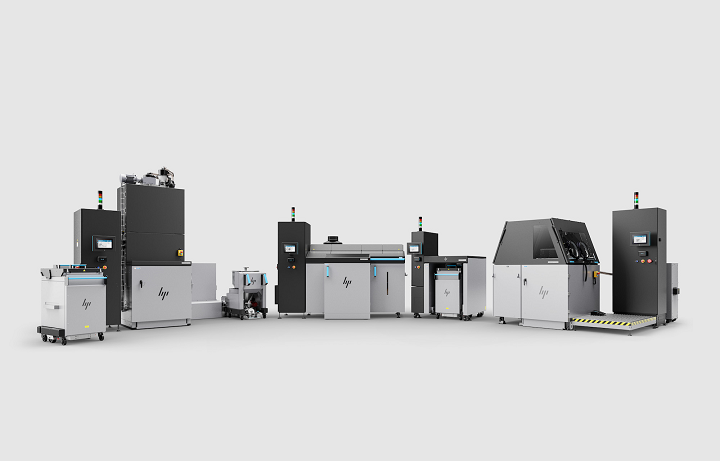
HP’s new Metal Jet S100 Solution is opening the doors for a digital reinvention of the global metals manufacturing sector. Image courtesy of HP.
But software and workflow optimization are becoming equally important. HP has introduced tools that optimize part packing inside builds, automate printer operations, and improve throughput. According to Rangarajan, even changing packing strategies can significantly affect manufacturing economics, having seen customers improve their cost by 10% by just changing their packing strategy.
HP is also increasingly positioning itself less as a hardware company and more as a broader AM solutions provider. That shift became more visible recently with the introduction of HP’s Industrial Filament platform, which moves the company beyond its core Multi Jet Fusion systems and into high-temperature industrial filament printing applications. According to Rangarajan, the move came largely from customer demand for additional manufacturing options and materials.
“What we see is that in this industry, customers are asking us, ‘How are we doing high-temp?’ We want to become an additive manufacturing solutions provider, where we help customers scale additive. HP’s move into industrial filament printing came largely from growing demand for additional applications and materials beyond the company’s traditional Multi Jet Fusion platform.”
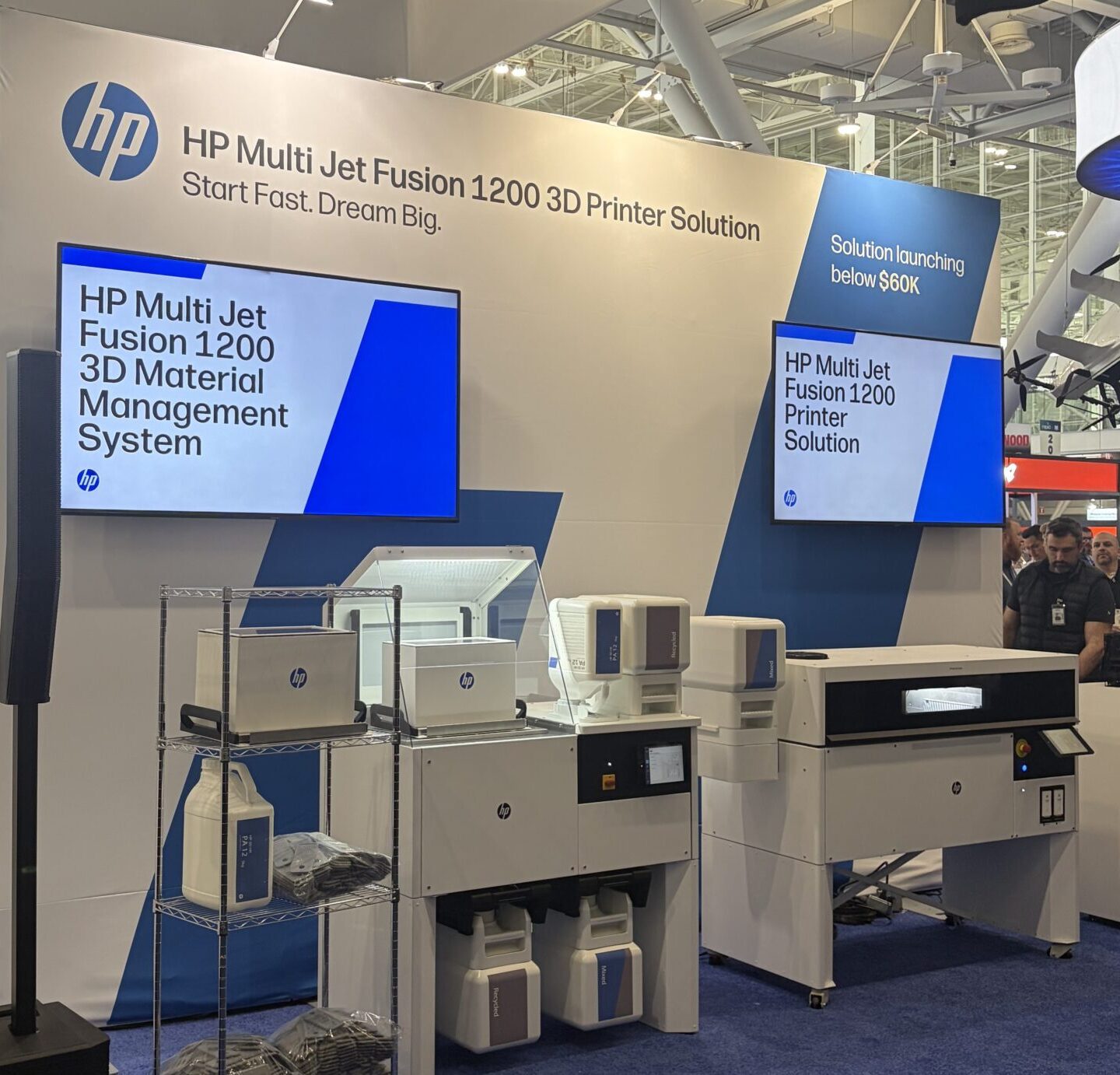
HP unveils the Fusion 1200 printer on the RAPID + TCT 2026 show floor. Image courtesy of Sarah Saunders/3DPrint.com.
Rangarajan also pushed back on the idea that additive manufacturing has to replace traditional manufacturing entirely. Instead, he described AM as another manufacturing option designers can use when it makes the most sense for the product, cost, or application.
“I think the complementing is probably where [it goes],” he said. “There’s always going to be trade-offs. When a designer is trying to solve a problem, they don’t really care how the part is made. What we want to do is provide options to meet the product’s functional requirements in the most cost-effective way. Additive is really well-positioned for that. The technology is also beginning to unlock new areas like mass customization in footwear, eyewear, and medical applications, where personalized products are becoming commercially realistic at a larger scale. We can actually start doing affordable mass customizations. Now you’re paying the same you would pay [otherwise], so it becomes an easy choice.”
Rangarajan also admitted that the AM industry spent years making promises that were sometimes too ambitious. According to him, some of the sector’s biggest problems came from overpromising.
“We need to stop saying additive is going to replace everything in manufacturing. A lot of those overblown promises are what set the industry back.”
Instead, HP’s current strategy appears much more grounded: improve reliability, reduce costs, focus on applications where additive provides a clear advantage, and slowly integrate the technology into mainstream manufacturing workflows. In fact, for Rangarajan, success would ultimately mean that additive manufacturing would become “ordinary.”
“Additive should just become another manufacturing option. Then designers can choose and deploy it the same way they would any other manufacturing technology,” he concluded.