
Dirk Simon had deep experience in materials and chemistry before joining the 3D printing industry. Instrumental in BASF and Farsoon’s market introduction, Dirk has spent a lot of time thinking about how to build and create new businesses and products. Now he runs his own firm, Square New Business Exploration, where he aims to help people succeed in building their own new offerings. We interviewed Dirk to find out more.
I wanted to know how Dirk thinks companies should develop new business. He said that, “First, the company needs an aligned definition of ‘New Business Development,’ sorry, on an abstract level, and what they actually mean by ‘New.’ Economic science can help here; there is broad consensus on such definitions, but it surprises me how often they are not well known or well applied in industrial companies. The Ansoff Matrix can help define what Sales- or NBD-Managers should do, and more importantly, what they should not do.”
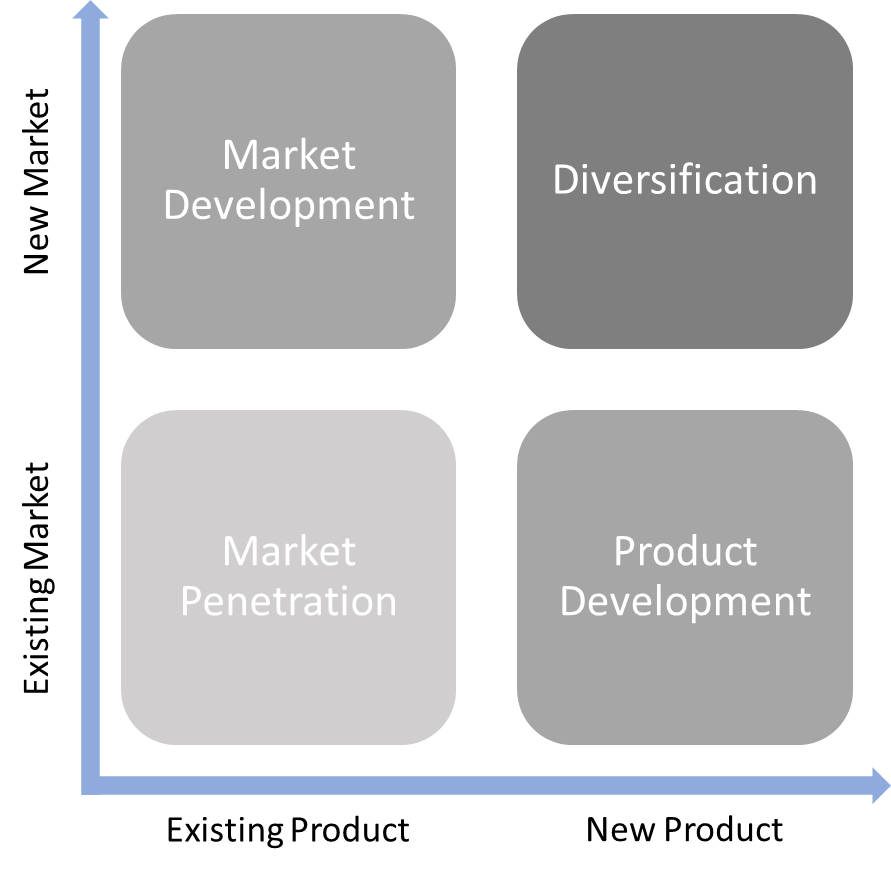
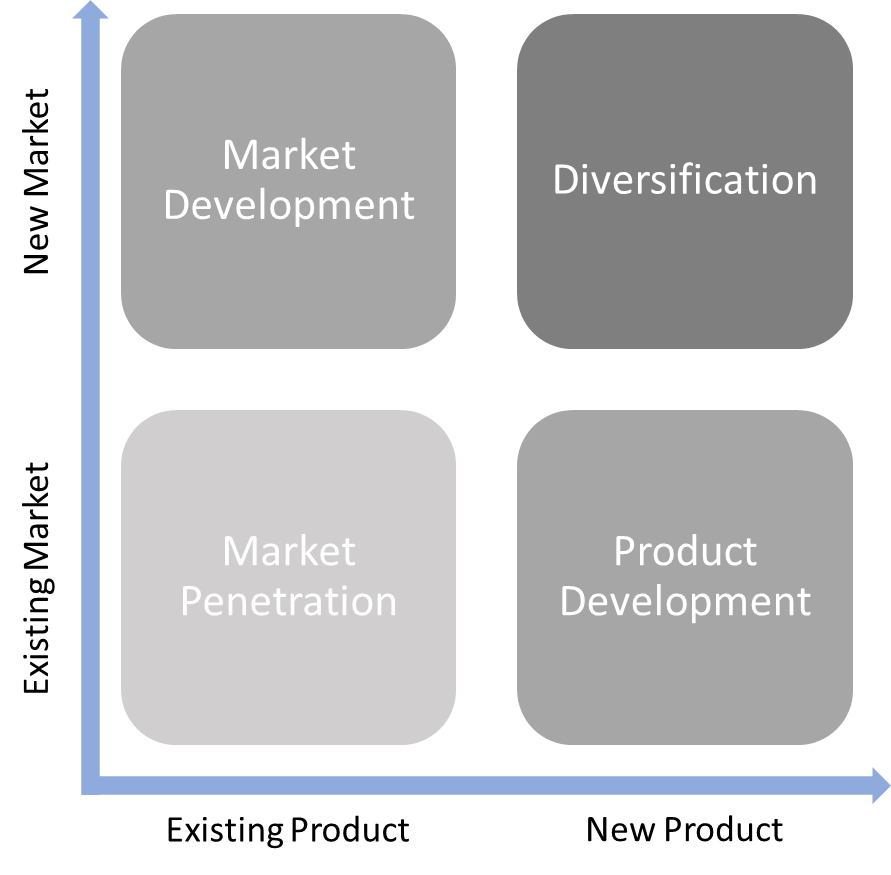
The Ansoff Matrix and its four business growth strategies. Image courtesy of Dirk Simon.
The graph shows an area of a company’s existing sales, with its existing products, in the markets it serves today. This is often called the “core” business of a company. If a company is in the services business, you can replace “products” with “competences” because, in services, you basically sell your competences. The x-axis of the Ansoff Matrix describes the product level from existing to new; the y-axis describes the market level from existing to new. Thus, for the definition of “New” within this graph, from your core business you can go in three directions:
- Entering new markets with the existing products
- Serving the existing markets with new products, or
- Developing new products for new markets
Accordingly,
- entering new markets is called “Market Development”
- For selling new products in the existing markets, the company performs “Product Development”
- The diagonal direction in this graph is called “Diversification,” entering new markets with new products
Actually, Ansoff defined “new” as new for this company; however, you can also think of “new” as new to anybody.
- An example from the past of this “new to anybody” is the business development in music, from vinyl records and magnetic tapes to CDs and DVDs, and now to streaming.
- Another example is the business development of dental aligners, which opened a new market based on new products.
This shows that “new to anybody” often involves radical innovation based on disruptive technology.

Turn songs into 3D printed sculptures you can ‘Listen To’. Image courtesy of Reify.
That’s super helpful from the outset. I think that a lot of people just toss them all under one heap and hope for the best. Having a more methodical understanding from the get-go seems useful. What are the major pitfalls?
Dirk thinks that “The strongest pitfall, in one short phrase: mixing the objectives in the organization of a company. For these four areas in the Ansoff Matrix, the leadership team should give clear directions to specific people in its organization; and it needs different people for every direction. The Sales-Managers should focus on selling existing products in existing markets, targeting to increase the market share of the company in this existing market.
“Product Development is often internally guided by Product Management, taking care of the product-life-cycles and sponsoring R&D-projects for new product development, however, just for the markets already served by the company. Market Development Managers take the responsibility to search for new markets to sell the existing products. This could be cross-industrial, for instance from medical to consumer, or from aerospace to automotive, or it could be regional, selling in Asia and not only in Europe for instance.
“Then it needs specialized people for diversification, with strategically oriented Managers. For the diversification, I’ll go a bit deeper into the major pitfall: Starting product development before a successful reality check, before almost for sure knowing that the new market really needs this new product. This is the major pitfall. In other words, the major objective of a diversification is managing the uncertainty due to missing intimacy of the markets new to the company.”

The Trustees of the Natural History Museum.
Validating what you’re doing is so important, and so many people pitch inventions no one needs or have value propositions that don’t deliver. And I’ve never spent any time really thinking about who or what part of a firm should do which different initiative. Does that mean diversification is better run by the board of a company rather than a business unit taking the lead?
“Well, in my 30 years of working in industry, big companies answer this question differently in waves of about 15 years: When I started in the chemical industry, 1995, there was the integration of centralized units into business units at its peak. Around the year 2005, you saw many companies extracting groups from the business units to centralized units. Since about 2020, you see the reverse trend, the centralized units are dissolved.
“From my point of view, it’s not so important if it is done in a business unit or centralized with the reporting line to the board of directors. More important is that the objectives of the four areas of the Ansoff Matrix are clearly organizationally separated. In companies with several business units, it also must be well defined which directions are considered, continuously searching for the cross-segmental alignment. I did this in Ciba as well as in BASF, it was high efforts, often inner-company politics played a strong role, however, I appreciated the input from various perspectives, with the result of broad acceptance of the selected directions of the diversification.”

3D printed orthopedic implant featuring a porous lattice structure. Image courtesy of GE Additive.
In many businesses, such as medical devices and orthopedics, large companies let the small fry take all the risk and then buy them when they’re ready to introduce a product, taking on the regulatory burden and scaling the product globally. Would it be better to let start-ups do the job of developing new products generally?
“This is done quite often, and it’s also evaluated quite often by economic science. My impression is that these empirical studies don’t conclude in a clear consensus. From my point of view, developing new products for new markets from the scratch in a start-up approach is great. As far as I know, an economics student has the original idea of dental aligners while he was in dental treatment. He, together with a friend, also economistq, founded a start-up company, which is Invisalign [Align Technology] today, a global large corporation. They didn’t sell the start-up.
“Back to your question: as an established company, I would acquire a start-up company, if the founders didn’t establish the start-up for selling it later. In such situation, as an acquiring company, you need to strongly describe, which synergies this acquisition generated, which then is convincing the founders of the start-up to sell their company.”

Align’s Invisalign aligners. Image courtesy of Align Technology.
OK then, if that is the case, how should companies judge new business opportunities?
Dink thinks that,
“This goes back to the question on how to manage the uncertainty. This is also a major topic of economic research, and you find a lot of literature on this topic. In a nutshell, a company needs to judge, I prefer to speak about KPIs, every of these four areas of the Ansoff Matrix fully independently, with fully different metrics.
- For the market penetration, the objective of the Sales-Managers, a company needs to measure its market share, and annually assess if the growth of volume and value is higher than the growth of volumes and values of the total existing markets.
- The market development can have a process KPI related to the progress of market development projects, and then the KPI is the sales of the existing products in the new markets in relation to the investments, the efforts, of developing the new market.
- For product development, one KPI is the time it takes to develop new products, and the sales with new products in a certain timeline after market introduction, and for sure the profits with the new products.
- The main KPI for the diversification team is the success rate of reality checks, the secondary KPI is the new sales development versus the investments in the new product development and the new market development.
I like Dirk’s view here. To me it’s super systematic. Generally, I don’t think enough organizations pay attention to who is exploring new business opportunities and whether they’re the best-placed people or part of the business to do so. Also, the balance between different units doing this and alignment is ill-considered. In another installment, we continue to talk with Dirk and look deeper into who should innovate and how we should measure success.