
Pull up the print stats on multi-color FDM jobs. The number that stings isn’t time; it’s material efficiency. On six-color models, single-nozzle systems consume significant filament during transition flushing, expelling waste as purge towers or blocks. For high-transition prints, this overhead sometimes approaches the final part’s mass. Operators know this. Most have absorbed it into production economics and moved on.
MOVA AtomForm, however, has chosen a different approach.
Walking at RAPID + TCT 2026, you see plenty of multi-color solutions — most still fighting that same problem. But at Booth #1313, something stood out.
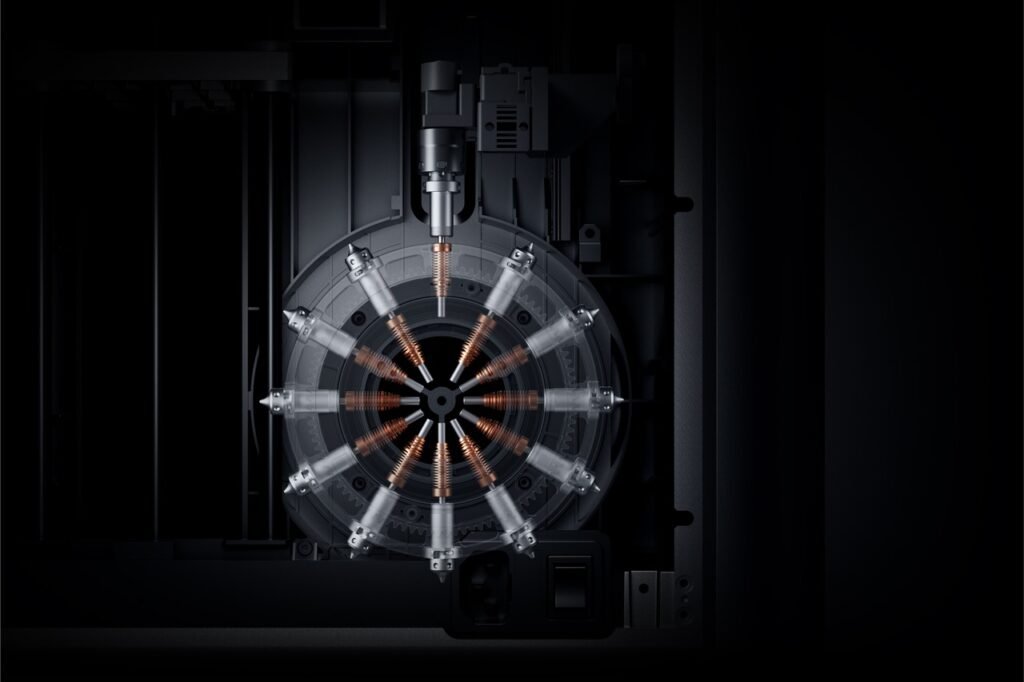
Making its debut, the Palette 300 doesn’t just optimize flushing; it removes the condition that makes extensive flushing necessary. Twelve dedicated nozzles, each locked to its own filament path. Color change: an approximately 40-second mechanical swap. No shared nozzle requires flushing during material transitions.
“It Wasn’t a Slicer Problem”
Waste became hard to ignore during beta deployments, according to AtomForm. “This wasn’t solvable by optimizing slicer settings. It was a structural bottleneck inherent to single-nozzle architecture.”
The OmniElement turret exists because software alone cannot fully eliminate shared-nozzle constraints. Waste optimization, however sophisticated, still operates within the limitations it’s trying to overcome. So, the Palette 300 engineers removed the reason for it.
Twelve Nozzles and Why It Matters
Here’s how AtomForm landed on that figure. Internal data showed 90% of real-world multi-color jobs use six colors or fewer. That’s the floor. Engineering constraints set the hard ceiling: twelve is the maximum the turret can accommodate without sacrificing the 300×300×300mm build volume. Between coverage, redundancy needs, and mechanical footprint, twelve satisfied all three.
While the OmniElement houses twelve nozzles, the system supports up to 36 colors by daisy-chaining six RFD-6 filament units. This enables massive palettes that are impossible to achieve on a single-nozzle setup without hours of manual intervention.
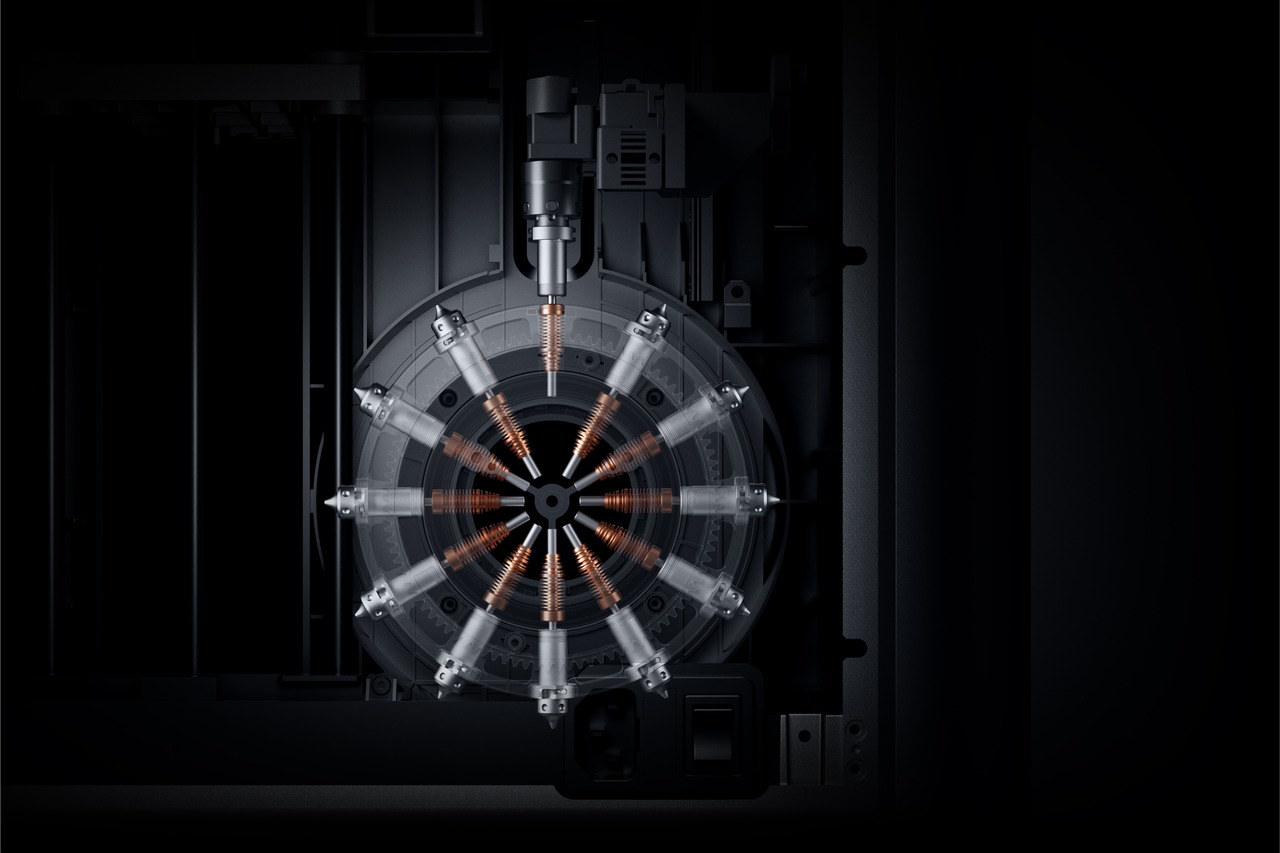
AtomForm palette 300.
What twelve nozzles provide beyond six is redundancy. A nozzle clog on a conventional machine at hour eight of a ten-hour print is a total loss. On the Palette 300, onboard cameras catch the failure, the system pulls a spare of matching diameter, and the build continues from the exact layer where the interruption occurred. No restart. No operator intervention. That recovery capability has long been an industrial feature, but never before on a desktop machine.
Beyond the Turret: Motion Control Is the Real Enabler
Forget the turret. Look at the motion system.
MOVA Group’s background is robotics: sensor fusion, closed-loop control, precision actuation at scale. That shows up in the Palette 300’s closed-loop step-servo motors: the actual position is checked against the commanded position, corrections applied in real time. This continuous synchronization maintains positional integrity under dynamic loads, mitigating the risk of mechanical drift during long-duration prints.
Add 50+ sensors, four AI cameras performing live extrusion monitoring, a 350°C hotend, and a 65°C active chamber. The Palette 300 targets engineering-grade materials, starting with common filaments, with validation for high-performance options underway.
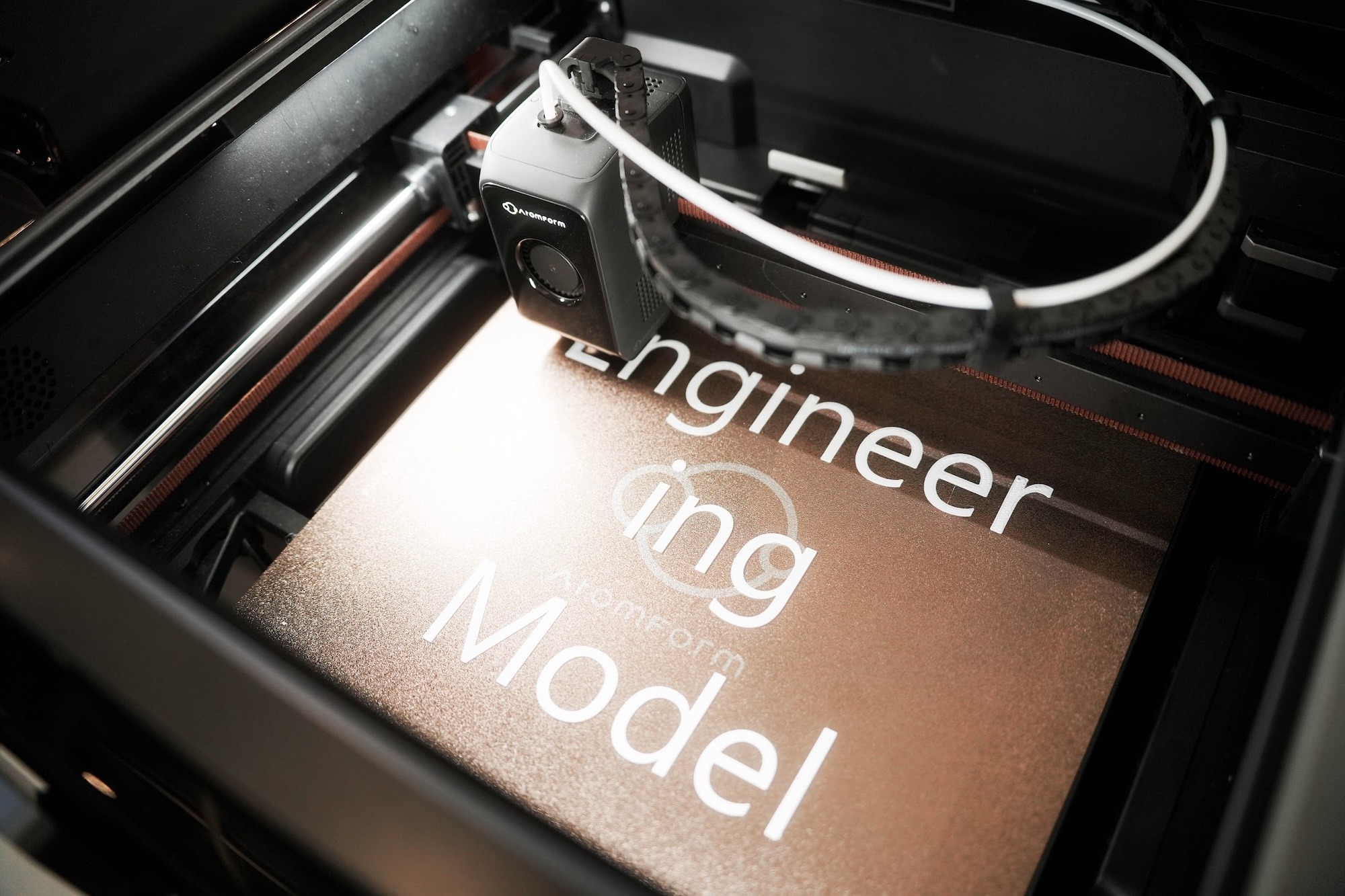
AtomForm palette 300. Image courtesy of Mova.
What the Waste Reduction Looks Like
In AtomForm’s six-color benchmark, a traditional single-nozzle setup consumed 422.15g of filament, with 292.89g purged as waste. Using the OmniElement turret and ReadyPrint feeding system, the Palette 300 eliminates the purge tower, achieving a claimed 90% reduction in transition waste. For a studio, that means recovering over 70 kg of filament annually — a saving that multiplies quickly with engineering-grade materials.
A New Brand Backed by Established Robotics Engineering
AtomForm is a young brand. That’s worth saying plainly.
MOVA Group is not young. The parent company’s manufacturing scale, engineering depth, and design recognition — MUSE Design Awards Gold, iF Design Award — back a subsidiary making significant hardware claims in its first major North American appearance. For any robotics spinout entering additive manufacturing, the gap between ambition and validation is normal. What closes it is production cycles, not press releases.
AtomForm chose RAPID + TCT over a consumer electronics venue, a deliberate decision to stand before an audience that will scrutinize every claim here. The machine is on the floor. The engineers are in the room. That’s the right test.
Two years ago, flushing 70% of your filament as waste on a multi-color job was just the cost of doing business. Today, that math is harder to defend. The Palette 300 largely removes the need for traditional purge-based flushing. Whether it holds up in daily production is the only remaining question.
Reservations will be open soon at atomform.tech.
Images courtesy of Mova