

Additive manufacturing (AM) funding has shifted in China and the United States over the past five years, but in different ways. In China, metal 3D printing companies accounted for a growing share of suppliers receiving equity financing, while fewer polymer-focused companies attracted investment. In the US, aerospace and defense companies continued to raise capital even as the number of funded companies in other sectors declined. An analysis of AMPulse data from 2021 through 2025 shows how these trends developed, which companies attracted investment, and the role different investors played in supporting their growth.
One example of how investment and industrial demand are coming together is X-Bow, a US company developing solid rocket motors using AM. In May 2025, X-Bow announced the final closing of a Series B totaling more than $105 million. Alongside the financing came an agreement with Lockheed Martin to accelerate X-Bow’s development as an independent supplier of solid rocket motors and related services. Lockheed Martin was not simply investing in the company. It was also a prospective customer looking for another source of production capacity.
The charts count each funded company once per displayed period, regardless of how many rounds it raised. They measure recorded recipients, not invested dollars or the entire market.
Metal gained share among funded Chinese suppliers
AMPulse records equity financing for 117 Chinese AM suppliers in 2021–2022 and 100 in 2024–2025. Metal-focused companies accounted for 49 of the earlier cohort and 53 of the later one, lifting their share from about 42% to 53%. Polymer-focused recipients fell from 46 to 16, or from about 39% to 16%.
Metal represented 48% of the 60 funded suppliers recorded in 2023. Other technologies and unclassified companies also gained share between the two-year periods, from 19% to 31%; they remain in the denominator throughout.
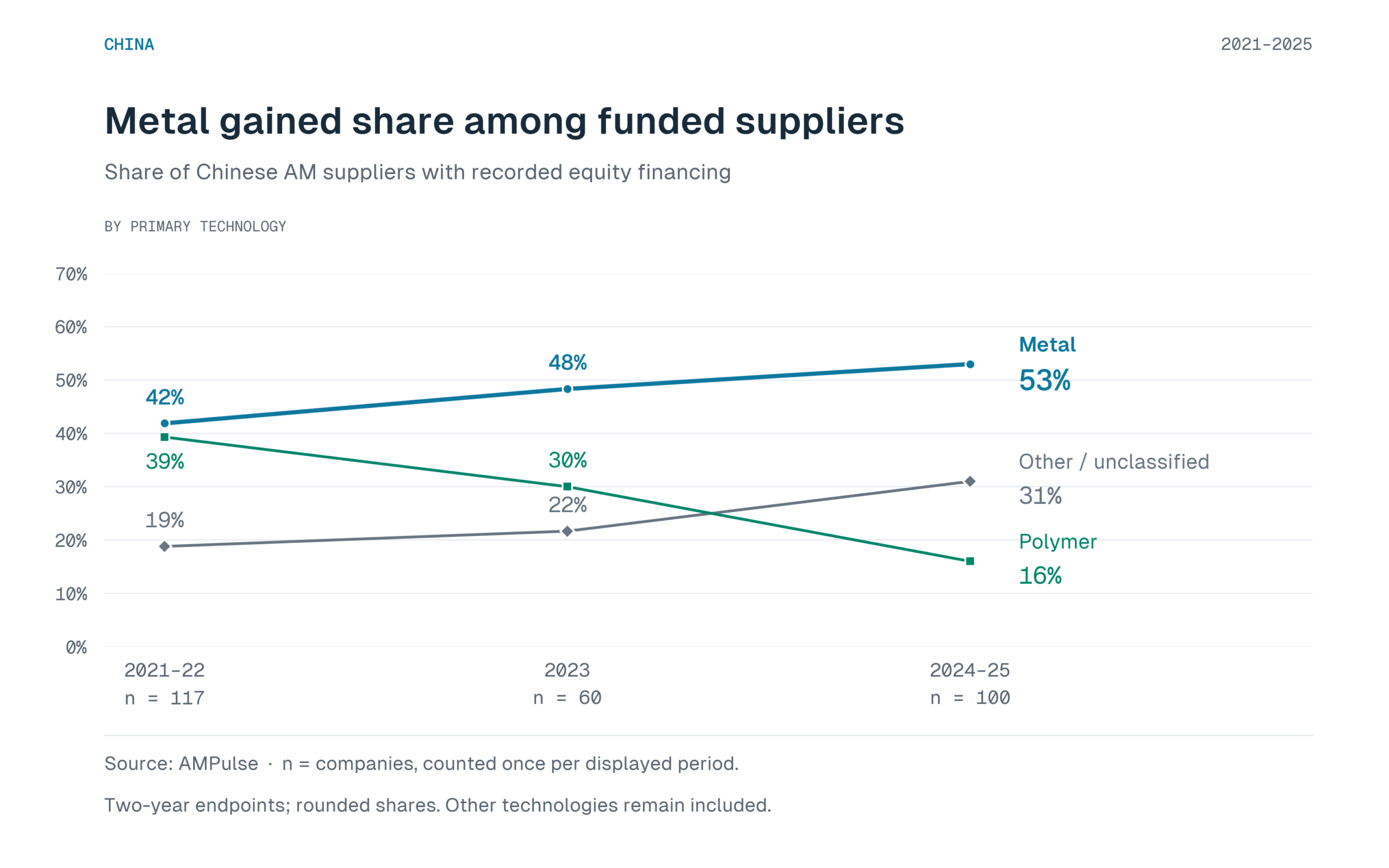
Chinese AM suppliers with recorded equity financing, counted once per displayed period and classified by primary technology. The endpoints pool two years; 2023 covers one year. Shares are rounded. Image courtesy of AMPulse, October 18, 2026 snapshot.
The total funded cohort contracted by approximately 15%, while the number of metal-focused recipients edged up from 49 to 53. Metal’s larger share therefore reflects both its own resilience and fewer recorded polymer recipients.
The trend was different in the US. The equivalent US supplier comparison was largely flat: metal accounted for roughly 28% of funded suppliers in both two-year periods. In other words, the shift toward metal among funded suppliers was specific to the Chinese companies in this dataset.
Institutional capital backed Chinese metal AM capacity
Several Chinese metal AM companies attracted investment from institutional and industrial funds during this period. HBD and Yuding Additive offer two examples of how that capital flowed into equipment development and manufacturing capacity.
HBD’s January 2022 financing was one such investment. The metal AM equipment company raised a $60 million Series A led by Qianhai FOF, with Grand Flight Investment and CITIC Securities Investment participating. HBD said the proceeds would support research, technical hiring and high-end manufacturing, alongside plans for a new research and production base in Shanghai.
Another example is Yuding Additive, a company with roots in aerospace research. Its issuer filing records a RMB 300 million ($44.8 million) capital increase in 2024 and a further RMB 846.55 million in December 2025. Investors in the 2024 financing included Xiong’an Fund, SDIC Unity Capital’s Chuanghe Xincai Fund, and CAS Star.
Beihang University and a research team established Yuding to develop large, high-performance metal components. The filing records 20 investors in the December 2025 capital increase, which was fully paid that month.
Institutional investors, specialist technology funds and state-linked industrial capital featured in both companies’ financings. These investments reflect the role of funds focused on advanced manufacturing and industrial technology.
China’s desktop brands also attracted corporate capital
Metal AM was not the only part of China’s 3D printing industry attracting investors. Consumer and desktop printer manufacturers also secured funding, including from some of the country’s largest technology companies.
Tencent VC participated in Creality’s 2021 Series A alongside Qianhai Equity, Shenzhen Capital Group and other investors. Creality’s exchange filing, on pages 110–114, records a total round of RMB 508.5 million ($76 million), including RMB 74.5 million ($11.2 million) from Tencent VC.
In November 2025, Jiemian reported DJI’s Series B investment in ELEGOO’s parent, Zhinengpai. The following month, Snapmaker announced a Series B co-led by Hillhouse Ventures and Meituan, with participation from Shunwei Capital, Meituan Longzhu and other investors.
These desktop brands retained access to technology-company capital even as fewer polymer-focused suppliers appeared in the funding record. The examples also show a difference in the types of investors involved. While industrial and specialist funds backed companies such as HBD and Yuding, desktop printer manufacturers also attracted investment from major Chinese technology businesses.
US Aerospace and Defense Funding Holds Steady
In the US, the most notable shift was not between metal and polymer technologies, but between the industries receiving investment. Aerospace and defense companies maintained a relatively steady presence in the funding market even as the overall number of funded AM businesses declined.
AMPulse recorded equity financing for 90 US AM-related companies in 2021 and 61 in 2025, a decline of about 32% in recipients.
The aerospace and defense cohort grew from 18 to 21 companies. Its annual count stayed between 18 and 21 throughout the five years. In other end markets, the number of funded companies fell from 72 to 40.
Aerospace and defense consequently accounted for approximately 34% of funded companies in 2025, up from 20% in 2021. The combined category retained a similar number of recipients as the rest of the recorded cohort shrank.
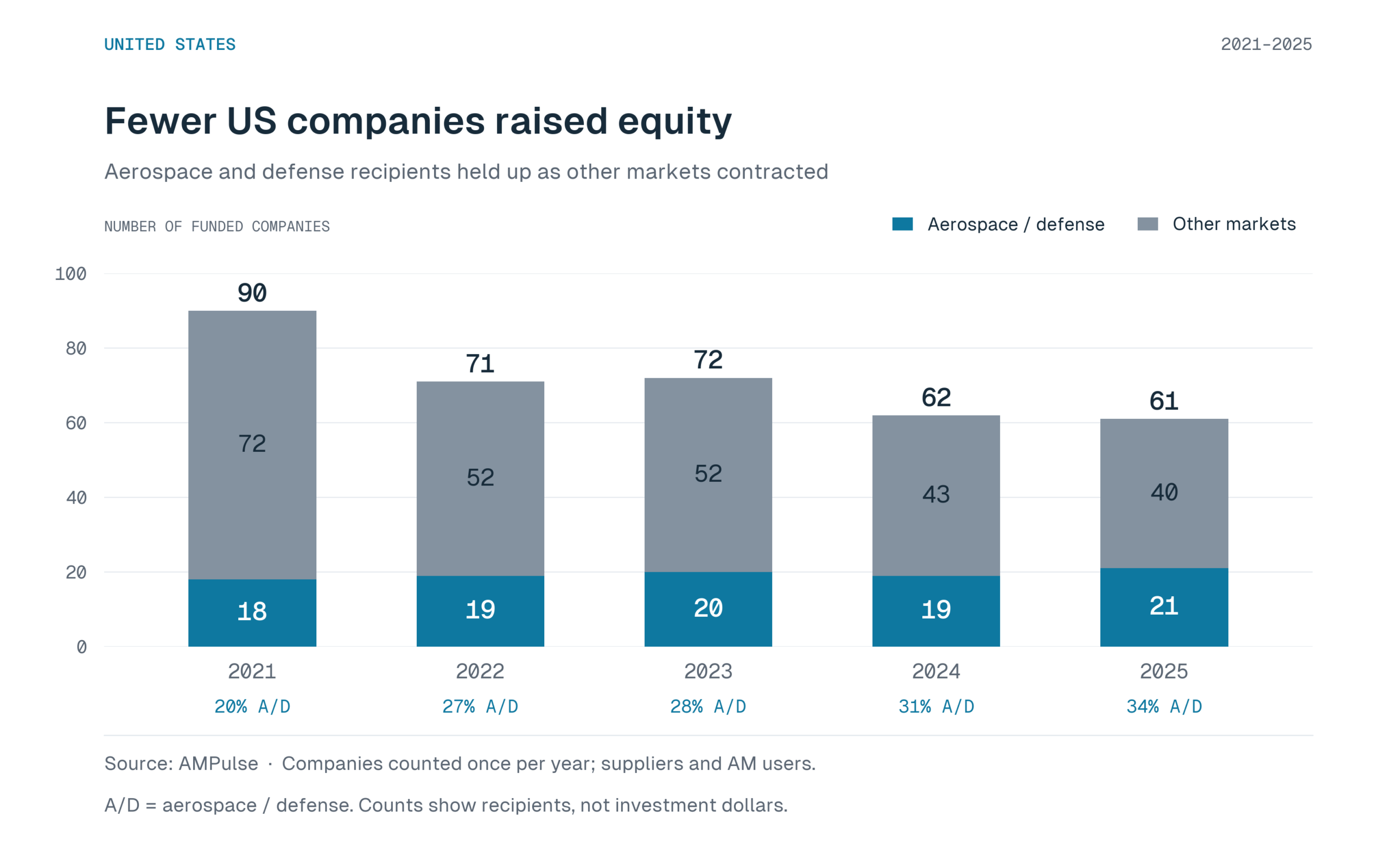
US companies with recorded equity financing, counted once per year by primary end market. The cohort includes AM suppliers and businesses using AM to make their own products. Aerospace and defense form one category. Image courtesy of AMPulse, October 18, 2026 snapshot.
The pattern remains a supplier-only comparison, with aerospace and defense rising from about 21% to 33% of funded companies.
Companies such as X-Bow and Firehawk illustrate the kinds of aerospace and defense businesses attracting capital during this period. Both are developing propulsion technologies and secured financing tied to potential industrial or commercial partnerships.
X-Bow’s business is solid rocket motors and additively manufactured propellant. Financing supports propulsion development, production, and customer qualification. Lockheed Martin’s supplier-development agreement connected its investment to that work. The government R&D awards covered in earlier reporting are outside this equity-financing dataset.
Firehawk’s 2025 financing brought another industrial connection. The company announced an oversubscribed $60 million Series C led by 1789 Capital, with Presto Tech Horizons participating as a strategic investor. Presto Tech Horizons was formed through a partnership between venture firm Presto Ventures and industrial group CSG. The announcement tied the investment to developing European access to propulsion and energetics production, and said the parties were exploring industrial applications of Firehawk’s technology.
In both cases, investors brought potential routes to customers or industrial partners alongside capital. The next question is whether those relationships lead to qualified products and repeat orders.
Industrial investors backed more than defense
Aerospace and defense were not the only areas attracting industrial investors. Companies developing metal and polymer 3D printing technologies for broader manufacturing applications also secured financing.
In October 2023, Seurat raised a $99 million Series C led by NVentures, NVIDIA’s venture capital arm, and Capricorn’s Technology Impact Fund. Other investors included Honda, while existing backers included General Motors Ventures, Porsche Automobil Holding SE, and Denso. Seurat said the proceeds would help deploy machines and expand factory capacity, with printing factories planned at or near customers.
In May 2024, Inkbit announced a $19 million financing led by Ingersoll Rand, with participants including Ocado, Stratasys and Zeon Ventures. Ingersoll Rand described an interest in commercializing Inkbit’s technology for industrial and life-science applications. Inkbit’s Vision-Controlled Jetting platform produces complex, multi-material polymer parts.
Although the companies use different technologies, both investments were tied to plans to expand industrial applications. Both attracted funding during a period when fewer US companies appeared in the equity-financing record.
Funding activity and industry revenue tell different stories
While the financing data shows which types of companies attracted investment, it does not necessarily reflect where the AM industry generates most of its revenue.
Service businesses clearly show the limits of a funding-led view. In AMPulse’s 2025 AM Capital Map, which includes non-equity capital events, 47 of 2,062 tracked service companies had a recorded event (2.3%). The corresponding rate for hardware companies was 12.7%.
Those rates describe AMPulse’s tracked-company cohort. The service-company base is less fully curated, so the 2.3% figure should not be read as an industry-wide financing rate.
Services account for a much larger share of industry revenue. According to AM Research, AM services generated $8.53 billion in revenue in 2025, accounting for approximately 53% of the $16 billion global AM market. Funding records and revenue measure different aspects of the industry, but the contrast shows why financing activity alone is a poor guide to its commercial structure.
These figures show why investment activity needs to be considered alongside other measures of industry performance. A sector can account for a substantial share of revenue without having a similarly large presence in equity-financing records.
The 2021–2025 financing record points to a larger role for metal among funded Chinese suppliers and resilience in US aerospace and defense. The company examples put specific projects behind those patterns: HBD and Yuding’s metal equipment businesses, X-Bow and Firehawk’s propulsion businesses, and Seurat and Inkbit’s production processes.
For AM companies looking for customers or partners, those projects merit attention beyond the funding announcement. Ultimately, the more important question is what happens after the investment. Factory openings, qualification milestones and repeat orders will show whether the financed capacity is finding demand.
About the data
The charts use an October 18, 2026 snapshot of AMPulse’s records for January 1, 2021 through December 31, 2025. Each company is counted once per displayed period, after identified aliases are consolidated. Companies can appear in more than one period. X-Bow received additional capital at its 2025 final closing after an initial close in 2024. It appears in both annual recipient counts, but only once in a pooled 2024–2025 comparison. No 2026 investment events are included.
The China series covers AM suppliers by primary technology. The US series includes suppliers and businesses using AM to make their own products. The analysis uses the country, technology, and main market listed in each company’s profile at the snapshot date. These labels do not reconstruct changes in location or product mix over time, or identify how each round’s proceeds were spent. Snapmaker is classified as multi-material and appears in “Other” in the China chart.
The equity series includes identified strategic equity investments and primary private placements. Identified debt, grants, contracts, reward crowdfunding, acquisitions, secondary share transfers and IPOs are excluded; unclear financing types and unclosed commitments are held out.
Source completeness and discovery vary by country and year. The named company examples were checked against filings, company announcements, or original reporting; we have not individually verified all underlying legacy records against sources. The counts are not a market census or a measure of total invested dollars. The separate global capital-map comparison uses its published 2025 cohort and a broader set of instruments.
Featured rendering courtesy of AMPulse