
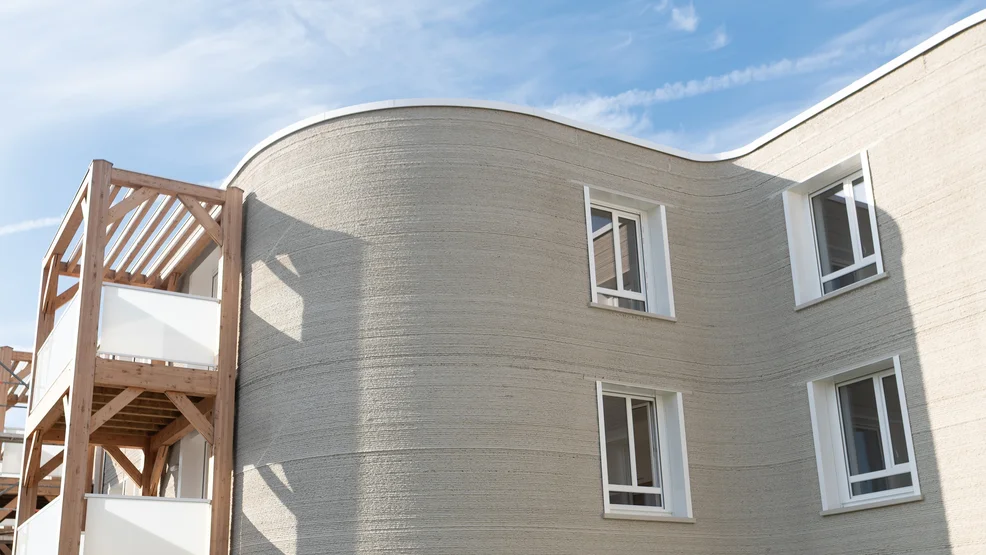
Holcim has announced that a 12-unit residential structure, ViliaSprint² in Bezannes, France, was finished in a year. Nice to see that people seem to be properly building structures rather than doing fly-by-night 24-hour demos. The structure was built by Plurial Novilia (a subsidiary of Action Logement) using TectorPrint, a binder for mortar that comes in two versions. One is ready to print while the other is mixed twice and can be used as micro mortar or concrete with strengths ranging from 15 to 90 MPa. This material was previously used by Holcim, GE Energy and Cobod for wind turbine towers. Previously, on the 3D Villaprint Project in 2018, the ink material was supplied by VICAT.
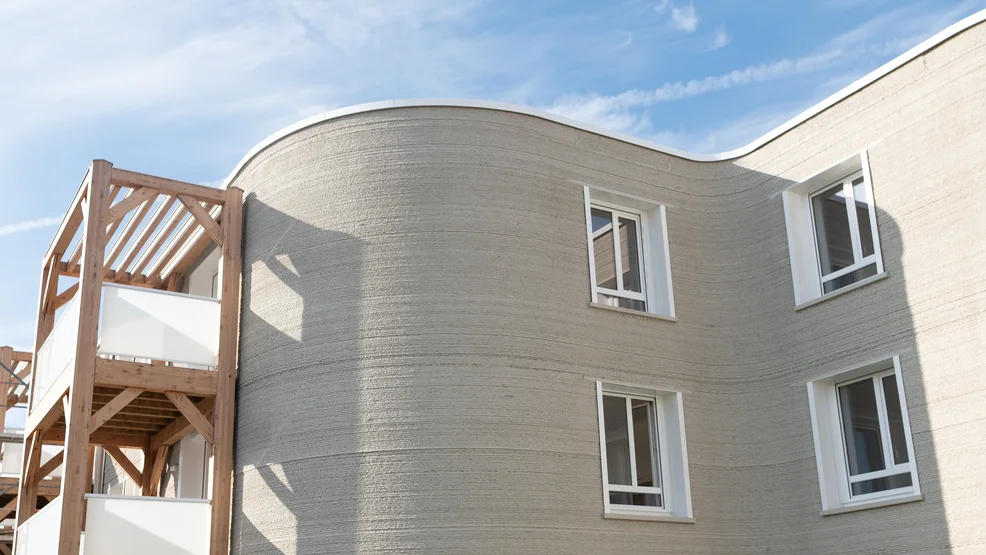
ViliaSprint² in Bezannes.
Other partners in this project, which will also include a follow-up phase in ViliaSprint², are PERI 3D Construction, the rather puzzlingly, and one hopes not ironically, named HOBO Architecture, and COBOD for the 3D printers. The COBOD units printed the three-story, 800 m2 structure on site. Multi-story buildings are very difficult to do with 3D printing, and the regulatory process for this can not have been much fun. So this is a great step forward toward making more dense, efficient structures using additive manufacturing. What’s really cool is that two identical buildings were built side by side, one using 3D printing, the other using traditional construction. I love this because we can now really compare the two structures, their costs, and how they are used over time. I hope we get much more data from this project, as it could be a great way to conduct research and learn more. The structure used about 10% less concrete, and the walls were completed in half the time. The team estimates that there was a CO2 reduction of around 30% as well. The company also used far less labor and less backbreaking work overall.
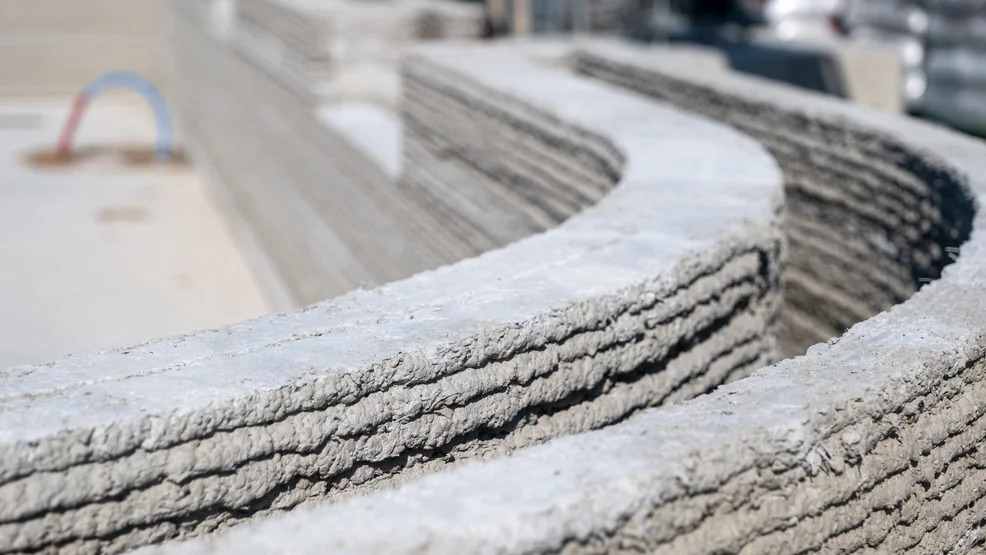
Holcim 3D printed the residential structure in Bezannes.
Johnny Huat, Managing Director of Plurial Novilia, said,
“ViliaSprint² marks a major milestone in the exploration of new construction methods. The project has made it possible to concretely assess the contributions of 3D printing to produce housing more quickly and sustainably.”
Hélène Lombois-Burger, Head of Concrete and Aggregates R&D at the Holcim Innovation Center, stated,
“3D printing in construction is about more than just using a robot. It’s a holistic ecosystem where the material takes on the role of structural autonomy. By combining the precision of TectorPrint with our mix design expertise, we are proving that high-performance housing can be both low-carbon and fast to build. We are effectively moving from construction to advanced manufacturing on the job site.”
There is more to be done, however, since
“By the end of the build, our 3D printing productivity increased by 35% compared to the start of the build. We’re already carrying that momentum into our next goal: an upcoming 40-unit residential development. We want to move from experimentation to a fully competitive scale, reducing costs still further and proving that we aren’t just printing walls, but a more sustainable, resilient way of living.”
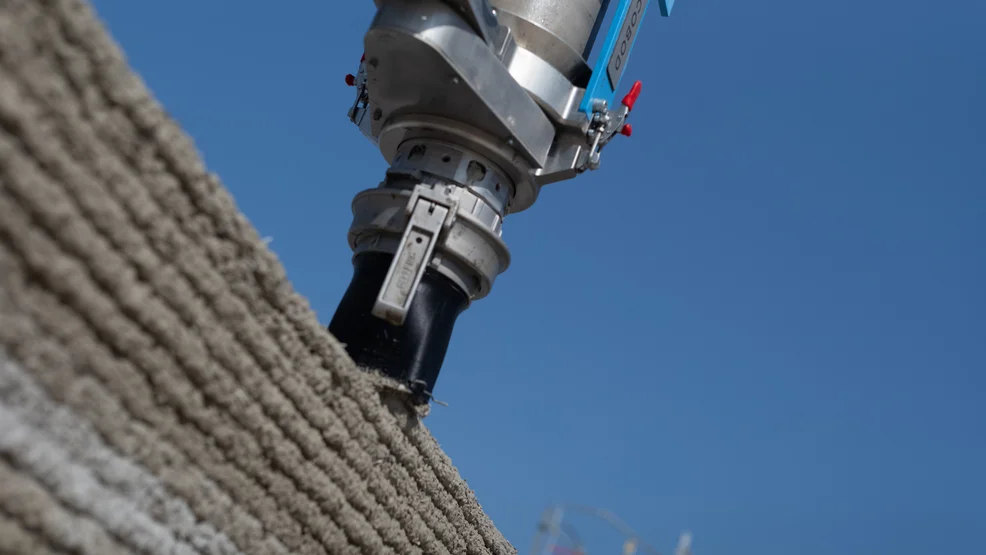
Holcim 3D printed the ViliaSprint² residential structure in Bezannes.
This is real progress in 3D printed construction. Real regulatory work, real risk assessments, and real buildings. This is not some dictatorial dreamscape or a monument to government waste somewhere; this is work into seeing if this is a real solution. Action Logement is a uniquely French behemoth that manages over 1.1 million homes in France. It assists people in getting homes when there is an immediate need, in helping them access homes that can be financed, or in building inexpensive rental homes. It has real market power, and with housing affordability being such a big problem for many, they could see their efforts intensified. So a 40-unit building is a great step, but perhaps a step towards many more buildings in France and beyond.
Now I’m on board with the speed, lower labor, and reduced costs, and think that this could be very important. But using 10% less concrete in a building is like using 10% less heroin. Sure, it’s good for you. Better than staying at 100% heroin use, for sure. But 10% less heroin will kill you in the end as well. So if we are to do the heavy lifting to deploy this technology more widely, surely we can do a lot better than regular old concrete?
Images courtesy of Plurial Novella