

Experienced 3D printing executive Neil Glazebrook has started GBI Group. Neil began in machining operations before moving to CAD/CAM sales, Product Management at Cimquest, and launching AB Corp’s 3D printing business. Neil now wants to grow a focused, customer-centric service that helps firms implement AM. Offering CNC as well as polymer and metal additive, Neil wants to make the path from idea to product simpler and less risky. Rather than waiting for customers to pitch him perfect files, he wants to help them iterate and get it right.
Based in Massachusetts, GBI wants to “evaluate the application first and the manufacturing process second” because Neil believes that “Customers don’t need another company selling machine time. They need a manufacturing partner who understands where, when, and how to use these technologies effectively. Buying equipment is the easy part. Knowing where the technology creates value, building a repeatable process around it, and moving an application into production is where experience matters.”
For now, Hurco CNC and Xact Metal will be their in-house offering. In LPBF, they will offer Corrax, 400 series steels, M300, 17-4, 316L, and cobalt chrome. He also wants to offer material extrusion in TPU, ABS, PETG, PLA, and CF parts.
The company also wants to combine parts from different processes while looking at DfAM, mass reduction, cost reduction, and scaling. The firm thinks headwinds will come from supply chain uncertainty and growth in US-based manufacturing. GBI is ITAR-registered and will implement AS9100 and ISO 9001.
Neil believes that “The conversation needs to move beyond whether we can print something. The more important question is whether we should—and whether it creates a measurable advantage for the customer. We’re taking lessons learned over decades in manufacturing and using them to build the kind of company we believe customers increasingly need—responsive, technically capable, secure and accountable”
GBI hopes to service the defense, medical, industrial, and aerospace markets. Many companies hope customers will send them an unending stream of perfect files, forever. But most manufacturing companies don´t master DfAM yet. Most firms use Additive sparingly right now. And generally, developing good business cases and applications in 3D printing is hard. By focusing on helping companies print what matters, GBI positions itself as a partner rather than a straight-up 3D printing focus. I also like the further focus on determining the best process rather than just pushing out parts in whatever process you happen to have available.
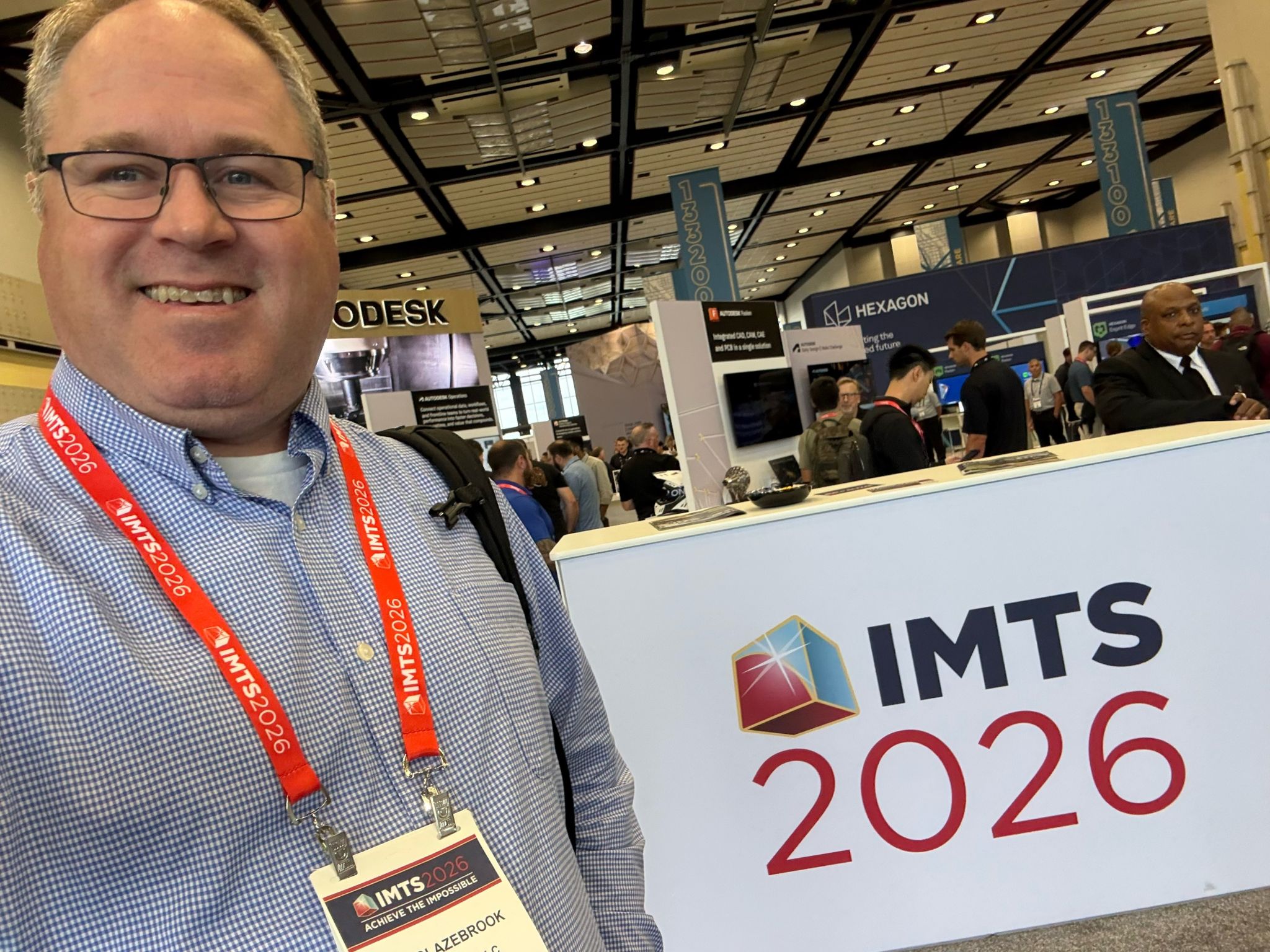
Neil Glazebrook at IMTS 2026. Image courtesy of Neil Glazebrook via LinkedIn.
That seems like a sensible approach that could really help customers expedite their additive manufacturing journey. I’ve long advocated for more expansive services. The main issue retarding growth in additive manufacturing is institutional resistance and risk. People tend to stick with what they know and understand. And risking your career or a key project on some newfangled thing you don’t understand seems foolish to many. So, helping people choose where and when Additive will win matters. And de-risking your partner by helping them implement additive from design to finished part increases their chances of success. What’s more, it minimizes the risk to their livelihoods while accelerating implementation. To me, this is the right approach right now to help your customers grow into additive sustainably.