
Shipbuilding giant Austal USA recently announced the launch of the Digital SEA (Secure Exchange for Additive) platform, which should play a major role in expanding accessibility to the sorts of capabilities that Austal USA and the US Navy are developing at the Additive Manufacturing Center of Excellence (AM CoE) in Danville, Virginia. Chief among those capabilities is the Wire AM process from AML3D, which, like Austal USA (albeit on a much smaller scale) is an Australian company benefitting from its outsized role in the US defense sector.
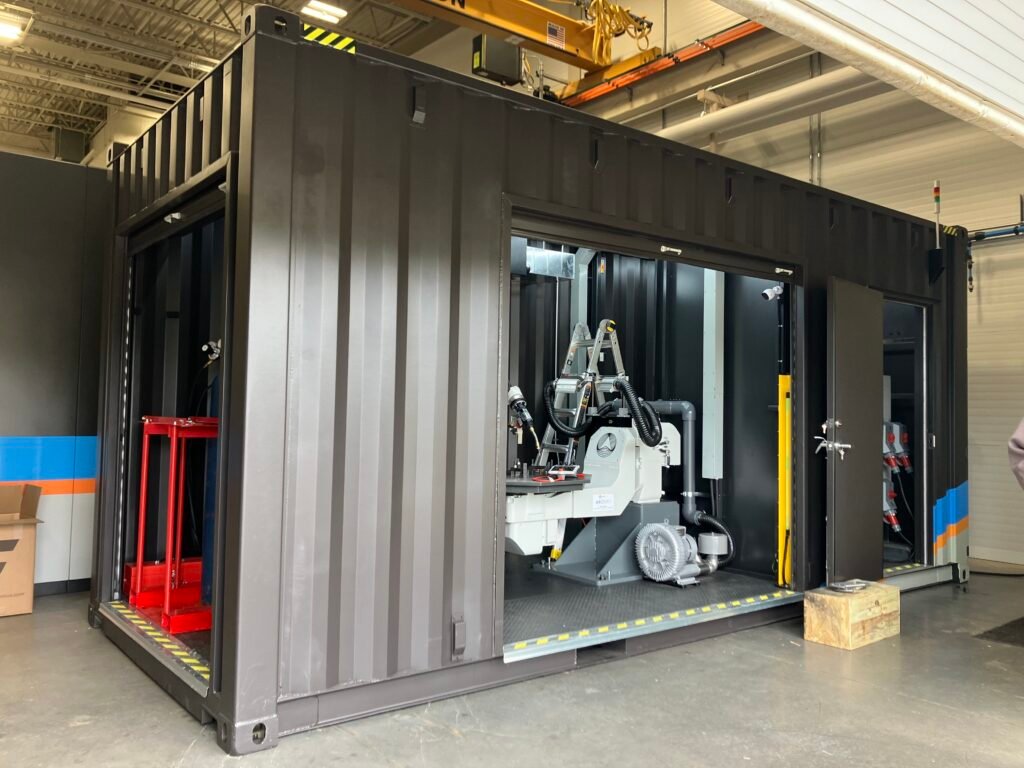
The Virginia CoE, meanwhile, just expanded its own capabilities with the installation of AML3D’s first portable ARCEMY system, a AU$1.2 million (~$864,000) machine mounted in a 20-foot shipping container. This is now the third AML3D system in service at the AM CoE, with two custom, large-format AML3D systems already installed at the Virginia site.
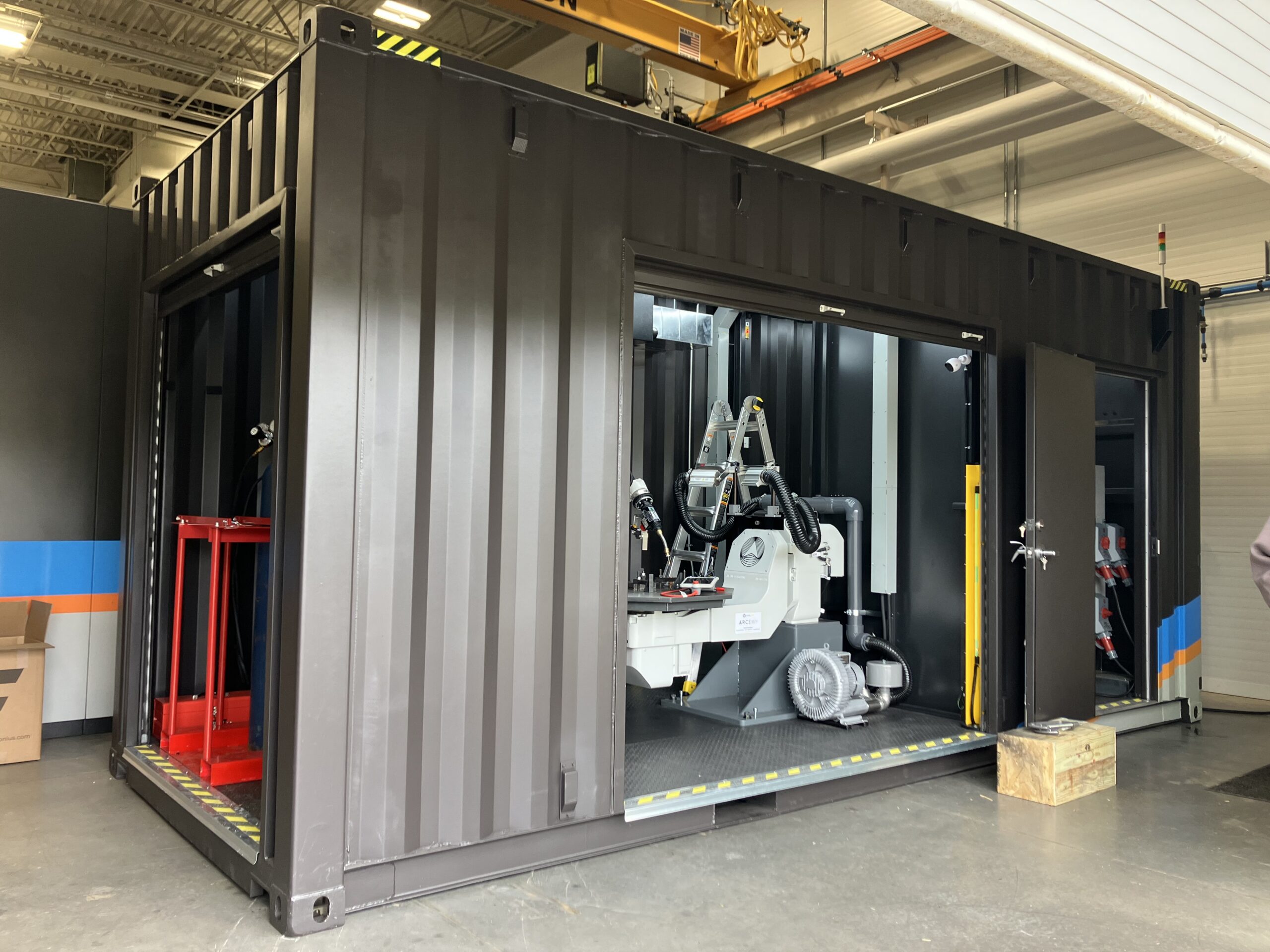
Image courtesy of Austal USA
The advantage of portability means that as the AM CoE continues to expand, Austal USA and the US Navy will have a much easier time reorganizing their production space as the need arises. According to AML3D, the containerized system takes as little as 1-2 days to reinstall, compared to 2-3 weeks for its fixed counterparts.
Additionally, access to a containerized model will give the US Navy and its partners the opportunity to test the possibility for using AML3D’s technology under expeditionary manufacturing conditions. As the US military demonstrated most recently at the Balikatan joint exercises in the Philippines, manufacturing at the edge is an increasingly vital component of the Pentagon’s long-term advanced manufacturing objectives.

In a press release about the installation of the first portable AML3D ARCEMY system at the US Navy AM CoE in Danville, VA, Sean Ebert, the CEO of AML3D, said, “It is exciting to continue to build our relationship with Austal USA. The success of this first portable, containerized system demonstrates how AML3D can flex its technology to meet multiple US military and industrial use cases. …[W]e are still only beginning to access the huge opportunity…outlined in the Letter of Intent we received from the US Navy that indicated a need for up to 100 [AM] systems and 3,400 additively manufactured parts by 2030.”
While Digital SEA and the containerized ARCEMY system are each notable in their own right, there’s also an undeniable synergy between the two releases in terms of how they meet the same fundamental demand: lowering the adoption barrier for large-format metal AM. This has implications far beyond the maritime defense market, although the US Navy will of course be the most immediate beneficiary of the software/hardware combo.
In fact, if Austal USA and the Navy can indeed bear out the viability of using containerized wire-arc AM (WAAM) under forward operating conditions, there will be no shortage of work for the Navy, itself, in areas outside of maritime. Aside from defense, AML3D also has a growing footprint in the utilities market. In a world where the US military is permitted to reassume some semblance of willingness to cooperate with its allies, I can envision scenarios in which the US Navy and its allies collaborate on a sort of ’emergency grid repair fleet’ to underwrite Western energy security.
And, even aside from using containerized welding robots in contexts of forward deployment, the agility implied — especially insofar as those portable systems are backed by distributed manufacturing software platforms — makes the tech a far more compelling sell to new users. This isn’t just about the ability to train new users more quickly, but the sheer ability for less cumbersome resale in the secondary market.
I’ve long been a fan of WAM, but portability was obviously never one of the reasons why. If that’s a promise that Austal USA et al. can truly validate, then AML3D will have transformed into an even more intriguing prospect than was already the case.
Images courtesy of AML3D unless otherwise noted