
From making millions of value-engineered Prusa clones, Creality really has aggressively pivoted to more complex machines. The company has made strides forward in software, and the Ender’s of yore is shipping versions of its speedier K1, K2, and K3 systems.
Now the company is launching scanners too. Creality seems intent on offering the full gamut of creation and file-sharing tools. But can the erstwhile hardware focus keep up in a world that is becoming increasingly software-defined?
Its new scanner, the Sermoon P1S, combines structured light and a blue laser scanner. The handheld device is meant for reverse engineering, industrial applications, and fieldwork.
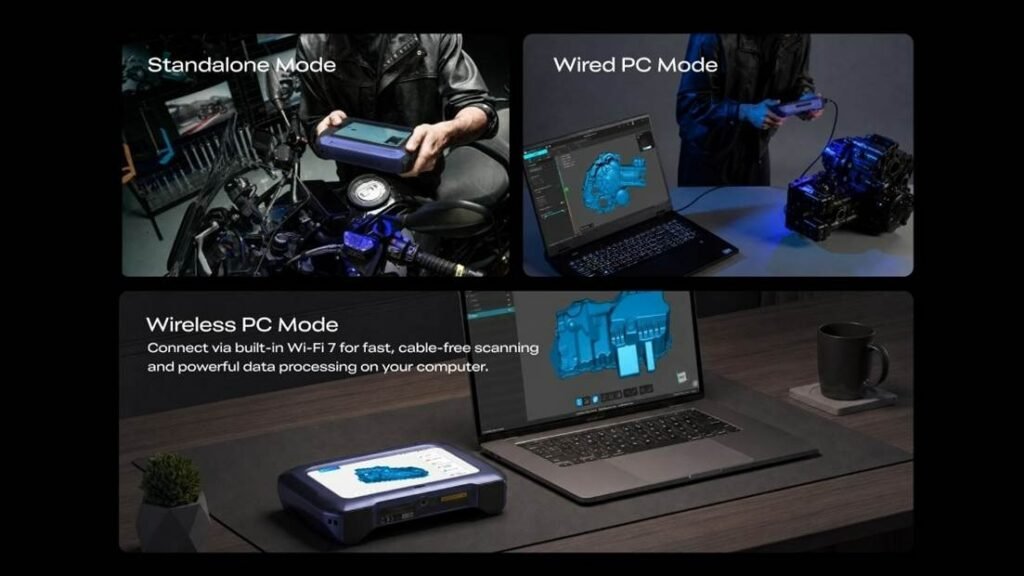
With a claimed 0.02 mm accuracy and 0.02 mm + 0.08 mm/m volumetric accuracy, the scanner can work without a PC, doing all processing on board. That could be very handy indeed in an automotive shop or if you have to travel a lot with the device. There’s a 6-inch touchscreen that lets you see what you’ve scanned and what you’re capturing. You can process and review the processing on the device itself. This should also save time and let an operator work more quickly.
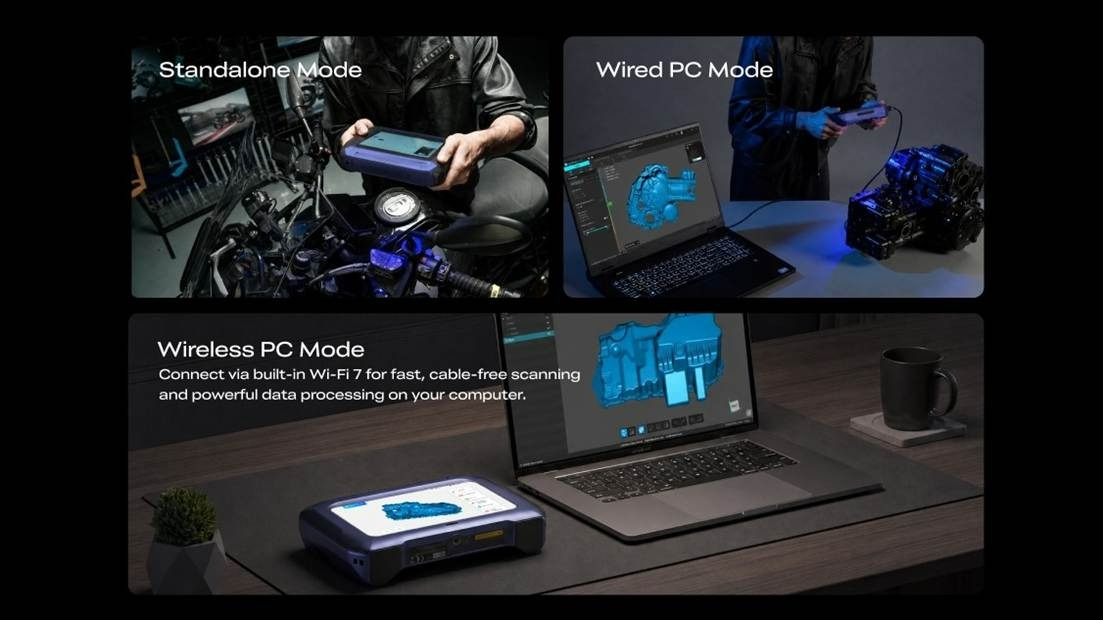
They think that it will be especially useful for large objects or scanning on location. Depending on your needs, you could opt for 34 cross laser lines, 7 parallel lines, a blue laser line, or NIR structured light. You could use the cross lines for a quick measurement or initial scan to determine size, or to scan an entire car hood. Meanwhile, the parallel lines could provide more detail, while the blue laser could reach parts and occlusions that others could not. For more organic areas, the structured light could also help. Creality also says, “Creality’s MASK technology is designed to capture surface contours and fine details on small- to medium-sized objects with greater fidelity, preserving subtle features of the original object.”
If all these different approaches work, this could be a very versatile device for industrial use. Usually there’s no perfect scanner for everything, so this probably won’t be either. But it may be versatile enough to work well most of the time. It seems to be made primarily for reverse engineering.
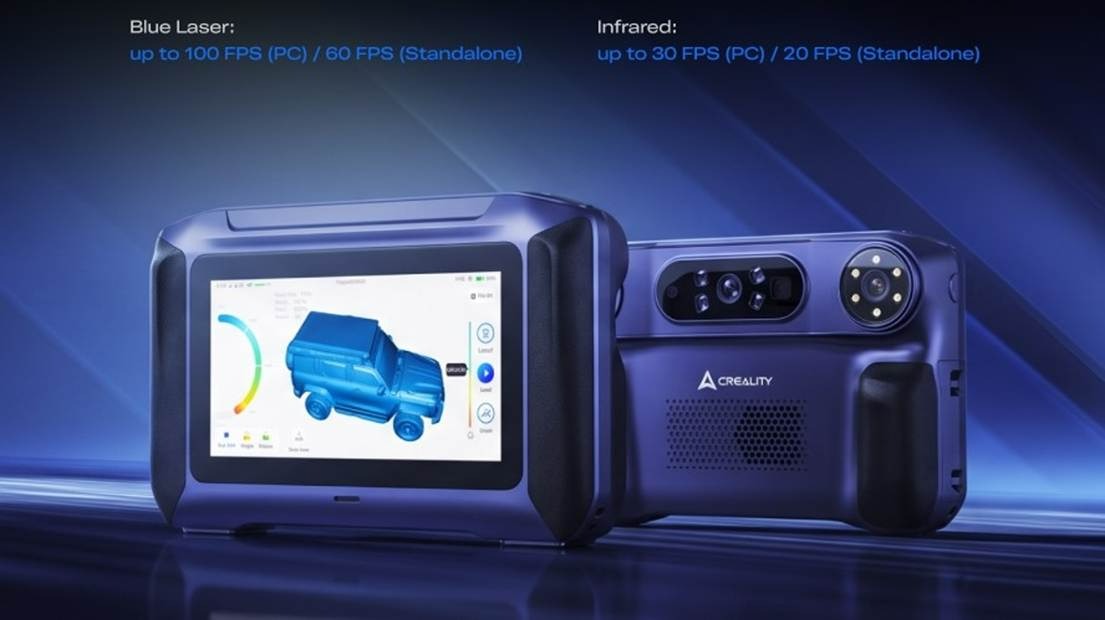
Blue-laser scanning can be as fast as 60 fps in handheld use alone, or 100 fps when continually connected to a PC. The scanner weighs 807 grams. This is the same weight as the paperback version of the textbook Object Recognition by Computer by W. Eric L. Grimson. So it’s not going to be fun after a while. A Shining Einstar weighs 500 grams and is about the same as a Revopoint Miraco Plus and 300 grams heavier than the Sermoon S1.
Onboard processing is handled by a 3.36 GHz 8-core Qualcomm CPU, Adreno 740 GPU, and FPGA, with 16 gigs of memory and 256 gigs of storage. You can run it over Wi-Fi 7 or wired. Batteries are replaceable, which is a nice touch. You can scan with the blue laser at 110,000 lux and structured light at 80,000 lux. If that’s correct, it could mean scanning on a sunny day or in the afternoon. The company says that they’ve tried to improve performance on dark surfaces and metallic, shiny surfaces, another bugbear. They also have a software tool, CrealityScan, that can do some processing. There’s also an AI assistant to help you resurface parts. The price is $2,299.
Scanning for a long time was terrible, really. Except if you had Geomagic and an Artek Eva, it was a horrible experience. Shining has done a lot to make scanning more accessible. Now, with Revopoint, Creality, 3DMakerpro, and others, the competition is really heating up.
Rather than something for everyone, this thing seems ideal for a body shop. So if you’re making a kit car, modding a car, or making 3D printed accessories, this may make a lot of sense to you. The features seem well thought through, and it seems like a sensible device overall.