
For years, thermoplastics have been the workhorse of additive manufacturing (AM). They are pretty easy to process, available, and compatible with many of today’s industrial 3D printers. From prototypes to production tooling, thermoplastics have helped push 3D printing into factories across aerospace, automotive, defense, and consumer products. But as the industry takes on larger and more demanding applications, manufacturers are beginning to run into the limits of what thermoplastics can do.
Some applications demand more from materials. Parts used in aircraft, defense systems, and other harsh environments often need to withstand high temperatures and heavy use over long periods. That is leading researchers and manufacturers to take a closer look at thermosets, a type of material that has been used a lot in traditional manufacturing for decades.
Unlike thermoplastics, thermosets are designed to hold their shape once they are cured and cannot be melted down and reshaped. That makes them useful for applications where parts need to withstand heat and maintain their performance over time.
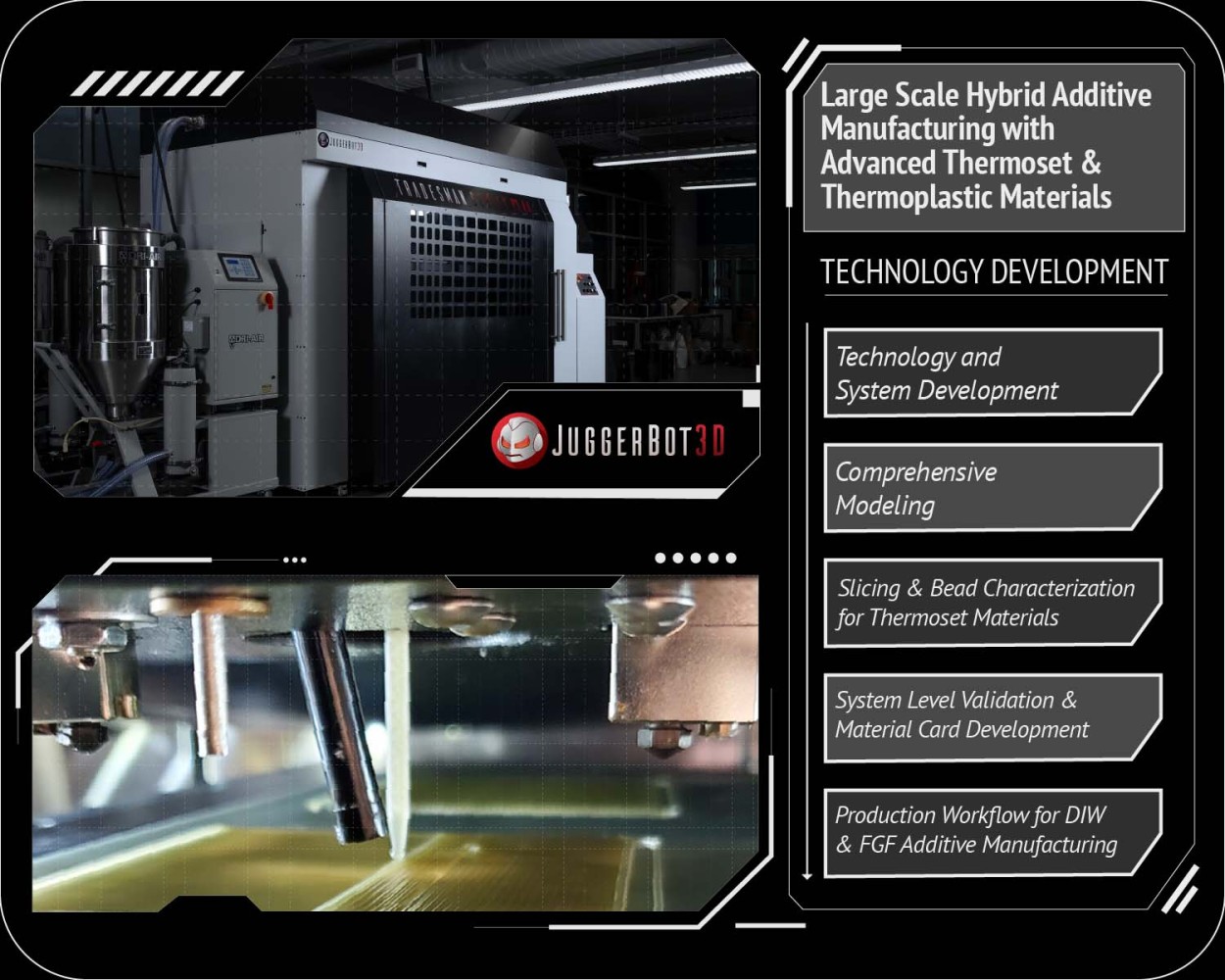
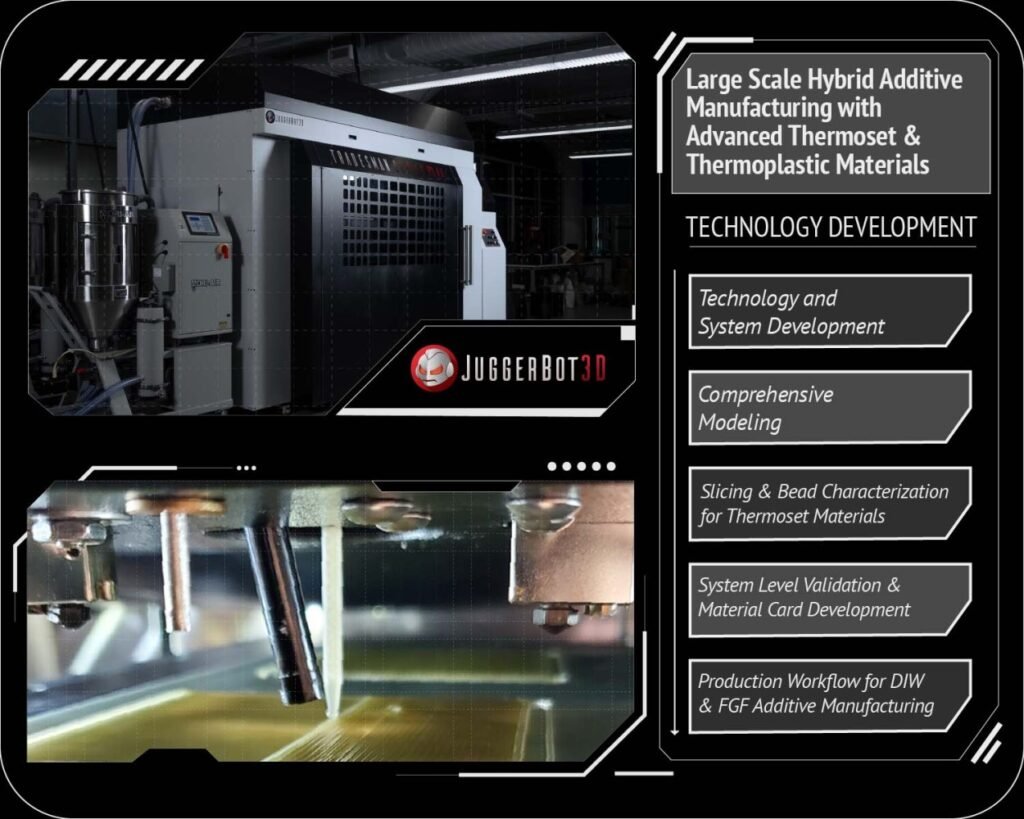
Project ACME (Advanced Composite Material Extrusion) Technology Development Graphic. Image courtesy of JuggerBot 3D.
The challenge is that thermosets have traditionally been difficult to integrate into large-scale AM systems. But that is where Ohio-based JuggerBot 3D saw an opportunity. The Youngstown company built its reputation around large-format pellet extrusion systems designed for industrial applications. And through a multi-year research effort, it set out to combine thermoplastic and thermoset processing within a single platform.
That work resulted in a large-format machine called the H6-106 hybrid system, developed through an America Makes project funded by the Office of the Under Secretary of Defense for Research and Engineering and managed through the Air Force Research Laboratory (AFRL). The project grew out of a $4 million AFRL award that JuggerBot received in 2024 to advance this technology.
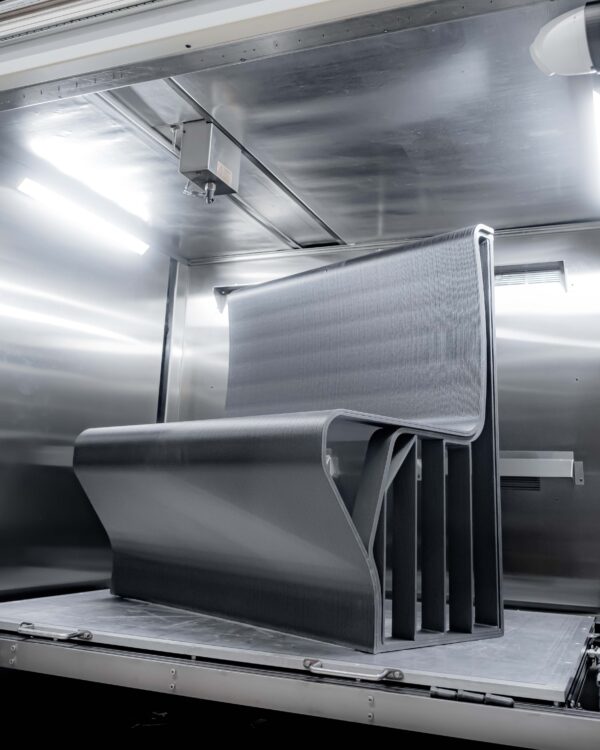
Large-format rail-grade polycarbonate inside the JuggerBot 3D printer build chamber. Image courtesy of JuggerBot 3D.
According to JuggerBot, the project addresses a growing need in aerospace and defense for materials that offer greater durability and thermal performance than many conventional additive manufacturing materials.
Built on the company’s Tradesman platform, the H6-106 combines pellet-fed extrusion technology with a two-component resin delivery system. The machine can process both thermoplastics and thermosets and includes a fully enclosed, heated chamber designed to create stable conditions during printing.
For JuggerBot, the larger goal is to expand the range of materials available for large-format AM. If manufacturers can successfully print with both thermoplastics and thermosets, they could have more options for tooling and other applications that demand higher performance.
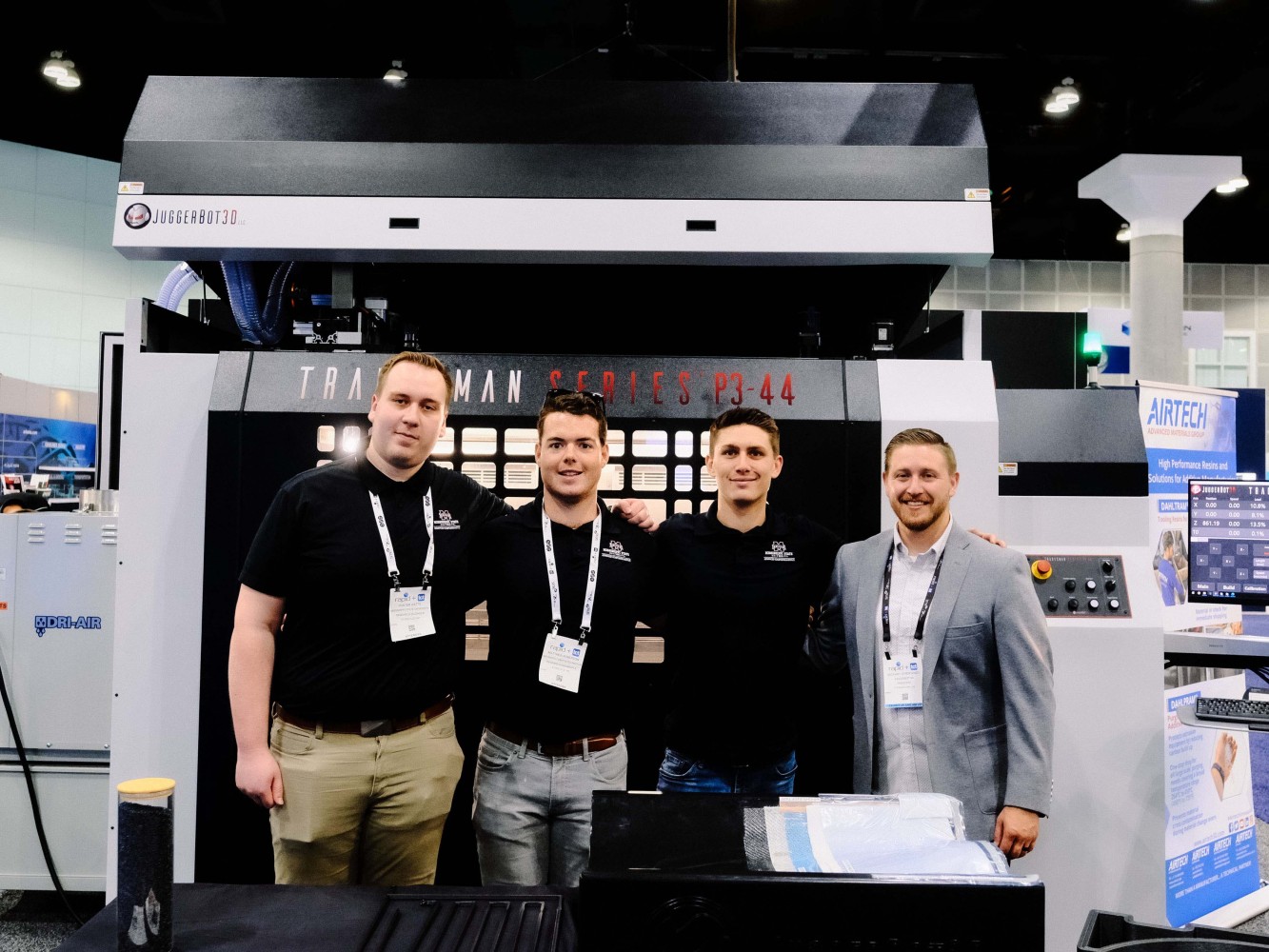
Mississippi State University Advanced Composite Institute Team with JuggerBot 3D at RAPID + TCT 2024. Image courtesy of JuggerBot 3D.
But developing new materials is only part of the challenge. Manufacturers also need to know that those materials can be used well in real production environments, not just in research labs. That is one of the main goals behind the project. JuggerBot plans to use the hybrid platform to produce aerospace tooling and demonstrate that the technology can meet industry requirements while delivering constant results.
JuggerBot has been working on large-format AM for years. The company has collaborated with researchers at Oak Ridge National Laboratory (ORNL) on projects involving pellet-fed printing, process automation, and software tools designed to make industrial adoption easier.
We are seeing manufacturers seeking to make larger, more demanding parts, and material options are becoming just as important as printer size or speed. If systems like the H6-106 can expand the range of materials available for AM, they could help open the door to new applications in industries where performance is critical.