
Asia’s additive manufacturing sector spent the back half of May moving capital and capacity, not just demos. Chinese desktop and consumer printer makers pushed onto public markets, metal powder producers broke ground on new lines, and Korean defense and medical programs advanced toward serial production. Here is what happened across the region from May 18 to May 31, 2026.
Key Takeaways
- Coverage window: May 18 – May 31, 2026. About two dozen distinct AM-relevant announcements across seven Asia-Pacific markets (China, Hong Kong, Korea, Japan, India, Taiwan, and Singapore).
- Largest disclosures: Creality (HKEX: 3388) listed in Hong Kong and raised about HK$1.27 billion in a 3,829-times oversubscribed IPO; HeyGears closed a $44 million Series C; Shenzhen Gongda Laser closed a Series C of several hundred million yuan for green-laser metal AM; Agnikul Cosmos fired a cluster of four 3D printed semi-cryogenic engines.
- Regional themes: Chinese capital markets and metal AM capacity, Korean defense and medical AM moving toward serial production, and footwear emerging as a recurring Chinese AM application.
Funding and Investment
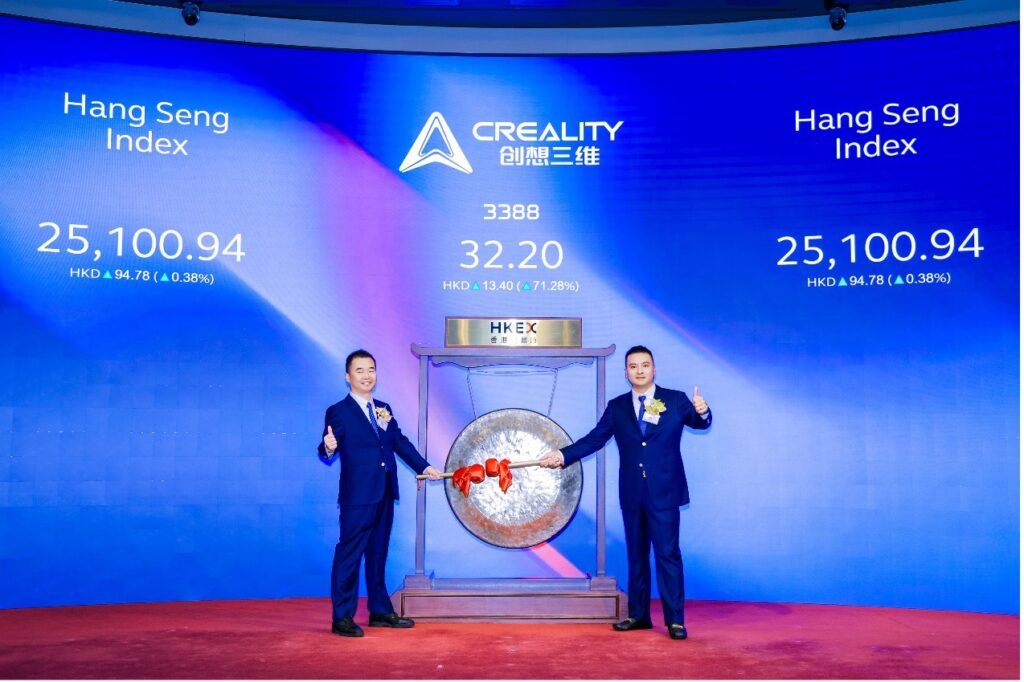
Creality completed the period’s largest capital event. The Shenzhen consumer printer maker listed on the Main Board of the Hong Kong Stock Exchange on May 29 under stock code 3388, raising net proceeds of about HK$1.27 billion (roughly $162 million). The public offer was 3,829 times oversubscribed. The stock opened at HK$33.88, about 80 percent above its HK$18.80 offer price, before closing its first day up about 21 percent. It is the first consumer 3D printing company to list on the Hong Kong exchange.
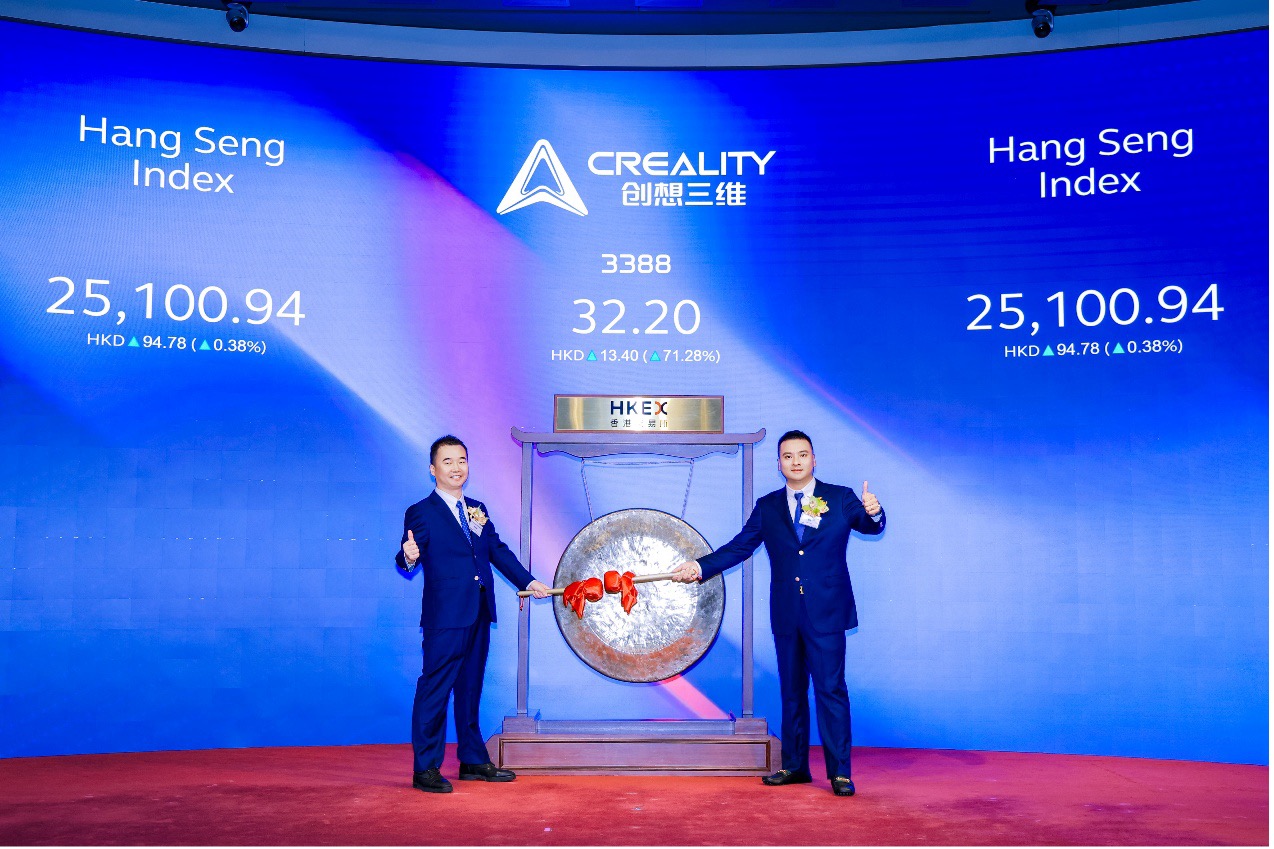
Creality goes public. Image courtesy of Creality.
HeyGears raised a $44 million Series C, more than 300 million yuan, led by Legend Capital and Fortune Ventures. The Guangzhou firm, known for dental and jewelry resin systems, said it will use the funding to move into the consumer resin market, with a full-color system planned for the third quarter of 2026. About 70 percent of its revenue now comes from materials rather than printer sales.
Sunlu Technology, the FDM filament producer, is moving from China’s New Third Board (NEEQ) toward a ChiNext IPO to fund a capacity expansion. Its IPO guidance was filed through sponsor Orient Securities; the filing did not disclose a specific investment figure.
Shenzhen Gongda Laser closed a Series C of several hundred million yuan to expand green-laser metal AM. Through its Xihe (希禾增材) subsidiary, which has more than 100 systems deployed today, the company plans to scale to 1,000 systems over the next three years, targeting copper thermal-management parts for AI compute hardware.
Hardware and Materials
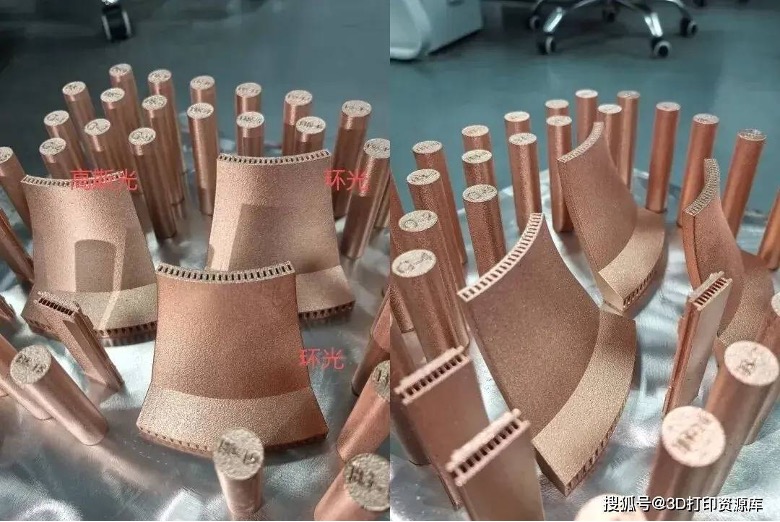
Shenzhen Gongda Laser closed a Series C of several hundred million yuan for green-laser metal AM.
Chinese metal AM specialists pushed on powder and systems. Tiangong International, the Jiangsu special-steel maker, is scaling up plasma-atomized titanium alloy powder toward a stated 3,000-tonne-per-year target through its Tiangong Titanium Crystal joint venture, with the first production phase already underway.
Japan’s DAIHEN entered the metal printing business with ArcBuilder3D, a large-format wire-arc additive manufacturing system for structures such as ship propellers and rocket nozzles. The company said the wire-arc process cuts production cost to less than half that of powder-based methods, priced the system at 75 million yen, opened orders on May 29, and set a first-year sales target of 20 units.
In Taiwan, Phrozen previewed the Sonic Mighty Revo 16K MAX, a large-format resin printer with a 14-inch 16K LCD, dual-zone heating, and an AI-monitoring camera. Shining 3D launched the OptimScan Q12 HD metrology scanner, rated at up to 0.004 mm accuracy.
Hanbang Laser, under its HBD brand, partnered with Hebei Hanglun, the titanium-bike maker behind Hi-Light, to produce 3D printed titanium alloy bicycle frames on its HBD P400 systems, which were shown at TCT Asia 2026. Tuobao Additive (拓宝增材) opened a base in Zhejiang’s Qingshanhu Science and Technology City and said a single machine had run more than 500 hours of continuous LPBF printing using fully domestic core components. Unionfab extended its metal printing service to the United States, Canada, and Germany, pairing multi-laser SLM systems with an AI-driven process platform that it says cuts low-volume metal lead times from 30 days to as little as five.
Aerospace and Defense
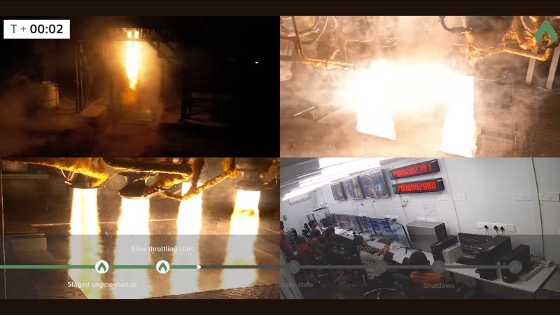
Agnikul Cosmos fired a cluster of four 3D printed semi-cryogenic engines, a first for India.
In Korea, DN Solutions contracted to supply its AM2CNC platform, which pairs metal LPBF with precision CNC post-processing, to defense components maker LDAS in Icheon to support prototype and serial production of precision firearm and defense parts.
LinkSolution showed a mobile AM Fab system, a vibration-isolated container built around its EP-500 printer for field production of drone frames and discontinued spare parts; it was demonstrated with a Korean army infantry division earlier this spring. The EP-500, a PEEK-capable polymer FFF printer, carries a South Korean defense ministry “excellent commercial product” trial-use recommendation, supporting priority procurement.
In India, Agnikul Cosmos fired a cluster of four 3D printed Agnilet semi-cryogenic engines, a test the company described as a first for India. The firing synchronized eight pumps, eight motors, and eight speed-control algorithms, validating multi-engine control for the reusable booster stage of its Agnibaan launch vehicle.
Medical and Bioprinting
 Rokit Healthcare reported preclinical results from a kidney regeneration study with researchers at Brigham and Women’s Hospital, a Harvard Medical School teaching hospital, led by KIM-1 discoverer Joseph Bonventre. The omentum-based patch preserved or regenerated kidney function in 62.5 percent of subjects, reduced the area of renal fibrosis by 50.4 percent, and lowered the KIM-1 kidney injury marker by 42.5 percent. A domestic pilot clinical trial in CKD stage 3 to 4 patients is planned for the second half of 2026.
T&R Biofab joined a 13 billion-won national project led by POSTECH and a 9.5 billion-won government-funded project to develop an AI bioink platform aimed at reducing batch variability for organ-specific bioprinting. Japan’s Instalimb took a J-KISS investment from Orthomos Investment, part of the Orthomos Group, and signed a basic agreement with the group company Alcare to explore co-developing 3D printed prosthetic sockets and orthotics.
Graphy and KAIST published a study on a functionalized (acetylated) cellulose-nanocrystal-reinforced vat-photopolymerization resin, reporting up to a 173 percent increase in tensile strength at low filler loading for elastomeric medical-grade materials. In Singapore, Castomize commercialized a 4D-printed orthopedic cast and brace that uses a heat-moldable, skin-safe smart polymer in place of plaster, with regulatory clearance in Singapore and several other Asia-Pacific markets.
Footwear and Consumer
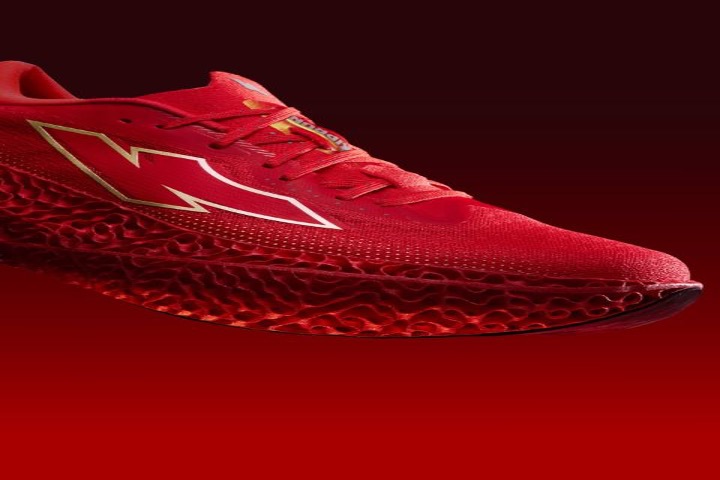
Kiprun KIPNEXT running shoe with an HP Multi Jet Fusion 3D printed midsole.
Resin and powder footwear scaled up in China. TPM3D, also known by its Chinese name Yingpu (盈普), advanced an SLS PEBA process for mass footwear production and said its SLS PEBA shoes passed a 200,000-cycle dynamic-flex durability milestone without irreversible deformation. Kiprun, Decathlon’s running brand, entered the market with the KIPNEXT 3D running shoe, using an HP Multi Jet Fusion 3D printed midsole, claiming 75 percent energy return, and priced at HK$1,949 (about $250) in a limited release in China.
Bambu Lab expanded retail distribution, placing its 3D printers in 64 Sam’s Club stores across China, and teased its A2L “Extra Large” model, which it revealed on June 1 with a 330 x 320 x 325 mm build volume.
Construction
In Japan, V3D Asia and Nakazawa Construction (中澤建設) ran a field trial of a gantry-type construction 3D printer in Unnan City, Shimane Prefecture, using locally sourced concrete and mortar; the company called it its first deployment in Japan. In India, Tvasta and 14Trees, the Amazon- and Holcim-backed venture, launched the Cedar construction 3D printer, whose AI companion is trained on thousands of mix combinations to optimize locally available material mixes.
What to Watch
- Chinese metal powder capacity is expanding on multiple fronts at once, from BLT’s jump toward 3,000 tonnes per year to Tiangong’s 300- to 3,000-tonne titanium ramp and Beifeng’s copper powder. Whether that capacity meets demand or outpaces it will show up in pricing over the next few quarters.
- Korea’s defense AM programs have moved from research centers to stated mass-production targets. The open question is whether the Pangyo and Daejeon centers reach serial output and, if so, at what point it counts.
- Creality’s debut sets a public-market benchmark for Chinese consumer AM. Where its proceeds and HeyGears’ fresh capital go, R&D versus overseas expansion, will signal how the segment reads its next growth phase.
- Footwear is becoming a recurring AM application in China, with PEBA powder processes from multiple suppliers. The test is durability and cost at retail scale.
Prepared by AMPulse | www.ampulse.online