
Aibuild has launched FETS for Additive Manufacturing, a Finite Element Thermomechanical Simulation tool that lets you simulate stress, distortion, thermal effects, and thermomechanical effects. The solution has been optimized for DED, friction stir, and Material Extrusion. For both metals and polymers, the tool can be used to predict residual stress, warping, cracking, sagging, interlayer bonding, and adhesion. The team thinks that its solution is significantly faster than alternatives, perhaps 10,000 times faster. Aibuild went to the National Institute for Aviation Research (NIAR) at Wichita State University to test the tool.
Aibuild CSO Guy Brown noted,
“We kept hearing the same thing from engineers. I know simulation is the right thing to do, but I just can’t wait three days for an answer. And honestly, that’s before you even factor in the cost of getting it wrong. A failed build is often thousands of dollars in material, machine time and energy, and hours of someone’s time you can’t get back. Aibuild FETS came out of wanting to fix that. It’s not just process parameters either, it’s the whole thing. The path the tool takes, the thermal behaviour, the entire build strategy. Engineers can now just know whether a part will print successfully, in seconds, before any of that money is on the line.”
NIAR Program Director Jeswin J. Chankaramangalam added,
“As a research institute serving the aerospace industry, NIAR’s mission is to validate and de-risk advanced manufacturing technologies before they reach production floors. Thermal control has been one of the biggest challenges holding back metal additive at industrial scale. This foundation means we’re well positioned to benefit from upcoming AI enhancements that Aibuild is developing. For the aerospace manufacturers we work with, this represents a validated path forward: they can adopt large-format metal AM with the thermal process control they need, and the platform will keep getting faster as AI capabilities come online.”
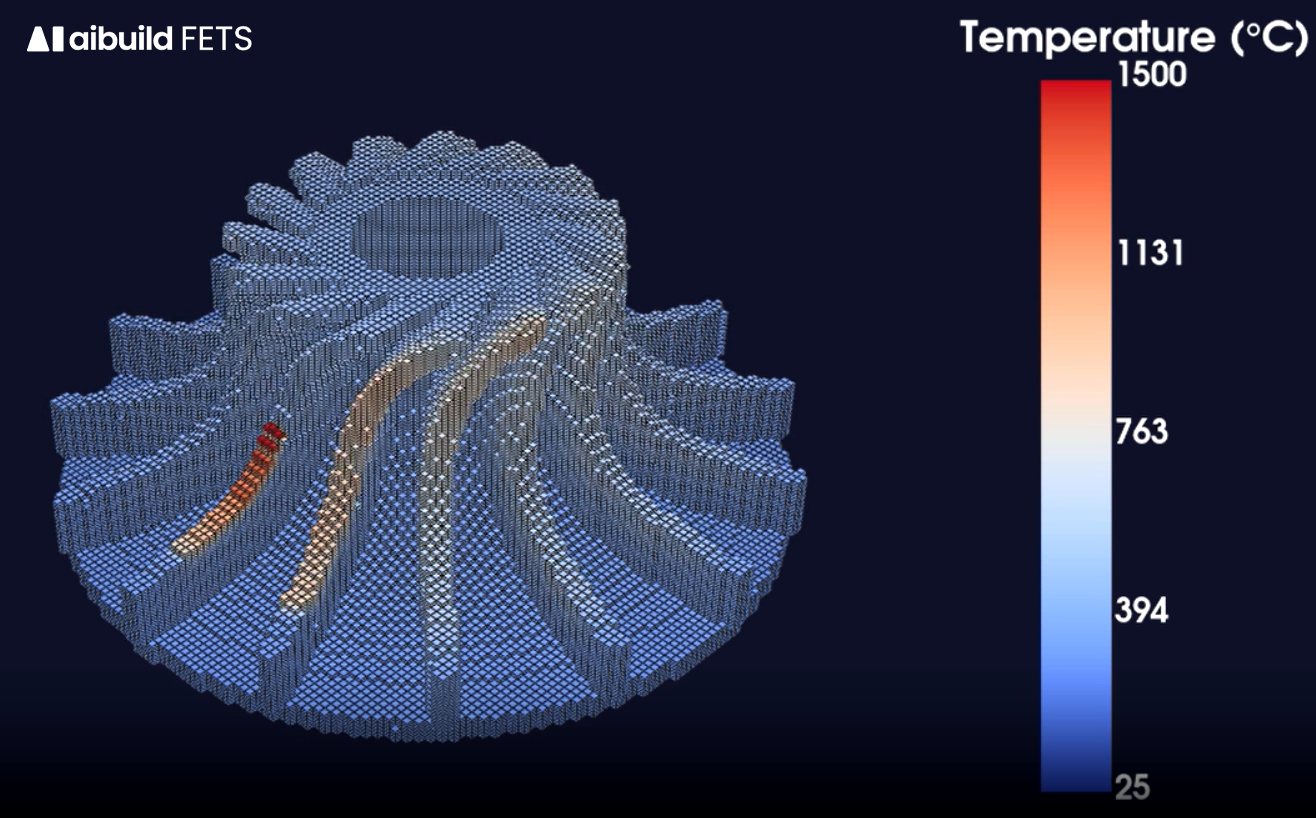
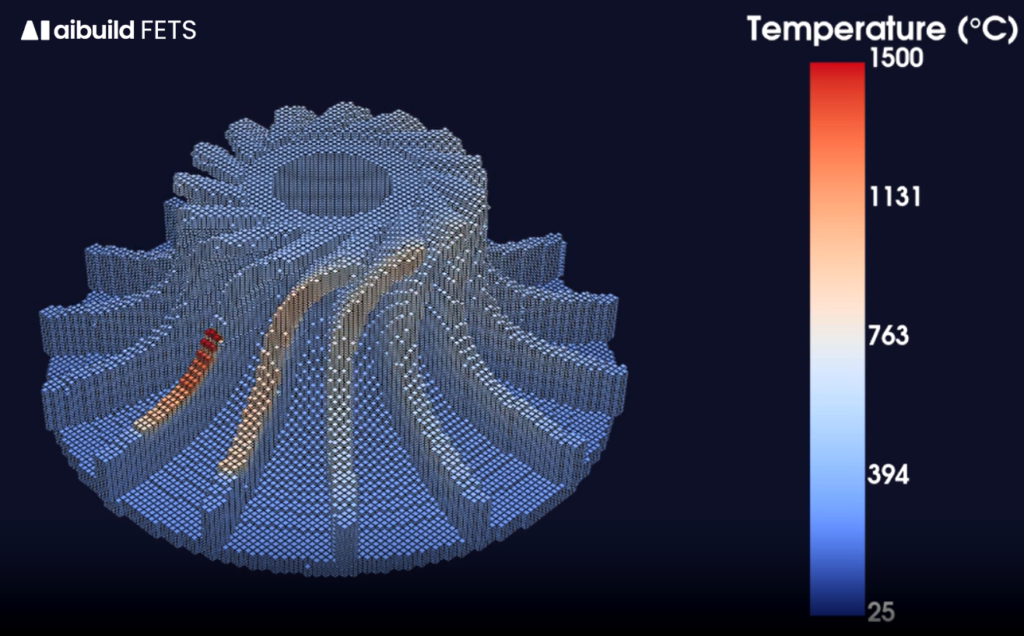
Aibuild FETS simulation showing temperature distribution across a 3D printed structure. Image courtesy of Aibuild.
AIbuild says that, as well as different materials and processes, the cloud-based tool can work with different CAD software while being easy to use. Warping, sagging, and intra-layer bonding are all very typical problems for people making large-format 3D printed parts. This tool will make many people’s lives easier. New parts can be made much faster with this tool, and getting a first new part right the first time will be more likely. Companies will be more efficient, while users should get parts faster. This is a great capability to have.
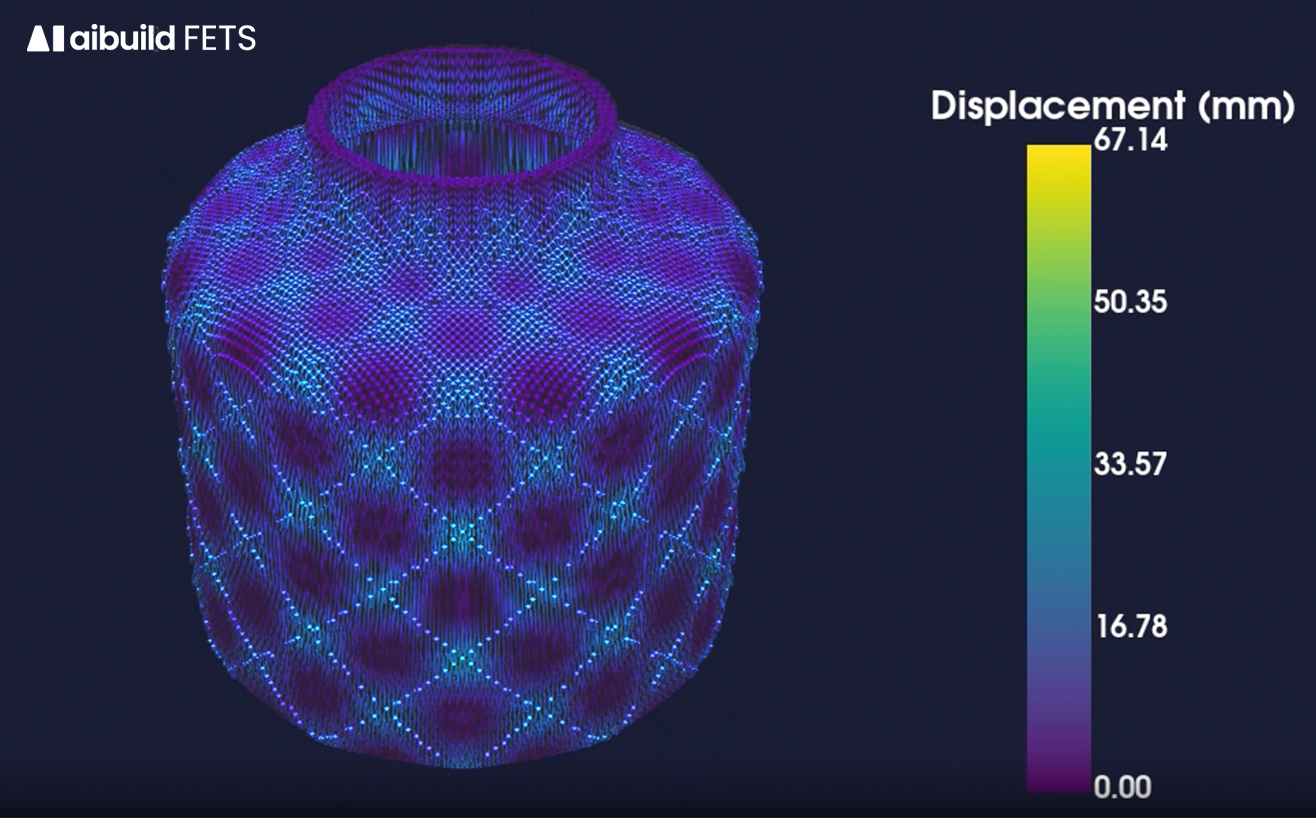
Aibuild’s FETS simulation showing displacement distribution across a 3D printed lattice structure. Image courtesy of Aibuild.
What’s more, a lot of people who use AIbuild are system integrators. Typically, robotics integrators make a lot of the DED, cement, and large-format polymer 3D Printing systems. A lot of these are custom, so fast simulation will help them develop these unique systems faster. Also, a robot arm integrator who has built a polymer extrusion system will be more likely to apply that expertise to building a DED system. Their customers can also get up and running without much in the way of 3D printing expertise. In large format, there are a ton of companies completely new to 3D printing. Large-format parts are very different, and printing is very different from desktop systems. So if you are experienced, then your Material Extrusion design rules and Dfam ideas will not translate exactly to large-format parts. Many people are also making unique, large-format parts. A single tool to transport a single large turbine on a truck is printed, just once. So accessible simulation for these guys is extra important and helps them with an endless stream of unique parts.
So this is an excellent move by AIbuild to make their platform more valuable to their integrator and end user partners. At the same time, the company is expanding into Aibuild OS, which uses AI to make workflows simpler. On the whole, the firm seems to be making itself an invaluable tool that end users of large format systems will live with day to day. They’re moving from a company that powers your back end to one that will power your manufacturing business, whether you’re an integrator or a company using a 3D printer to make parts. I love what they’re doing and think that this is a great move for the company and our industry.