

Cockroaches have been surviving on Earth for more than 300 million years. They can crawl through tiny cracks, climb almost any surface, and adapt to harsh environments. Now, researchers have found a way to help them survive underwater too.
A team from Nanyang Technological University (NTU Singapore) and Waseda University in Japan has developed a tiny 3D printed diving suit for cyborg cockroaches, allowing the insects to stay underwater for up to three hours while carrying electronic backpacks. The work combines 3D printing, robotics, and biology in a new type of biohybrid system that could one day help inspect flooded infrastructure or search areas that are difficult for conventional robots to reach.
The research was published in the journal Nature Communications in a paper titled “An amphibious cyborg robot with a miniature diving suit.” The study was led by Hirotaka Sato of Nanyang Technological University.
Unlike robotic insects, which are built entirely from scratch, cyborg cockroaches are living insects equipped with lightweight electronics. The backpack can include a battery, sensors, and wireless controls that allow researchers to guide the insect as it moves through its environment. Rather than controlling every movement, the system gently steers the cockroach while relying on its natural ability to crawl, climb, and navigate obstacles on its own.
“By fitting a cockroach, which is a terrestrial species, into this diving suit, we allowed it to survive and operate in oxygen-deprived environments,” the researchers wrote in the paper. “Transforming it into an amphibious cyborg robot capable of operation across land and water.”
The new addition is a miniature diving suit designed to help cockroaches breathe underwater for longer periods. The lightweight wearable traps a pocket of air around the insect’s breathing openings and includes a tiny oxygen-generation tank, measuring just 10 by 10 millimeters, made from a 3D printed PMMA-like photopolymer resin. Instead of carrying a limited oxygen supply, the device generates oxygen through an electrochemical reaction, continuously replenishing the air pocket while the insect is submerged.
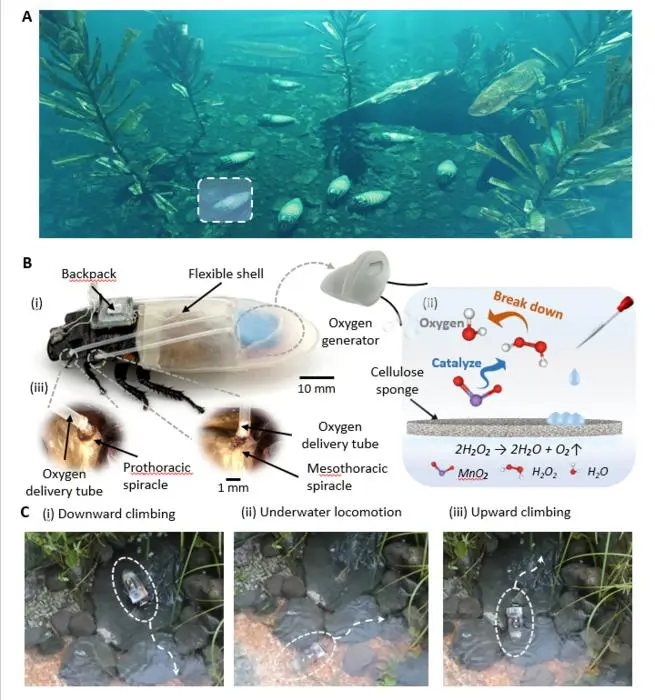
How the insect diving suit works. Image courtesy of NTU Singapore and Waseda University.
The oxygen-generation tank and two tiny 3D printed spiracle connectors (small fittings that attach to the cockroach’s breathing openings and direct oxygen through silicone tubes) form the core of the system. A custom flexible waterproof shell and the silicone tubes complete the wearable, allowing the cockroach to remain underwater for up to three hours while moving normally. According to the researchers, 3D printing made it possible to produce the miniature components with the size and shape needed for the wearable device.
Rather than simply helping cockroaches swim underwater, the researchers expect amphibious cyborg insects to reach places that are difficult or dangerous for traditional robots. As they write in the paper, the system could allow biohybrid robots to “operate seamlessly across terrestrial and underwater environments.”
To evaluate the system, the researchers sent the cyborg cockroaches through a series of underwater experiments, including fish tanks and 3D printed tube-shaped obstacle courses designed to simulate flooded environments. The insects swam, walked underwater, and crawled through the submerged passages while carrying their electronic backpacks. Even with the diving suit attached, they moved only slightly slower than they did on land, while their underwater survival time increased from just a few minutes to as long as three hours.
“This is important because real disaster sites can be challenging after heavy rain or flooding, blocking access routes in the rubble, drains and narrow gaps,” said Sato, a professor in NTU Singapore’s School of Mechanical and Aerospace Engineering. “By expanding the operating parameters of our cyborg insects to include underwater travel, we believe they can enhance search-and-rescue efforts.”
That could include inspecting flooded pipes, tunnels, sewers, or disaster areas where small, mobile systems have an advantage over larger robots. Because cockroaches can already crawl through tight spaces and climb over obstacles, giving them the ability to go underwater opens up even more places they can explore.