
A shift is underway in drone manufacturing. Government programs like the U.S. Department of War’s Drone Dominance, a $1.1 billion effort to deliver low-cost, one-way attack (OWA) sUAS at scale, are driving urgent demand for drones that are inexpensive, resilient, and rapidly producible. Or the US Army’s recent “Best Drone Warfighter Competition,” which was recently hosted in Huntsville, AL, that included dozens of teams competing with various platforms and different capabilities. At the same time, advances in additive manufacturing (AM) are changing what’s possible: lighter structures, faster iteration, and local, high-rate production. The result is a new industrial logic for unmanned aerial systems (UAS) that are based on speed, availability, and performance.
I recommend reading Drew Lawrence’s latest article with DefenseScoop to learn more about the ‘Best Drone Warfighter Competition’ published in February 2026.
Why Additive Manufacturing (AM) Matters Now
New operational requirements, such as payload, performance, range, and resilience, are converging with AM breakthroughs. Breakthroughs that yield parts previously impossible with traditional methods. This includes topology-optimized lattices, fiber-reinforced composites, and geometries that consolidate assemblies.
For programs like Drone Dominance, which have already produced 30,000 units after Gauntlet I and are preparing for Gauntlet II, additive enables both rapid prototyping and scale production while supporting a localized, supply-chain-resilient industrial base.
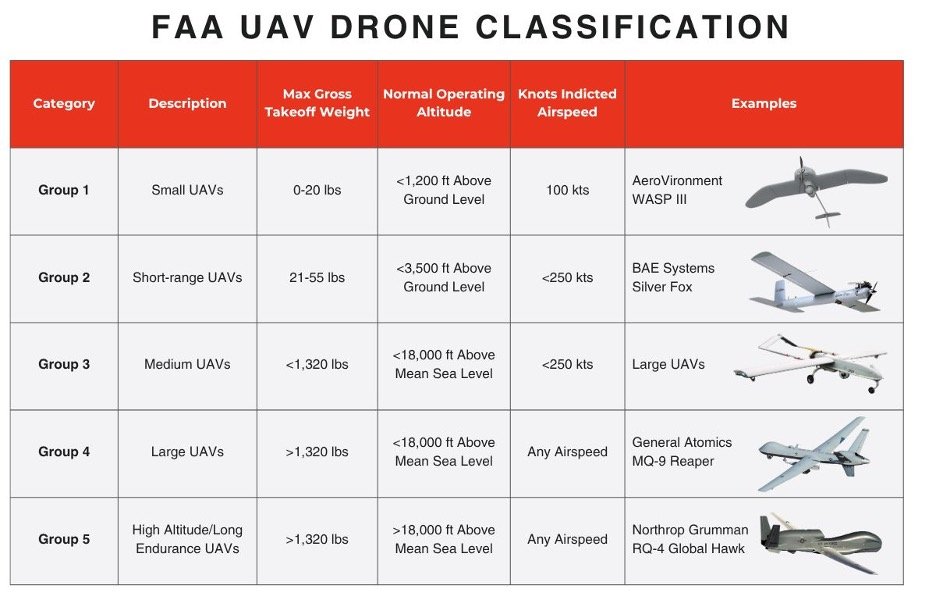
Understanding UAV Groupings & Fit-for-purpose AM
Not every 3D printing technology suits every drone. Categorizing UAS by mission and manufacturer helps match processes to platforms:
- Group 1: Very small, portable systems (hand-launched, <20 lbs). Typically used for intelligence, surveillance, reconnaissance (ISR) at the squad or platoon level. High-volume, low-cost manufacturing and rapid tooling are critical here because demand and iteration cycles are fast.
- Group 2: Small tactical UAVs (<55 lbs) with longer endurance than Group 1. Used by special units for persistent ISR or light payload delivery.
- Group 3: Medium-altitude tactical systems (generally >55 lbs) that carry larger payloads and operate beyond visual line-of-sight (BVLOS). These platforms require stronger load-bearing structures and longer-range propulsion, which is a natural fit for higher-performance composite and hybrid additive approaches.
- Group 4: Tactical or operational fixed-wing/multi-role systems with greater range and payload (often used for extended reconnaissance or kinetic action). Manufacturing emphasizes durability, repeatable production, and processes that are certification-ready.
- Group 5: Large, strategic UAVs (military-class, often weaponized or long-endurance systems). These demand more robust manufacturing methods, and additive plays a role in quick tooling rather than in part production.
Image courtesy of Endeavor3D.com
Key OEMs and the Role They Play
Several additive manufacturers are already embedded in the drone supply chain, each addressing different mission tiers.
Stratasys brings a pragmatic, aerospace-rooted approach to polymer additive manufacturing. By combining proven systems, materials, and a wide service footprint to help OEMs and primes move faster from concept to flight-ready parts. Their strengths in quick-turn tooling and direct component production make them especially well-suited to high-iteration, high-volume Group 1 programs, while active partnerships with defense primes help translate field requirements into manufacturable solutions across multiple UAV classes.
You can learn more about Stratasys and the Defense Supply Chain from a recent blog authored by Eric Quittem, Digital Marketing Manager at Stratasys.
Impossible Objects’ CBAM platform blends the structural advantages of long, unidirectional carbon fibers with a production mindset, delivering carbon-fiber-reinforced parts at high throughput and dense packing that drive down unit cost. That combination of superior load-bearing performance, fast cycle times, and demonstrated success positions CBAM as a compelling option for Group 3 platforms where endurance and strength-to-weight are decisive.
HP 3D Printing leverages Multi Jet Fusion (MJF) to push design-for-performance into production, producing ultralight, high-resolution airframe components and optimized lattice structures that improve stiffness-to-weight ratios. By focusing on manufacturability and repeatability, HP helps programs move prototypes into consistent, production-grade parts for Groups 1–3, enabling designers to extract performance through both material and design approaches.
EOS supplies precision metal and high-performance polymer additive platforms that answer the demands of load-critical, thermally stressed, and complex geometries found in higher-end UAVs. Their metal consolidation capabilities and high-temp polymer solutions reduce assembly time and improve maintainability, making EOS relevant across all UAV groupings where certification, durability, and mission-critical performance drive material and process choices.
Phillips Federal, a major equipment reseller serving the federal government, has an excellent resource about producing field-ready drones that shows the significance of carbon-fiber infused materials and their impact on lightweighting and production.
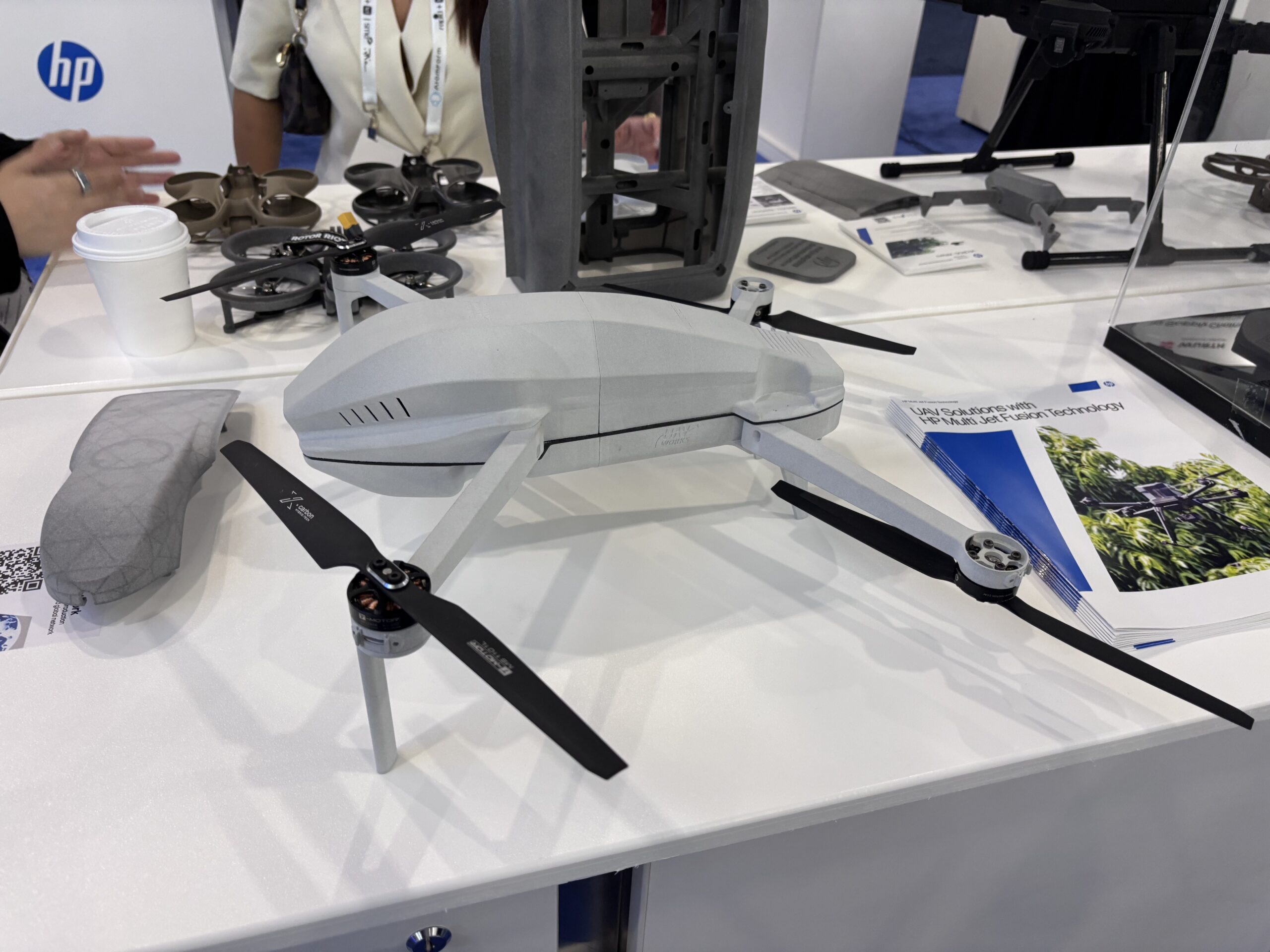
Drone components produced with HP’s Multi Jet Fusion technology on display at the event.
Key Applications and Recent Successes
Additive manufacturing is already transforming lead times for drone programs through rapid tooling and on-demand parts, compressing production schedules from months to weeks. The immediacy of 3D printed components enables teams to iterate on designs faster, validate aerostructures, and accelerate program cadence. This is exactly the practical outcomes Stratasys targets with its aerospace footprint, with proven, comprehensive, scalable, and disruptive technology solutions supporting drone manufacturing at all levels.
Beyond speed, AM unlocks meaningful weight and performance gains. Topology-optimized lattices, fiber-reinforced composites, and hybrid architectures shave mass while retaining strength and stiffness. This extends endurance and payload capacity on tactical platforms. Those geometric freedoms let designers rethink load paths and thermal management, producing airframes and internal structures that would be impossible or prohibitively expensive with conventional methods.
Be sure to check out HP’s upcoming presentation at XPONENTIAL, “Building Smarter, Flying Further: The Role of AM in Next-Generation UAVs.
For Impossible Objects, the priority is affordable mass production and version versatility.” Impossible Objects has an impressive history with the U.S. Air Force and recently shared the real-world traction and validation with Rock Island Arsenal (RIA), which is now expected to produce 10,000 drones per month using CBAM technology and material solutions. Access to this technology creates a feedback loop from the battlefield, allowing integration immediately without the need for tooling or external resources.
To learn more about the engagement with Rock Island Arsenal, I recommend reading the recent article published on Defense News.
Finally, distributed production and resilience are already shifting from theory to practice. In-field manufacturing, like the Firestrom Labs expeditionary manufacturing system that uses HP MJF technology, will enable repair and mission sustainment closer to operations. This reduces dependency on long logistics chains and helps meet high-rate defense production needs while also hedging raw-material risks.
Check out Carolyn Schwarr’s December 2025 article on Forbes.com, focused on Firestorm Labs and continued success with 3D printing.
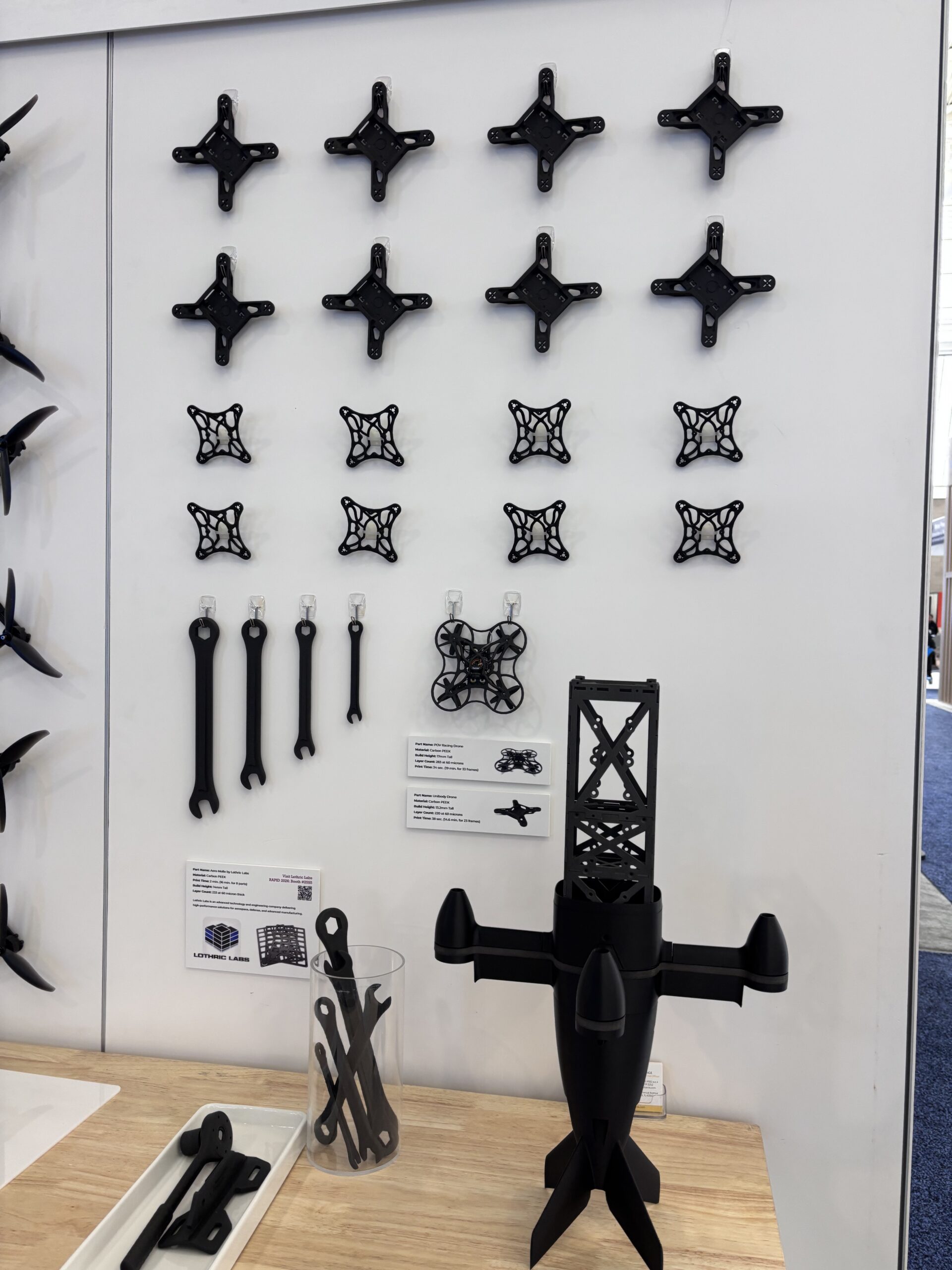
Impossible Objects and Titan Dynamics showcased large UAV platforms and drone systems at the event.
What’s Next?
The next advances aren’t just about printers. They’re about the digital thread that requires secure design files, certified material libraries, workflows, and robust technical data packages (TDPs). It’s about improved functionality through embedded electronics, or smart parts, that provide sensing data for health monitoring and maintenance. It’s about certification and standards that include qualification frameworks, material databases, and on-demand resources.
For military and regulated commercial programs, validated digital workflows and authorized in-field manufacturing are prerequisites for moving from pilots to practiced production.
If you build, design, manufacture, or engage in policy and procurement strategy for drone components, then it’s time for you to join the conversation at next week’s AUVSI XPONENTIAL in Detroit, MI (May 11-14).
AUVSI XPONENTIAL is the place to see these trends in action. Industry leaders and additive OEMs, including HP and Stratasys, will present sessions on production-ready AM, secure manufacturing at scale, and the role of AM in next-gen UAVs.
Additive manufacturing is no longer just a prototyping tool for drones; it’s an enabler of new production models. From high-volume polymer parts to carbon-fiber structural components and precision metal subsystems, AM technologies are being chosen to meet specific mission needs across UAV groupings.
As governments and industry scale programs like Drone Dominance, the winners will be those who combine validated digital workflows, the right print technology for the mission, and production-ready supply chains. If you want to influence or adopt that future, start at the show floor in Detroit.
If you’re interested in how additive manufacturing is reshaping drone production, supply chains, and defense readiness, these topics will also be explored at the Additive Manufacturing Strategies UAS: The Present and Future of Drone Manufacturing event on June 30, 2026.
About the Author
Ryan Hayford, founder of Hayford Consulting, is an additive manufacturing consultant who supports OEMs with marketing, sales, and go-to-market strategy and execution. He works with companies across the AM industry on business development, market positioning, and commercialization efforts.