
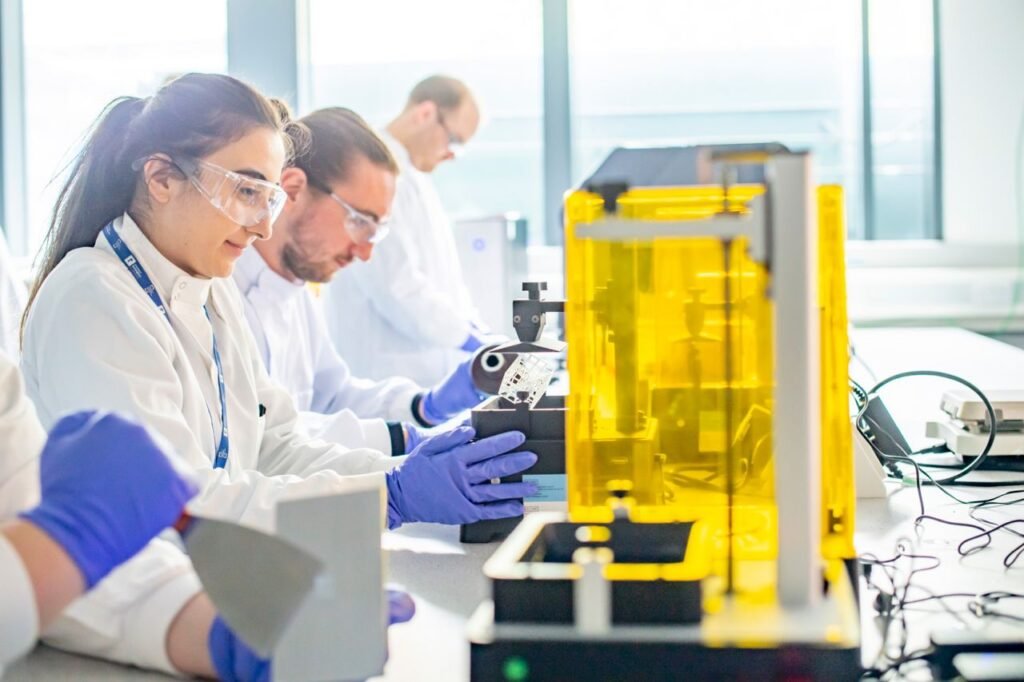
Researchers at the University of Nottingham are using 3D printing to learn how human cells sense and react to their surroundings. The project focuses on cells involved in healing, like those in skin and bone, and looks at how tiny physical features, such as surface shape and texture, influence their behavior. The goal is to understand this process well enough to design better materials that help the body heal on its own, which could reduce our reliance on drugs in the future.
At the center of the work is Dr. Robert Owen, who recently received a research grant from the UK’s Academy of Medical Sciences. In his lab, he and his team are studying how cells respond not only to chemical signals, but also to the physical shape of their surroundings. The funding comes through the Academy of Medical Sciences Springboard program, which supports early-stage, discovery-driven projects with monetary awards to help launch new research. That means the work is still in its early phases, with results yet to come.
The funding is part of a broader £6.7 million investment from the Academy of Medical Sciences, awarded to 55 early-career researchers across 38 institutions in the UK. The program backs early, curiosity-driven research to improve understanding of major health challenges, like Parkinson’s disease, Alzheimer’s, infectious diseases, and chronic pain. Dr. Owen, based at the University of Nottingham’s School of Pharmacy, is one of the researchers selected for this round of funding.
While the work is still at an early stage, in a LinkedIn post, Dr. Owen said he was “thrilled” to receive the award and highlighted support from the University of Nottingham, its School of Pharmacy, the Biodiscovery Institute, and the Centre for Additive Manufacturing (CfAM). He also noted that the funding will support a new two-year postdoctoral position, signaling that the project is now expanding.
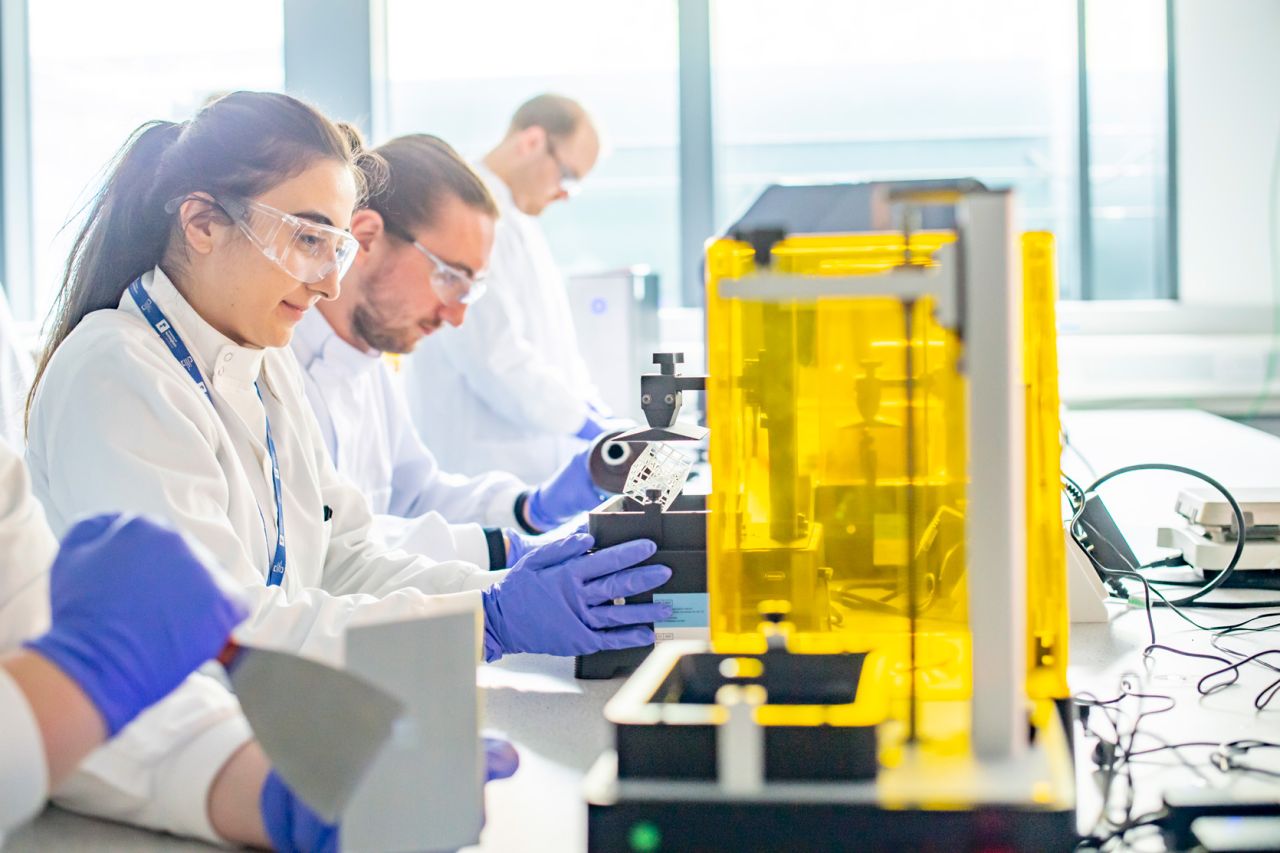
School of Pharmacy at the University of Nottingham. Image courtesy of the University of Nottingham.
Why Shape Matters More Than You Think
The researchers explained that cells live in complex environments. In the body, they’re surrounded by structures with curves, edges, and textures. These shapes and textures tell cells what to do, whether to grow, move, or start repairing damaged tissue. So the Nottingham team is recreating those “environments” using 3D printing. By building surfaces with very specific shapes, they can watch how cells react in real time.
This matters because most lab experiments are still done on flat surfaces, like petri dishes, which don’t reflect how cells behave inside the human body. In real tissue, cells are surrounded by complex 3D structures and interact with curves, textures, and neighboring cells all at once. Studies such as Jensen & Teng 2020 3D cell culture review and Duval et al. 2017 Modeling Physiological Events in 2D vs 3D Cell Culture, show that when you move from flat to 3D environments, cells can behave very differently, changing how they grow, move, and repair tissue.
So this is where additive manufacturing becomes key. 3D printing allows researchers to create highly controlled, complex structures, down to microscopic details, that would be nearly impossible to make otherwise.
In fact, UpNano said in a social media comment that its technology is being used in the research, a claim that was acknowledged by Dr. Owen. UpNano specializes in two-photon polymerization (2PP), a high-resolution 3D printing method capable of producing extremely fine micro- and nanoscale structures, and is super well-suited for studying how cells interact with surface features like curvature.
The system is part of the University of Nottingham’s CfAM, where it sits alongside a range of other high-resolution and bioprinting technologies, including platforms like the BMF 130, RegenHU Discovery, Cellink Lumen X+, a Formlabs Form 3, plenty of Anycubic SLA printers, and even a FRESH system, supporting high-resolution work at the scale of living cells.
At Nottingham, this lets Dr. Owen and his team build better environments to see how cells behave. That helps them study healing and disease in a way that’s closer to the real body.
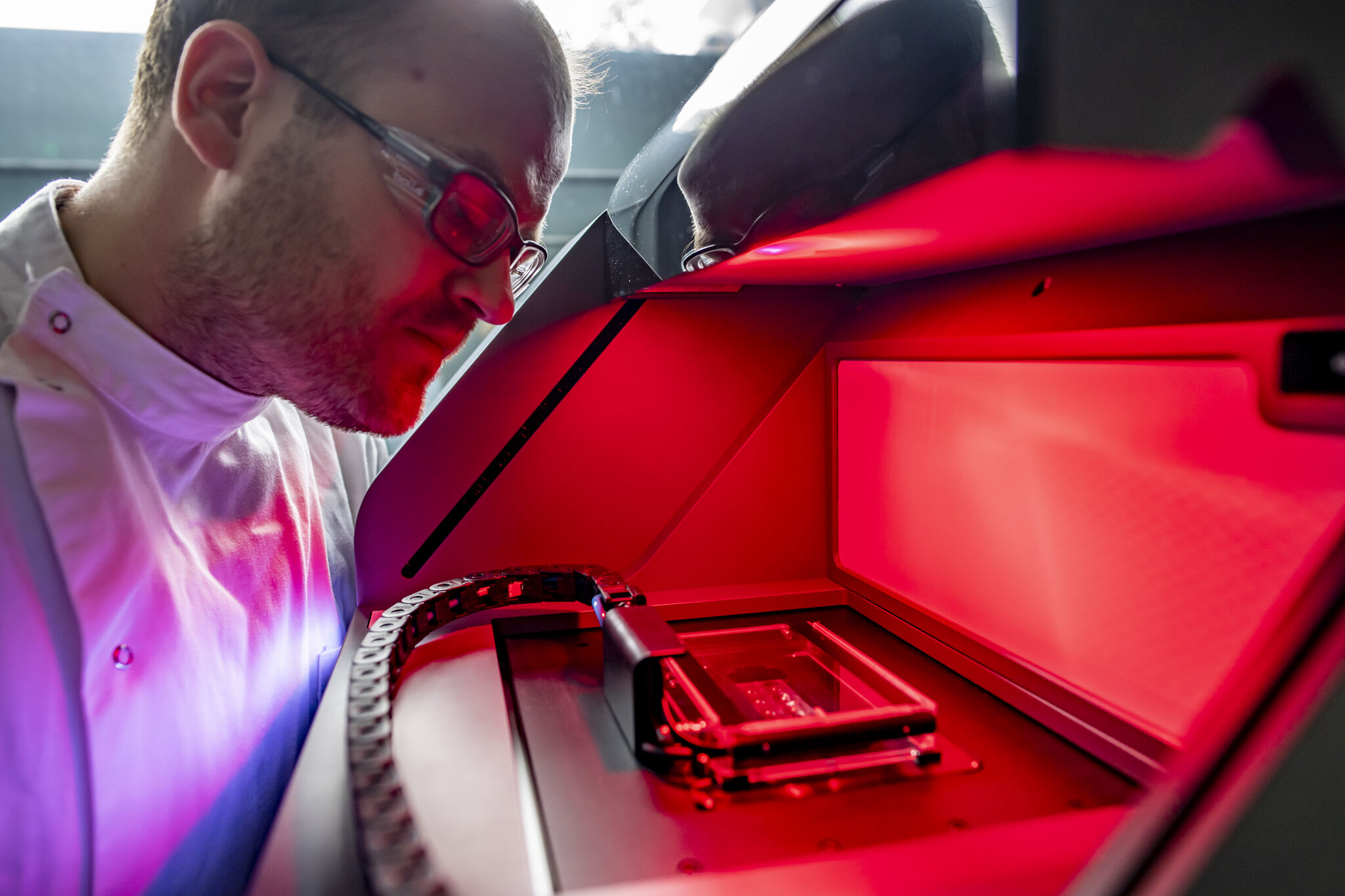
Dr. Robert Owen at the University of Nottingham’s Centre for Additive Manufacturing. Image courtesy of the University of Nottingham.
A Step Toward Drug-Free Healing
Dr. Owen calls this idea “SHAPE as Medicine.” It focuses on using tiny physical features, like curves and textures, to guide how cells behave and support healing, rather than relying only on drugs.
“This project will help me advance the concept of SHAPE as Medicine, using cell-scale physical features to direct cell behaviour and guide healing. By bringing together Nottingham’s strengths in advanced 3D printing, mechanobiology and analytical science, I hope this work will lay the foundations for a new way to design materials we implant into the body,” noted Dr. Owen.
For now, the research is focused on understanding how cells respond to these shapes. But over time, it could help researchers design better materials for the body.