

We’re focused on volumetric 3D printing, 3D printed insoles, and 3D printed prosthetics in this weekend’s 3D Printing News Briefs. Read on for all the details!
Researchers Using Holograms to Guide Laser Light for Volumetric 3D Printing
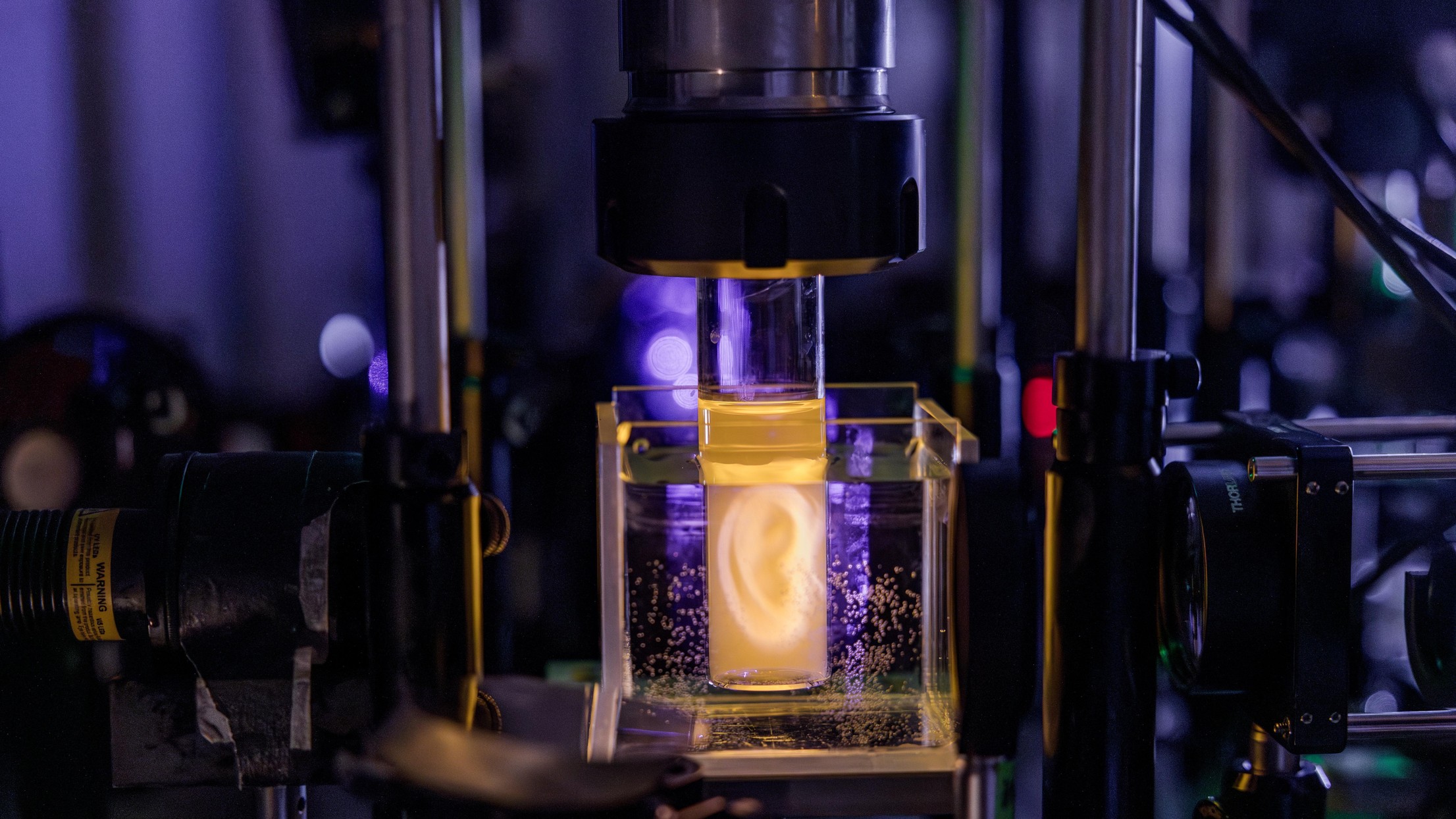
Holographic projection of a human ear model on a sample vial. 2026 Adrien Buttier/EPFL CC BY SA
Tomographic volumetric additive manufacturing (TVAM) uses laser light to harden a rotating vial of photosensitive resin into a specific shape. Last year, scientists from the Swiss Federal Technology Institute of Lausanne (EPFL) published a paper on their work using holograms to encode 3D forms; instead of modulating the brightness of light waves, they modulated the alignment, which preservers more laser power. Now, a team from EPFL’s Laboratory of Applied Photonic Devices (LAPD) has developed a new, more efficient platform for this holographic TVAM approach, using a device that can directly control a light beam’s phase in a volumetric 3D printing system. They used the system to solidify millimeter-scale objects within a few seconds, and centimeter-scale objects in minutes. The team says they’re able to produce higher-fidelity objects in light-scattering media because their method’s phase control makes it possible to use self-healing beams in the holographic 3D printing. The result is high-resolution, cell-compatible 3D printing at a scale that works for biomedical applications.
“Our method’s demonstrated efficiency and precision finally makes it possible to bioprint tissue-like structures at near-clinical scale. We have printed structures substantially larger than those achieved with previous holographic approaches, despite increased light scattering caused by the embedded cells,” said Christophe Moser, the head of LAPD.
Superfeet Unveils Mobile Enhancement to ME3D Platform for Insoles

Superfeet has been making 3D printed insoles for many years, and recently unveiled a major technology enhancement to its propriety ME3D platform that will improve access to its personalized insoles. Customers can now generate high-precision insoles through an iPhone scan on the company’s website. You can put together and order your insoles at home, but a select number of specialty running retailers around the U.S. are also offering this option, so you can get help from an associate during the scan process. A proprietary algorithm, based in podiatric data and biomechanical research, powers the process. After completing the guided scan on your mobile device, you’ll get access to an interactive experience, which allows you to analyze your foot profile (including arch height and shoe size), see a 3D rendering of your insoles, and choose from one of two specialized, high-performance foam options. The mobile experience also offers custom engraving on the back heel of the insoles. Once you complete your order, the biometric data is sent to Superfeet’s 3D printing facility in Washington, where your custom insoles are custom-engineered to your specifications.
“This evolution allows us to deliver a level of individualized engineering that was once only possible through specialized in-person experiences, unlocking access to our most advanced one-of-one custom technology. By putting this power into the hands of consumers, we ensure that whether you are at home or on the go, the highest standard of personalized support is just a few clicks away,” said Trip Randall, CEO of Superfeet.
There is no standalone app download for iPhones, but you will need an iPhone 13 or newer, that runs iOS 26, to scan at home.
Open Bionics Introduces First Above-Elbow Hero FLEX Prosthetic System

UK-based Open Bionics launched the world’s first medically certified 3D printed bionic arm, the HERO Arm, in 2018. Now, the company is introducing something that it’s spent years working on: its first 3D printed HERO Flex prosthetic for above-elbow amputees. These types of limb differences have long been overlooked by typical prosthetic technology, with too much weight and not enough ventilation. This 3D printed system is lightweight, modular, and, according to an Open Bionics Instagram post, “built to switch between bionic power and activity attachments for work, hobbies, and everyday life.” The company recently had its first fitting of the above-elbow HERO Flex with Praveen, a 43-year-old experimental physicist from New York who had his right arm amputated when he was less than two weeks old. Growing up, he used hooks and myoelectric arms, but found these so lacking that he has long gone without any kind of prosthetic. This came with its own set of issues, as some things are very hard to do without an arm, especially in his profession. But, Open Bionics reports that within an hour of being fitted with the HERO Flex, Praveen was easily gripping tools, opening a soda can, and holding his dog’s leash.
“With a bit of creativity and adaptation I was able to do quite a few things without prosthetics. Building little tools and contraptions, clamps to hold things while working on them. But there’s a limit to what you can do ultimately. And sometimes it is really nice to not have to be creative about the simpler everyday things,” Praveen said.
“This [Hero Flex] system is the lightest option I have ever worn. I love that it’s modular. You can attach an activity-specific attachment for hobbies or chores, then clip in a bionic hand for two-handed activities. I’m so excited to use this daily.”
Researchers Restore User Autonomy with 3D Printed Modular Prosthesis
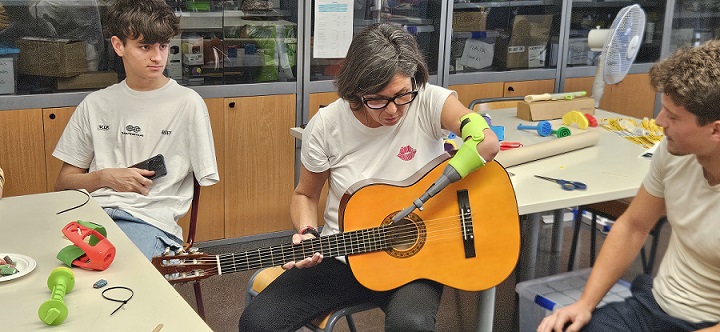
Participatory workshop conducted with end users of the prosthesis.
The Biomedical Design and Manufacturing Joint Research Unit, or BioFAB, is made up of researchers from the University of Alicante and the the Alicante Health and Biomedical Research Institute (ISABIAL). The team, in collaboration with the Artefactos university association, developed a 3D printed customizable, multifunctional prosthesis for individuals with upper-limb differences—specifically those without a full arm or elbow joint. The major issues with current prostheses are their complexity, and how expensive they are, with specific motors, sensors, and software raising the price and needing to be charged often. The BioFAB device uses a simple, functional, and lightweight mechanical system, with modules that are supposedly easy to switch. The custom-fitted socket is made with a biocompatible, flexible, and washable material, and the main body is 3D printed using whatever material best fits the user’s desired functionality. For instance, a rigid, impact-resistant material is used for a cooking prosthesis, with a high heat tolerance for cleaning. The device’s modular design improves autonomy and quality of life for people with upper-limb differences, and the patent-pending design has already been validated by users.
Javier Esclapés, the Scientific Director of BioFAB and a University of Alicante engineer, explained, “Our goal is to offer a more versatile, adaptable and affordable prosthesis that truly facilitates daily autonomy and prioritises the real needs of users.”