
Materialise (Nasdaq: MTLS) grew revenue and profit in the second quarter of 2026, as its Medical business continued to expand and stronger aerospace and defense demand helped its Manufacturing segment return to growth.
The Belgian 3D printing company reported second-quarter revenue of €70.1 million ($81.7 million), up 8.1% from €64.8 million ($75.5 million) a year earlier. Adjusted EBITDA rose 15.7% to €9.6 million ($11.2 million) and net profit reached €3.3 million ($3.8 million), compared with just €199,000 ($ 231,826) in the same quarter last year.
For Materialise, the quarter showed that profit is starting to grow faster than revenue. Executives pointed to higher sales, cost controls and a more focused business portfolio.
Aerospace Helps Manufacturing Return to Growth
For the additive manufacturing industry, one of the most important parts of the quarter came from Materialise Manufacturing. Revenue in the segment rose 6.7% year over year to €23.6 million. That marked a return to growth after Manufacturing revenue fell in the first quarter.
Management said the improvement came from its focus markets, particularly aerospace and defense. Aerospace was especially strong, with revenue from that market rising 40% during the quarter.
During the earnings call, CEO Brigitte de Vet-Veithen said aerospace and defense customers are moving beyond early adoption and looking at how to use AM at a larger scale.
“In the aerospace or defense segment, where the value of additive is well established, users already have a base of additive manufacturing. They now want to get to the next level, scale, do more and more parts with it. That’s where the NPI and the Enterprise capability come in. So those will be driving our growth going forward,” she told investors.
That growth helped offset continued weakness in prototyping demand. Materialise also highlighted a recent aerospace project with Lufthansa Technik. The company redesigned a small aircraft cabin part that had repeatedly failed and could not be bought on its own.
Lufthansa Technik can now use the 3D printed part instead of replacing the larger assembly. Following the project, Materialise was named an official workbench for Lufthansa Technik metal parts.

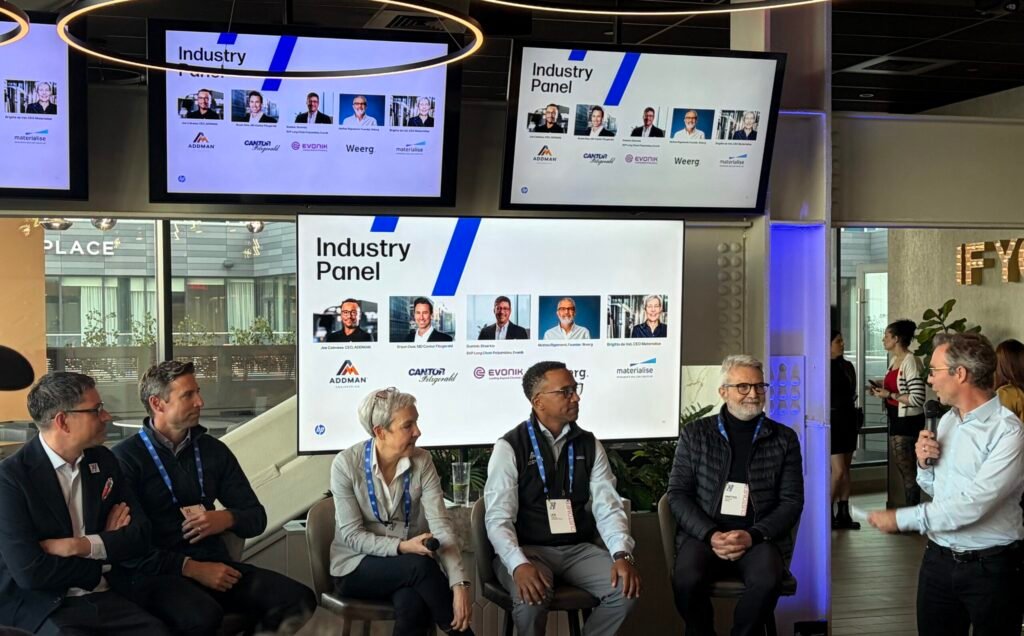
L-R: Dominic Stoerkle, Evonik; Bryan Dow, Cantor Fitzgerald; Brigitte de Vet-Veithen, Materialise; Joe Calmese, ADDMAN; Matteo Rigamonti, Weerg. Image courtesy of 3DPrint.com.
Also during the quarter, the Belgian Cyber Force and the Royal Higher Institute for Defence selected the company to lead the STRIKE-IT research consortium. The project is focused on secure digital manufacturing of spare parts and will use Materialise’s Identify3D and CO-AM technologies.
Manufacturing is also getting closer to profitability. The segment posted an adjusted EBITDA loss of €285,000 ($332,005) in Q2, improving from a loss of €807,000 ($940,098) a year earlier.
Medical is Still Materialise’s Main Growth Engine
Medical remained Materialise’s largest and fastest-growing business, with second-quarter revenue rising 12.2% to €36.9 million ($43 million).
During the call, de Vet-Veithen said she believes that level of growth is sustainable over the longer term. “I have previously always said that the structural growth rate for Medical is double-digit, but low double digits. Reasonably, a sustainable growth number that I would expect for Medical is around 10%, which is essentially what you see for the first half of this year. That is absolutely sustainable.”
The mix inside Medical was not even. During the earnings call, management said medical devices and services grew strongly while medical software was softer. One factor was weaker demand from U.S. academic customers following reductions in research grants. Management also pointed to reimbursement changes affecting some orthopedic customers.
Materialise continues to invest in personalized medical applications. During the quarter, the company invested in Belgian medtech startup Replasia, which is developing personalized 3D printed solutions and anatomical analysis software for hip preservation. The investment expands Materialise’s hip business beyond replacement procedures and into treatments designed to preserve a patient’s natural anatomy.
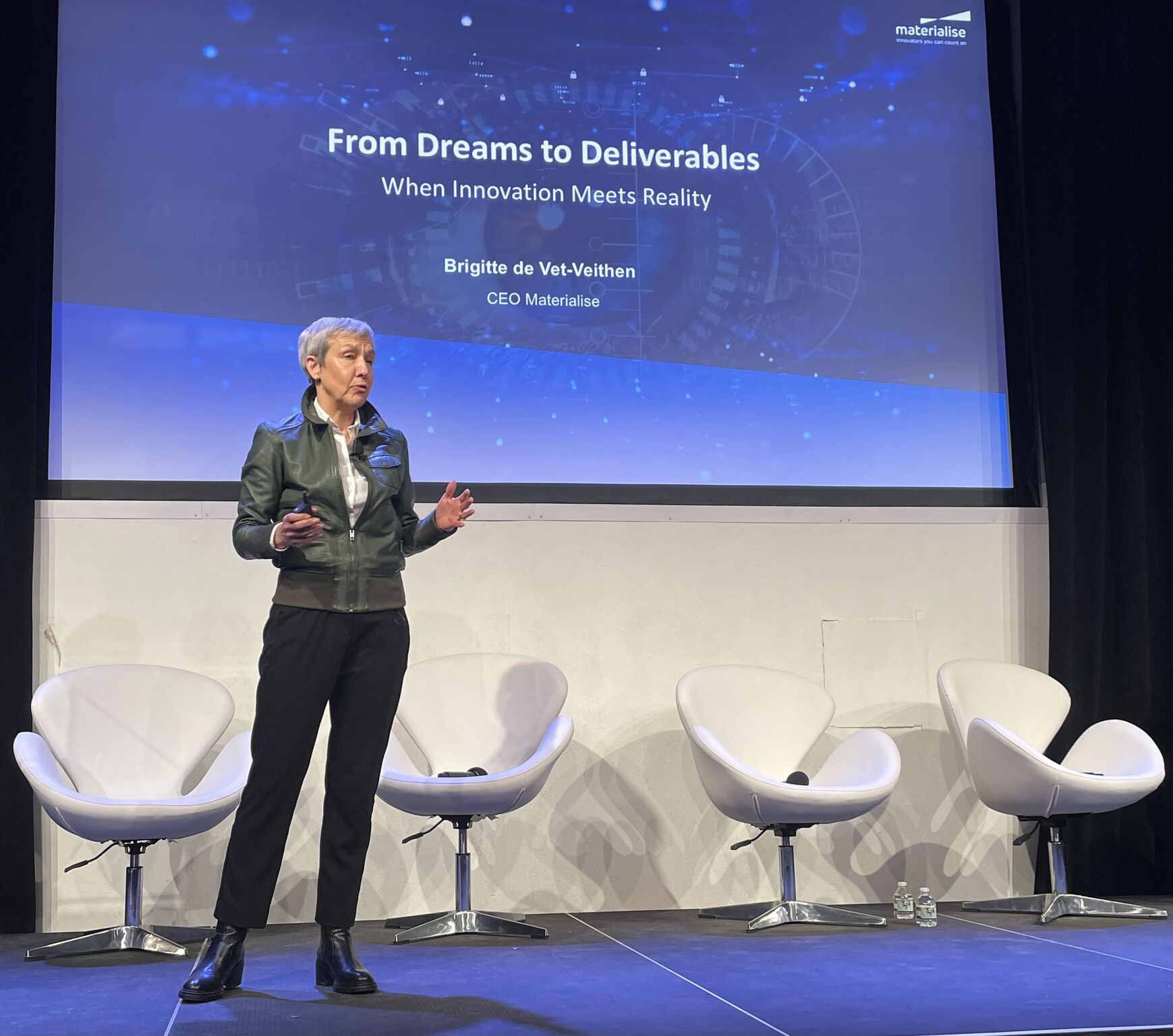
Brigitte de Vet-Veithen from Materialise speaks at AMS 2025. Image courtesy of 3DPrint.com
Materialise Software was the only one of the company’s three main segments to report lower revenue in Q2, falling 2.7% to €9.6 million ($11.2 million). About 86% of Software revenue was recurring during the quarter. The company also launched CO-AM Pro in May, one month ahead of schedule. The cloud-based product connects Materialise’s Magics software with data management and build preparation tools.
Speaking about the company’s upcoming CO-AM NPI and CO-AM Enterprise software, de Vet-Veithen told investors, “In particular, NPI and Enterprise for us will be growth drivers. Why? Because we position those in segments where companies have understood the value of additive manufacturing and are now in need of capabilities to help them scale.”
A More Focused Materialise
Materialise has also been selling off smaller parts of its business to focus on its core operations. In April, it sold its RapidFit business to the unit’s management team, which now operates RapidFit as an independent company. In July, Materialise transferred its eyewear business to its management team, while keeping a 20% stake in the new company.
Despite losing revenue from those businesses, Materialise kept its 2026 revenue forecast at €273 million ($318 million) to €283 million ($329.8 million). For the first half, revenue increased by 3.9% to €136.3 million ($159 million), and the company reported net profit of €5.2 million ($6 million), compared with a loss of €337,000 ($392,692) a year earlier.
Materialise also raised its profitability outlook. It now expects adjusted EBIT of €12 million ($14 million) to €14 million ($16.3 million) for 2026, up from its previous forecast of €10 million ($11.7 million) to €12 million. Management said recent cost reductions contributed to the improvement and expects some of those savings to continue.