
Additive manufacturing has been discussed for decades as a technology with the potential to reshape how products are designed and produced. Expectations have often focused on what the technology could enable in principle. Industrial adoption, however, has followed a more selective and uneven path.
This article examines additive manufacturing from a structural perspective. Rather than emphasizing technical capability, it looks at the forces that have driven adoption, the challenges those forces introduced, and the industrial responses that followed. The goal is not to predict future outcomes or promote specific technologies, but to explain why additive manufacturing looks the way it does today.
Understanding this context helps separate interest from deployment, capability from applicability, and potential from constraint.
From rapid prototyping to selective industrial use
Additive manufacturing technologies emerged in the late 1980s and early 1990s in response to a specific industrial need. The primary objective was to reduce the time and friction associated with design iteration. Early systems made it possible to translate digital models directly into physical objects without tooling, enabling faster form validation and earlier feedback in product development.
The initial industrial response was concentrated in design and engineering environments. AM systems were adopted as development tools rather than as manufacturing equipment. Their value lay in compressing iteration cycles and improving communication between design, engineering, and downstream functions. In this phase, success was measured in time saved rather than in parts shipped.
Several challenges limited broader use. Material properties were often inferior or insufficiently characterized for end use. Process stability and repeatability varied, dimensional accuracy was inconsistent, and surface quality frequently required secondary operations. Build rates were low, and cost per part was high compared with established manufacturing methods. These constraints were well understood and shaped how AM was positioned within organizations.
From the mid 2000s onward, improvements in machine capability, process control, and material quality began to change the decision context. In controlled settings, certain AM processes demonstrated mechanical properties comparable to those of conventionally manufactured parts. This did not remove earlier constraints, but it altered the balance between limitations and the value AM could deliver.
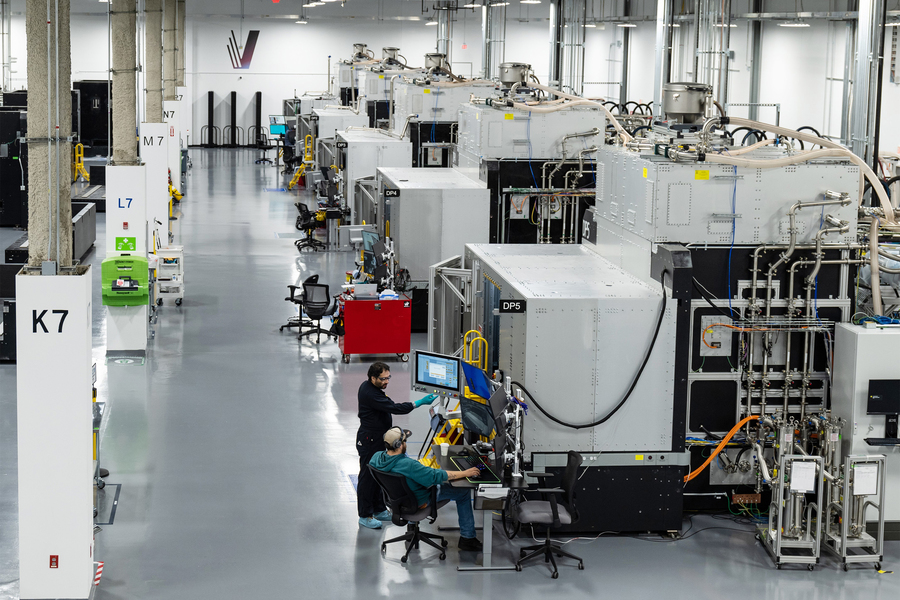
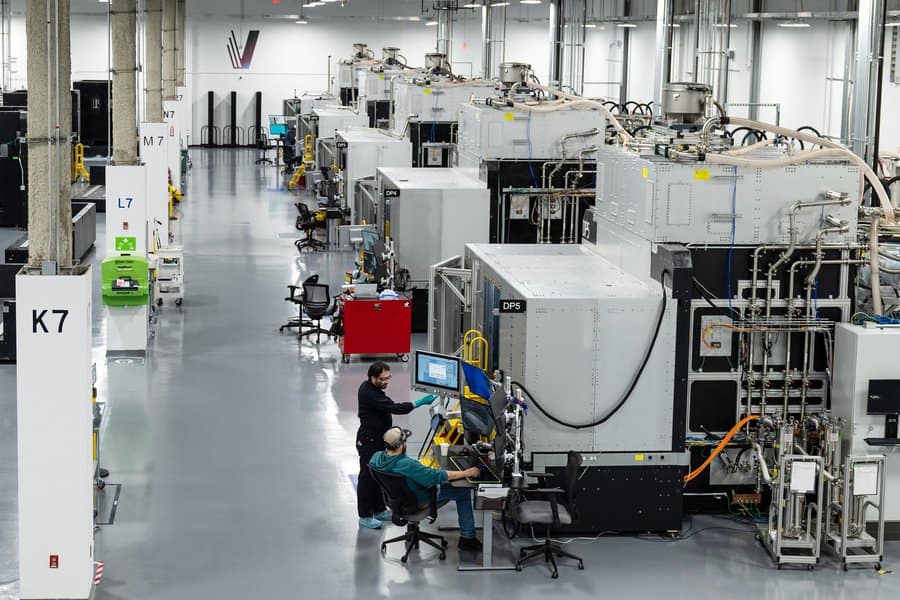
VulcanForms has created digital production systems based on its industrial 3D printing technology. Image courtesy of Joseph Seif.
The industrial response remained selective. Rather than a broad shift toward AM based production, adoption occurred in applications where functional performance, geometric freedom, or customization outweighed cost and throughput considerations. Aerospace components, medical implants, dental products, and specialized tooling inserts became early production use cases. In these contexts, AM was integrated as a manufacturing route for specific part families, not as a replacement for existing production systems.
This transition was incremental. Additive manufacturing did not move cleanly from prototyping to production. It expanded its role by accumulating narrowly defined industrial use cases over time. Even as production applications increased, AM continued to coexist with conventional manufacturing processes, each addressing different constraints and value criteria.
The resulting pattern established many of the structural characteristics that continue to shape additive manufacturing today. Early adoption was driven by iteration speed. Later, industrial use emerged where performance justified added complexity. Much of the public discussion around additive manufacturing still focuses on technical capability. The sections that follow examine instead what has driven adoption in practice and what has consistently constrained it.
This first installment has focused on how additive manufacturing moved from a rapid prototyping tool to a selective production method. In Part 2, the analysis turns to the forces that shaped industrial integration more directly: performance requirements, regulatory environments, and the influence of market cycles and capital.

Ulf Lindhe. Image courtesy of The Org.
About the Author:
Ulf Lindhe is a veteran executive in the additive manufacturing industry with decades of experience spanning technology development, industrial strategy, and global market expansion. He has held senior leadership roles within the metal additive manufacturing sector, contributing to the commercialization and international growth of advanced AM systems. Over the course of his career, Lindhe has worked closely with aerospace, medical, and high-performance engineering companies, helping bridge the gap between technological capability and practical industrial deployment.