
Recently, I wrote about an article by Col. Michael Mai, Chief of the US Army Working Capital Fund, in which he argued that the Army is “mispricing readiness” and that additive manufacturing (AM) could save the military far more than is typically acknowledged. The core of his argument is that when AM helps the military prevent wasted funding on lost training time by getting relevant hardware back into service, the Pentagon should account for that in its acquisition protocols.
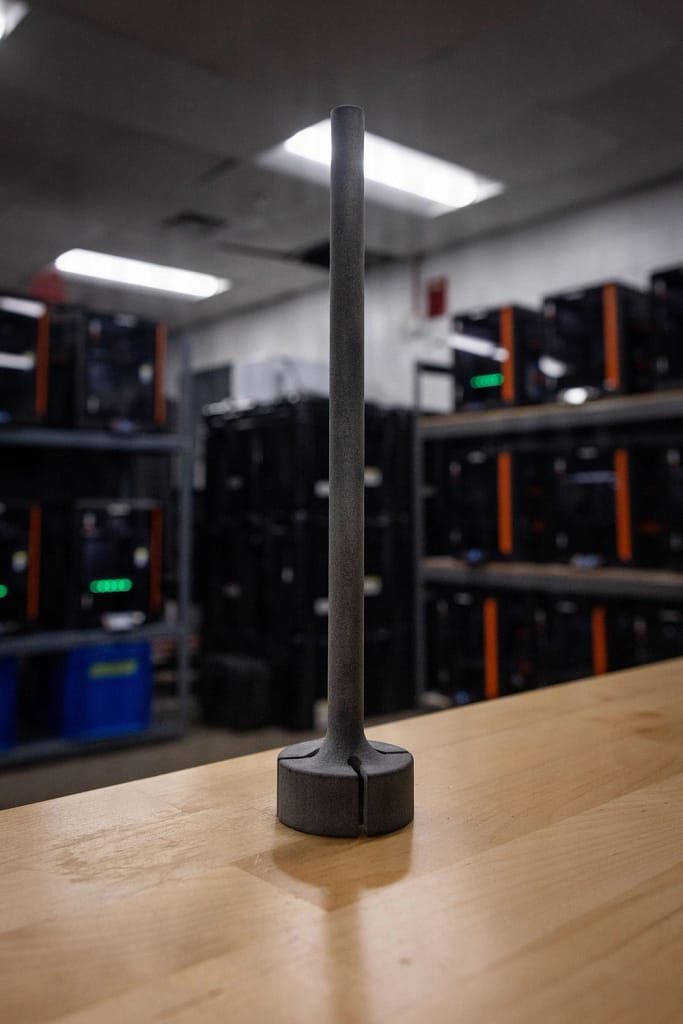
While Col. Mai specifically referenced the lost Army training time resultant from out-of-service tanks that were viable candidates for repair using AM, I noted in my post that there are presumably countless other scenarios across all US branches where the same logic applies. For instance, DVIDS just reported on a case from April of last year, out of the II Marine Expeditionary Force (MEF) Innovation Campus at North Carolina’s Camp Lejeune, involving an engineer equipment operator in 2nd Marines Logistics Group (MLG) who designed and 3D printed a replacement antenna mast for the Mobile User Object System (MUOS).
MUOS is the US Navy’s satellite-based communications system that, according to General Dynamics Mission Systems, “provides cell phone-like communications” for US service members. Naturally, the systems are routinely subject to considerable damage in the field — the antennas, in particular —making the need for repair parts very common. DVIDS states that such parts can cost upwards of $5,000 and the better part of a year to replace.

A Mobile User Object System antenna replacement mast, created by U.S. Marine Corps Lance Cpl. Eirick Schule. Image courtesy of Staff Sgt. Makayla Elizalde.
Lance Cpl. Eirick Schule created a replacement for the antenna that costs ten dollars in materials and ten hours to produce. Schule, a CNC machinist by trade before he enlisted in the Marine Corps in 2022, had just learned to use 3D printers in a course at Camp Lejeune. He put that training to good use not only by creating the replacement mast but also by serving as an AM instructor for much of last year.
So far, the II MEF innovation campus has produced 40 replacement antennas for units at Camp Lejeune, but it’s also produced 67 for Marines at Camp Pendleton in California. The total direct savings are around $600,000, impressive in their own right for just one part. But to refer back to Col. Mai’s argument, who knows how much more has been saved thanks to the prevention of wasted time?
Chief Warrant Officer 3 Matt Pine, the II MEF Innovation Campus Officer in Charge, told DVIDS, ““I went to a joint exercise in April 2025, and we looked at how many of these pieces were broken across the Marine Corps, and it was over one million dollars’ worth. …We started the ‘proof of principle,’ with 2nd MLG in July or August, where we innovate supply solutions to improve readiness by resolving supply latency issues. I’m not going to wait for you to tell me you have a problem; I can look at your back order and tell you that you have a problem. Here’s the solution: take it and do good things.”
Lance Cpl. Schule said, “Seeing something I designed being used and to know that I made an imprint that mattered to the Marine Corps makes me extremely happy. Now that I’m back in the [Fleet Marine Force] I am very eager to see my product I designed be used. Especially because I’m now in a communication battalion, so my likelihood of seeing it again is extremely high.”
There are a number of different elements here, all working in concert, that epitomize properly-executed AM adoption, reinforcing why I think that the US needs an Operation Warp Speed for manufacturing that Camp Lejeune helps lead the charge on. Officer Pine learned to use AM in the Marines and then helped teach Cpl. Schule how to use AM. Cpl. Schule subsequently taught other Marines how to use AM while figuring out how to save the Marines’ untold sums in the long run.
Every large, manufacturing-dependent organization could learn quite a bit from that dynamic, and I think the political will needs to be conjured up to formulate a plan to turn that potential into a reality. If the corrupt joke that was the Department of Government Efficiency (DOGE) wasn’t aiming to do something along those lines, then what exactly was its point? (Other than apparently giving the publicly unaccountable DOGE team access to federal government data).
One of the saddest things about this latest phase of government malfeasance is that, buried underneath the depraved surface, there are real success stories going on, like II MEF Innovation Campus, which could be harnessed and broadly applied if those sitting atop the levers of institutional control had an interest in activities other than using the public trust to enrich themselves. Everyone in a position to know seems to agree that tools like AM are now genuinely, technologically capable of helping solve society’s great challenges: policy and personnel are what stand in the way.
I don’t know what the starting point is for solving that precise problem, other than demanding it and encouraging others to do the same. Much better ways of doing things are within reach. Demand that they be used!