
Rather than just going through resellers, Chinese filament giant Polymaker is also going direct in Europe. The company wants to continue to work with 3D printing shops, webshops, OEMs, and distributors, but will also sell its products directly in Europe. I can’t imagine resellers will be thrilled, but it’s a logical move given the strides that Bambu Lab and Creality have made in selling their own filament. Filament is extremely profitable for these firms and deepens their relationship with customers. With a higher proportion of users set to be “crafters” and not makers, more people will want to do less, fiddle less, and print more conveniently. Polymaker’s dependence on large OEMs is growing. At the same time, we’re seeing a real concentration of players dominate the desktop market. Bambu Lab, Creality, Snapmaker, Elegoo, and a few others are doing millions of systems.
And when you’re doing millions of systems and selling tens of millions of dollars in filament, a few extrusion lines and a materials research department start to look like a great investment. Especially if not doing so means Bambu Lab will be more profitable than you in the long run. That’s not a strategic rodeo I’d like to clown stumble my way into. Seems like a surefire path to getting gored. With market power dynamics shifting, Polymaker as well needs to “own the customer” to remain relevant. All of this is a completely predictable but still insane consequence of High Speed PLA, which people laughed at but has changed everything.
Now, Polymaker will have a direct-to-consumer webshop focused on the UK, France, Germany, Poland, Czechia, and Spain. The company will also offer services in local languages and all of its Polymaker, Fiberon, and Panchroma brands. The company wants to have a “seamless and reliable purchasing experience, improved delivery times, and transparent pricing…. to strengthen customer support and engagement within local markets.”
Wildrik Van Der Weide, a VP at Polymaker, said,
“Our mission has always been to empower creators with the highest quality materials and the best possible experience. Expanding our DTC webshop into key European markets allows us to connect more directly with our community and better serve their evolving needs.”
The company’s engineering, consumer, and ecological materials will all be available in the shop. Another advantage is that European businesses no longer have to pay VAT while still getting wholesale prices directly from Polymaker. You can register for VAT access online, and the firm says it will get back to you within 2 business days. Only EU-based businesses can use this wholesale lineup.
In addition to these advantages, it can further insulate the firm from tariff fluctuations. For some businesses, this has been a real hell. Uncertainty and changes have created a lot of uncertainty and work. Local storage, distribution, and warehousing in Europe should improve this a bit. Perhaps the firm will also start producing in the EU? I would, if I were them, to serve customers better and remain competitive. In Europe, players like ColorFabb are innovative and responsive, while Prusament‘s success has been relentless. Local filament lines could make them more responsive and quicker.
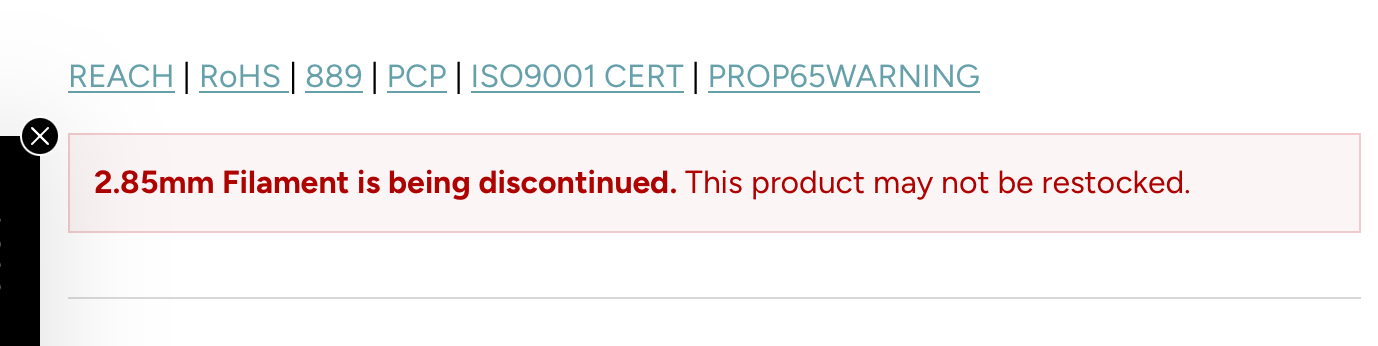
I really like Polymaker filament, and the quality and pricing are always good. The company offers Polychroma everyday PLA, polycarbonate, 8% reinforced ASA, fiber-reinforced PET, PPS, PA6, and production-oriented PLA. I love that they have cosplay material as well. While looking at their site, I also noticed that Polymaker is discontinuing 2.85mm filament. It’s crazy just how quickly the 3D printing world is changing. Only a few years ago, Ultimaker reigned supreme in enterprises, and Polymaker was the big bad wolf in filament land. It used to be that European firms dominated the filament market; now it’s Chinese firms. But in industrial printing, the large materials firms have pulled back, and OEMs are generally opening up access to materials.
On the desktop, however, it’s OEMs that are gaining more control and market power. A scramble for Europe is therefore a sensible move for Polymaker. The company will, however, have to make some more choices if it wants to thrive. Can it buy ColorFabb to cement a role as the most innovative filament firm? Or will it buy 3D4Makers to move into the industrial business? Or will the firm hack away at Hatchbox and the like, playing the volume game? While the firm used to feel as if it was comfortably sat in the middle of the market, it now looks besieged from all sides. I think we need companies that deliver on value and consistency, so I hope that it makes the right choices.