
While I would guess we’re still probably at least several years away from 3D printed drugs being a commonplace reality, the growing number of companies with proprietary additive manufacturing (AM) for pharmaceutical applications hints that there’s strong demand from the traditional giants of Big Pharma for building up the capability. Of course, we’re also starting to see disruptors bet on AM as a tool that can be leveraged to shift the pharmaceutical industry balance of power.
This is what’s happening with the announcement by Pete Pharma, a Phoenix-based pharmaceutical R&D startup. It has signed a deal with Atrium24, a Florida-based Customer Relationship Management (CRM) enterprise for pharmaceutical vendors. Through the deal, Pete Pharma will become the main provider of 3D printed pharmaceutical tech for Atrium24’s Group Purchase Organization (GPO) network.
A GPO acts on behalf of a collective of companies, using the enhanced purchasing power to negotiate better rates from wholesalers. In Atrium24’s case, the company negotiates on behalf of independent pharmacies to secure discounts from drug suppliers, or, in the case of Pete Pharma, discounts from providers of the technologies used to produce the drugs.
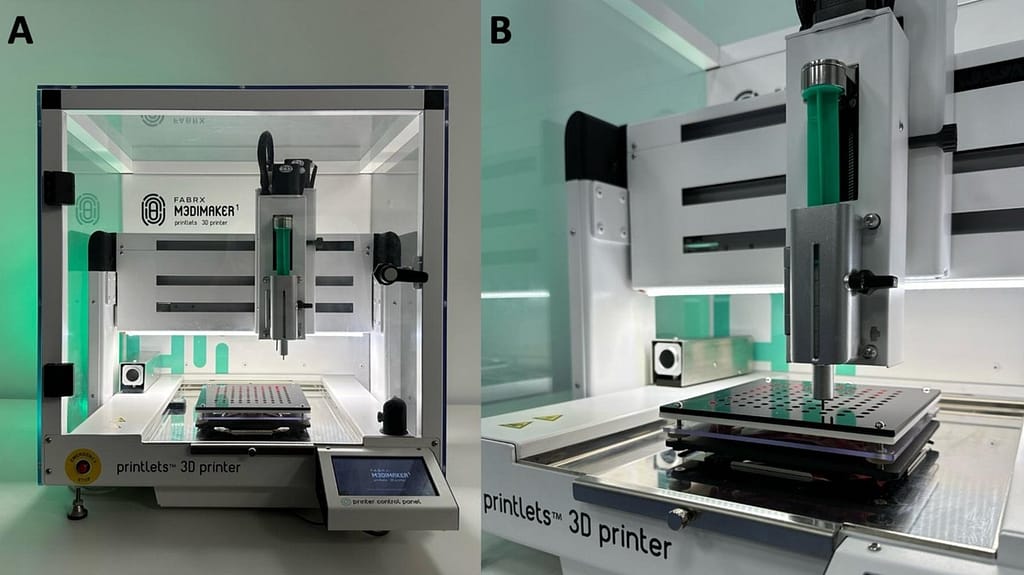
Pete Pharma announced in September 2025 that it was partnering with FABRX, the UK creator of the M3DIMAKER 3D printer and a pioneer in the AM for pharma market segment, to distribute the M3DIMAKER in the US. By now partnering with Atrium24, Pete Pharma has access to a nationwide group of independent pharmacies for sale of the M3DIMAKER platform and associated materials and services.
In a press release about Pete Pharma’s GPO deal with Atrium24, Marc Joiner, the owner of Pete Pharma, said, “This partnership reflects our shared belief that independent pharmacies deserve access to scalable, next-generation manufacturing tools. Atrium24 has built a strong ecosystem through its GPO and Dotti platform. By integrating our 3D printing infrastructure into that ecosystem, we are giving pharmacies a clear pathway to expand services, improve operational efficiency, and compete in a rapidly evolving healthcare landscape.”
Nicolette Mathey, PharmD, Owner of Atrium24 Technologies, said, “This collaboration allows us to integrate innovative pharmaceutical manufacturing technology into the Atrium24 ecosystem in a structured way that supports pharmacy-led growth. Our pharmacies are constantly seeking ways to differentiate and grow. Partnering with Pete Pharma gives to access to proven 3D printing capabilities and formulation infrastructure designed specifically for the compounding market.”
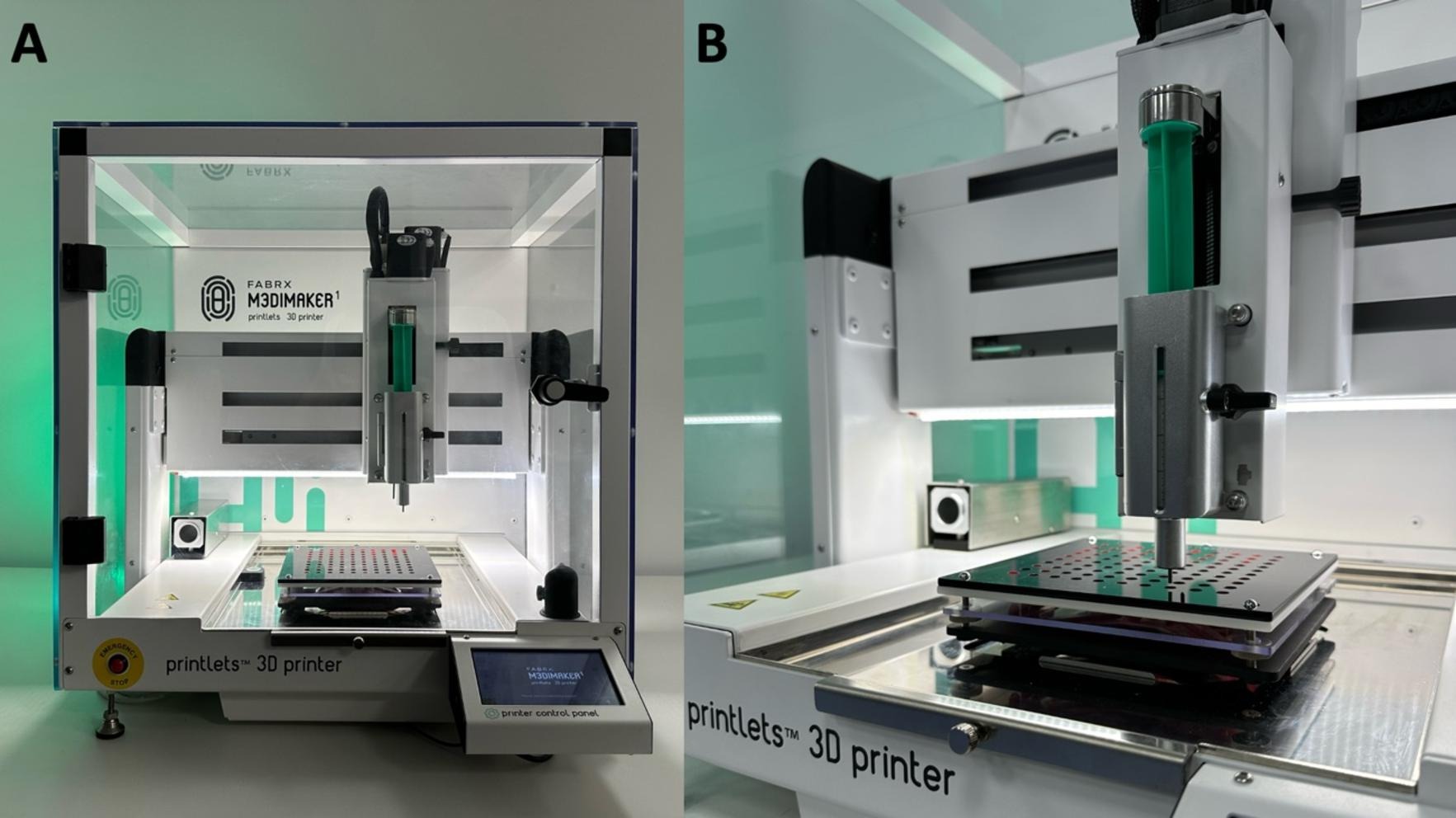
M3DIMAKER 1 pharmaceutical 3D printer with the capsule holder on top of the integrated balance. Image courtesy of FABRX.
Compounding, the practice of customizing medications to suit patients’ specific needs, is the most immediately available low-hanging fruit for 3D printed drug companies. While, as I said, the overall landscape of 3D printed drugs may still be a ways away from being the norm, I think that, soon enough, 3D printing may become the most logical option for compounders.
As Pete Pharma and Atrium24 seem to believe, that also creates an opening for independent pharmacies to gain a competitive edge over giant distributors. This actually doesn’t sound far-fetched: the business model for the leading drugstore retailers is clearly broken, as people can typically get better deals and a more convenient purchasing experience by ordering their meds online.
Under these circumstances, patients who need compounded meds are likely one of the last remaining demographics who have a real incentive to want a familiar brick-and-mortar establishment, and the person-to-person customer service that entails, as their source for prescriptions. Here, the lack of corporate agility and reputational damage that the pharma retailer leaders have rightfully suffered from years of delivering dismal service puts them at a competitive disadvantage against independents.
If the business model succeeds, the big-name brands will presumably try to emulate it, which would provide further tailwinds for continued growth of 3D printed meds as a legitimate, widespread solution. That’s the sort of precursor that could lead to AM for pharmaceuticals becoming a standard practice.
Image courtesy of Pete Pharma and FABRX