
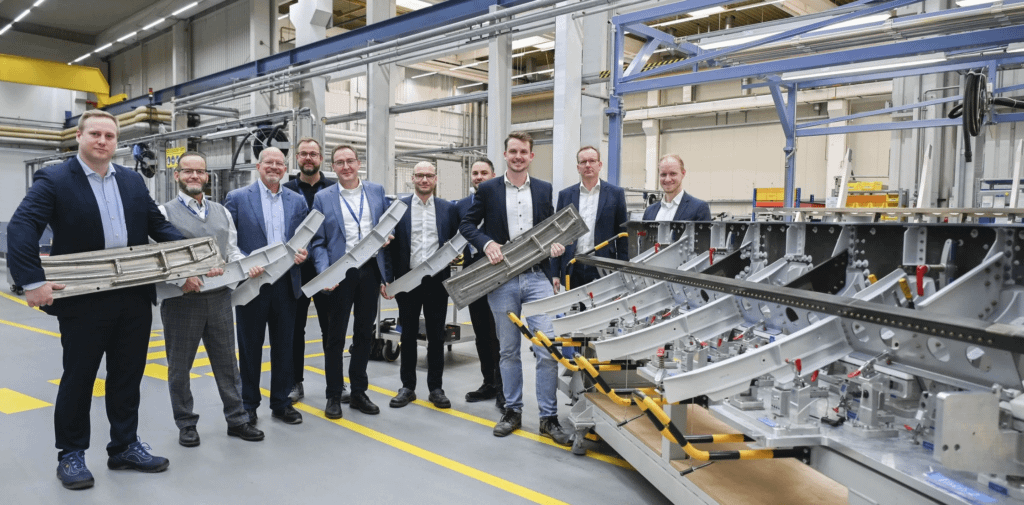
Norsk Titanium has signed a collaboration agreement with Airbus. The two firms will deepen their understanding for Norsk’s RPD (Rapid Plasma Deposition) DED technology. This is a good step forward for Norsk, which has qualified parts with Airbus, Boeing, and General Atomics.
Norsk Titanium CEO Fabrizio Ponte said,
“This agreement marks a pivotal milestone in the enduring technical partnership between Norsk Titanium and Airbus, acting as a catalyst for the adoption of additive manufacturing technologies at Airbus. With a standardized process it will be easier to transition parts to RPD and to bring many more parts into scope over time. This will support Airbus’ pioneering work to implement DED in more applications. We are still very early in the industrialization process, and we remain very confident that our RPD technology can offer the aerospace industry significant savings on cost and time. Together with Airbus we will make this happen.”
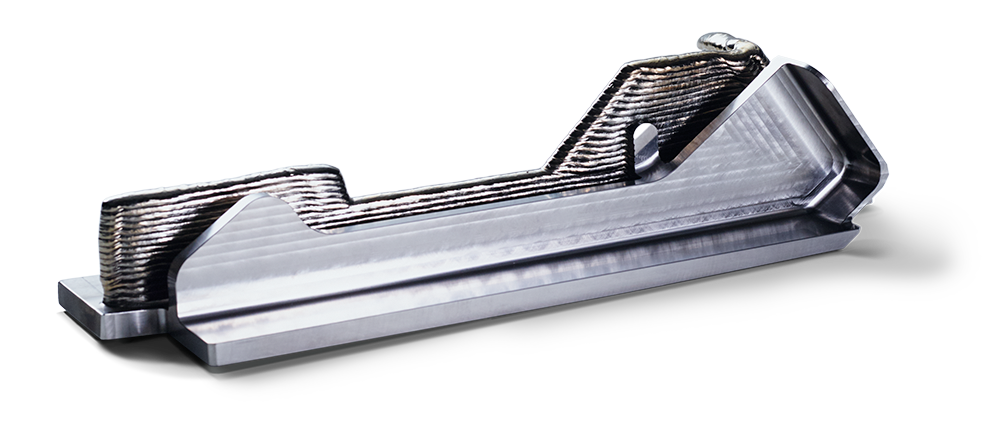
A Merke IV RPD machine will be placed at Airbus’s Varel factory to evaluate the “manufacturing processes, controls, and validation data to support the transition from part-specific qualification to broader process-based methodologies for specific titanium products.” The aim is to industrialize DED through better technical documentation and process control. This expands on a previous Master Supply Agreement for RPD materials to Airbus for A350 parts. Norsk has also itself produced Cargo Door Surround area parts for the A350, used on the current aircraft which is being produced at a volume of around 60 per year. The backlog of A350s is around 750 aircraft, so Airbus is interested in increasing the rate of production. DED will enable this, and the components actually cost less than the forged parts they replace. Integrated functionality, part count reduction, and reduced assembly costs are further benefits. A good basis for much deeper work with Airbus.

The Varel site makes over 3 million metal parts a year and is a leading site for aerostructures. It is now part of Airbus Aerostructures, composing what used to be Premium AEROTEC. The Varel site is a cutting-edge location for both DED and LPBF within Airbus. Notably, the site makes parts for military aircraft, such as the A400M Atlas turboprop military aircraft and the Eurofighter Typhoon, but also the A350 civilian airliner. The site also makes parts for Boeing and Dassault. Must be nice for Boeing to have some structural components on which it can rely. Aerostructures employs over 16,000 people across Europe. DED will be very applicable to wing spars, door protectors, and large components that Varel makes. Indeed, Airbus is aiming to make wing components and landing gear with DED later on.
The RPD process uses wire DED, process controls, and Argon gas to precisely build parts. With over 600 sensor checks per second, the company has worked hard to eliminate run to run and machine to machine differences. Each Merke machine has a build volume of 900mm x 600mm x 300mm and can reportedly produce over 20 tonnes of parts in a year. The company has 3 of its own machines in Norway, 9 in Pittsburgh, and hopes to expand to having 35 machines at the US site, which could give it over 570 tonnes of production capacity in the US.
Norsk has immense promise. It is clearly the leader in producing regulated DED parts for aviation. In working with many different firms and their suppliers, the company has done a lot of work in establishing itself in the long run. Financially, the journey has been rocky however, with the company getting a NOK 21.9 million (US$22 million) bridge loan from White Crystals, a Cayman Islands investment fund, in 2023. White Crystals currently owns around 20% of Norsk. The company is a subsidiary of Pergola Holding, an investment vehicle of 33 members of the Al Jomaih family (sometimes spelled Aljomaih). The Saudi family is a very enterprising one, which brought General Motors, Pepsi, Ineos, Enterprise Rent a Car, Shell lubricants, and Yokohama tires to the Kingdom. Starting in the 1930s, the family businesses have shown technical foresight and integration. It’s not only the distributor for Pepsi in the Kingdom, but also the bottler and the maker of the cans and other packaging for Pepsi bottlers throughout the Middle East. The company also owns, operates, and builds desalination and power plants. The family is uniquely connected in the region, with one member on the board of one of the largest banks and mobile firms in Saudi, as well as airline, Emirates.
With means, connections, and foresight, the family could help shepherd Norsk into becoming a major aerospace components supplier in the future. Especially in the region, there are a lot of industrial component manufacturing opportunities. And these opportunities abound in energy where they are very strong. With the current political climate, the nationality of the shareholders could also be an issue for some. Either way a long term stable Norsk will be a boon for our industry. The company has worked hard to make critical components well and could go far to advancing 3D printing across multiple industries in the future.