
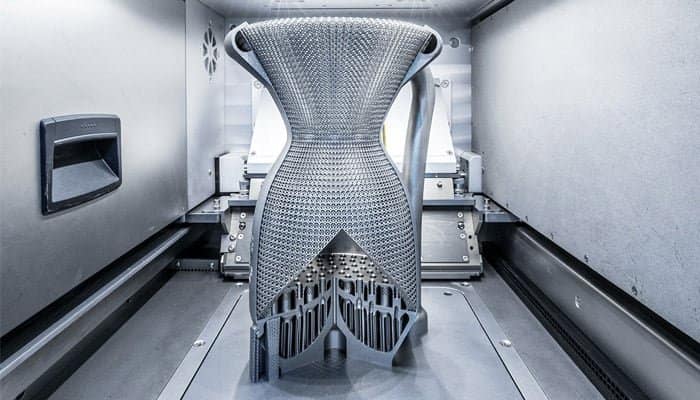
Nikon (OTCMKTS: NINOY) has announced a large impairment loss tied to its Digital Manufacturing business, the part of the company that includes metal 3D printing and advanced manufacturing operations. This news comes as the company reports weaker growth expectations for the metal 3D printing market.
For the quarter ending March 31, 2026, Nikon recorded ¥90.627 billion ($591.6 million) in impairment losses. Most of this charge comes from its metal additive manufacturing operations, especially SLM Solutions, a company Nikon acquired in 2023. Nikon removed the full value of goodwill from its books, along with some of the intangible assets related to SLM.
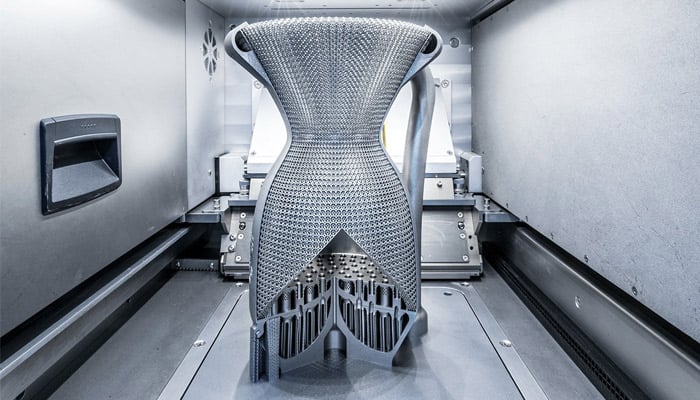
3D printed part for aerospace. Image courtesy of Nikon SLM Solutions.
Nikon’s Digital Manufacturing business includes Nikon SLM Solutions and U.S. subsidiaries such as Nikon AM Synergy Inc. and Nikon Advanced Manufacturing Inc., which support additive manufacturing operations and sales. Together, these units focus on selling and servicing metal additive manufacturing systems and related technologies.
Because this segment has not grown as quickly as Nikon expected, the company decided to reduce the recorded value of these assets. Nikon said demand for large metal 3D printers has been slower than projected, and competition, particularly from Chinese manufacturers, has increased. As a result, it lowered its financial outlook for the Digital Manufacturing unit and recorded the impairment loss, which reduces reported profit but does not involve new spending.
However, some believe there may be more behind the move than just slower market growth. Macro analyst Matt Kremenetsky of 3DPrint.com noted that in 2022, Nikon had a reason to present metal additive manufacturing as very valuable when it acquired SLM Solutions. In 2026, he suggested, the company may have a different financial incentive as it reassesses performance and strategy.
Kremenetsky also pointed out that while Nikon recorded a large impairment tied to SLM, other additive acquisitions made around the same time saw only minor write-downs. In his view, this may signal a strategic shift rather than a retreat from additive. He suggested that SLM’s long-term value for Nikon may lie less in external machine sales and more in supporting internal production for Nikon’s semiconductor capital equipment business. Nikon operates multiple production facilities in California defense technology hubs, giving it proximity to aerospace customers as well as major U.S. semiconductor fabs.
He further noted that Nikon did not indicate plans to sell the business and, in fact, stated it believes the segment could improve by 2029. Kremenetsky compared the situation to Velo3D’s move toward Rapid Production Solutions, where additive capacity is used more directly for production services. Writing down goodwill, he explained, does not automatically mean liquidation. However, if the company is not planning to sell the business, the impairment may represent a significant reset in expectations and increased pressure on the subsidiary to improve performance.

Nikon AM Technology-Center. Image courtesy of Nikon SLM Solutions.
Nikon, however, said the impairment should not be viewed as a strategic retreat. In a statement provided to 3DPrint.com, Hamid Zarringhalam, CEO of Nikon Advanced Manufacturing, emphasized that the company’s long-term direction remains unchanged.
“Nikon’s commitment to Advanced Manufacturing remains unchanged. While the broader metal AM market has recalibrated and adoption timelines have extended outside of defense and space, our long-term strategy remains the same.“We firmly believe the Defense and Space markets, particularly in the U.S. and Europe, will experience accelerated growth compared to other sectors, and our holistic strategy over the past two years has positioned us well to capitalize on this opportunity. In addition to our great progress in the defense sector, we have also just recently closed additional NXG orders that validate our value proposition and the importance of our technology for space applications with highly strategic customers, as well.“We are not in any way altering our market focus, customer strategy, or our unwavering commitments to our customers. While the overall Metal AM market itself has not grown as the industry anticipated, Nikon Advanced Manufacturing is making steady progress in delivering comprehensive, holistic metal AM solutions to our customers,” expressed Zarringhalam.

At the Long Beach, California, State of the City 2025 address, Mayor Rex Richardson invited Nikon Advanced Manufacturing CEO Hamid Zarringhalam on stage. Image courtesy of Nikon Advanced Manufacturing.
According to the company, the write-downs hit Nikon’s profit for the quarter and will affect overall earnings results for the year ending March 31, 2026. Nikon has also revised its outlook for the Digital Manufacturing segment, expecting lower revenue and larger operating losses than previously forecast.
Still, in its financial reports, Nikon said demand for large metal 3D printers is still expected to grow, especially in defense and space. However, the company plans to reduce costs and narrow its research focus.
The impairment does not mean Nikon is shutting down its Digital Manufacturing business. The company still owns and operates those units. The charge reflects lower expectations for future performance, not an immediate change in operations.