
A research team from the University of South China and Purdue University developed a new type of steel designed specifically for 3D printing, using machine learning to guide the process. The result is a strong, corrosion-resistant material that is also easier to produce.
This is important because materials are still one of the limits in 3D printing. A lot of the metals used in 3D printing today weren’t made for it. They were developed for things like casting or forging, and then adapted later. That can lead to issues like uneven strength, internal defects, or parts that don’t come out the same every time. More recently, though, companies and researchers have started to create materials specifically for 3D printing. This work follows that approach by designing a material from the ground up for 3D printing.
A New Approach to Designing Materials
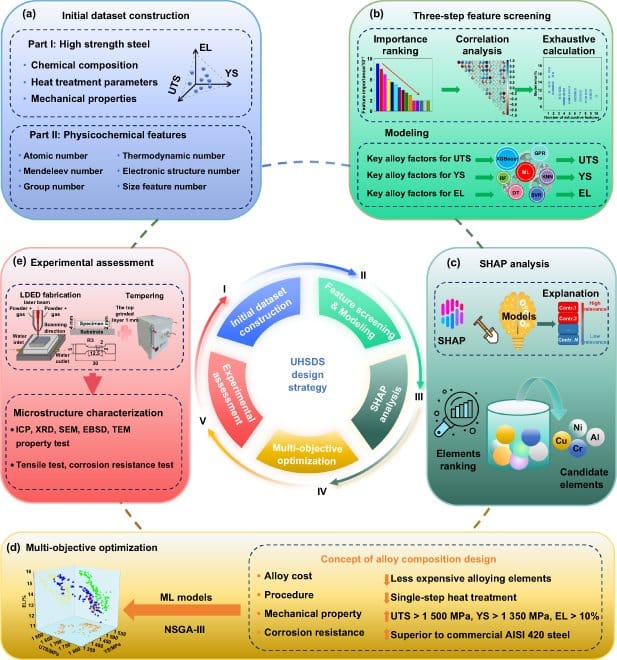
In this case, the team used machine learning to analyze how different elements and processing conditions affect steel performance. Instead of relying on trial and error, they trained a model using dozens of physical and chemical parameters. This allowed them to predict which combination of elements would deliver the best results.
In total, the system evaluated more than 80 variables, including how different elements behave and how they affect the metal during printing. It used this data to predict a composition that balances strength, ductility, corrosion resistance, and cost. The researchers then 3D printed the alloy and tested it to confirm the results. The material was not just simulated. It was actually printed using laser powder bed fusion (LPBF) and then tested through mechanical and corrosion evaluations to confirm the results.
This is a key part of their research, which is detailed in the paper “Interpretable machine learning integrated with physicochemical feature for developing additively manufactured ultra-high strength and ductility steel,” published in the International Journal of Extreme Manufacturing. The work was led by Yating Luo, Cunliang Pan, Xu Ben, Xudong An, and Hongmei Zhu at the University of South China, with Xiaoming Wang contributing from Purdue University, and supported by the National Natural Science Foundation of China.
The team also produced the material using laser powder bed fusion (LPBF) and tested it, showing that the approach works in practice.
Designed for 3D Printing with Strong, Durable Performance
Most metals used in AM today were originally developed for traditional processes like casting or forging and later adapted for 3D printing, which involves very different conditions. For example, widely used alloys such as stainless steel 316L, titanium Ti-6Al-4V, and nickel-based Inconel 718 were all created decades ago for conventional manufacturing. While these materials can be used in 3D printing, the rapid heating and cooling during processes like LPBF can affect their internal structure, leading to defects or reduced strength.
The new steel was designed with these conditions in mind. The machine learning model accounted for how the material behaves during the printing process, not just its final properties, making it better suited to additive manufacturing from the start.
According to the researchers, the new steel stands out for its performance. The material is both very strong and able to bend without breaking, which is a difficult balance to achieve. This means it can handle heavy loads without failing suddenly. It also resists corrosion so that it can perform better over time in harsh environments. This is especially important for industries like aerospace, energy, and marine, where parts are exposed to stress, heat, and moisture.”
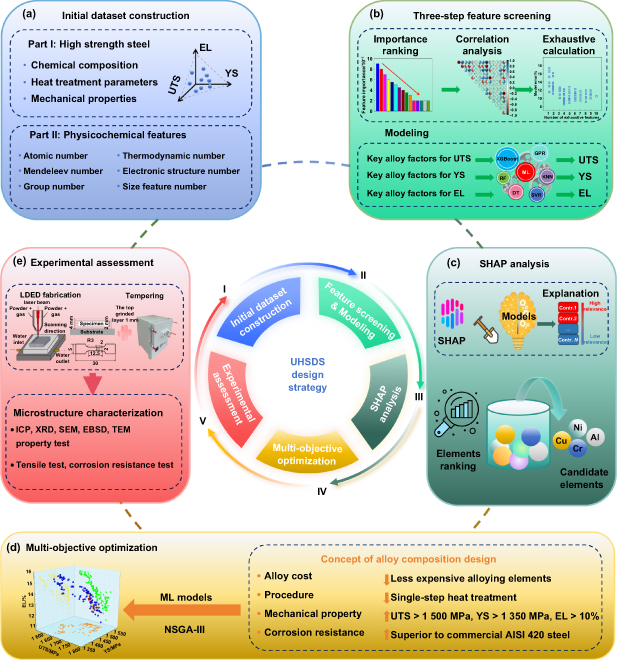
How the team used machine learning to design and test the new steel. Image courtesy of Yating Luo, Tao Zhu, Cunliang Pan, Xu Ben, Xudong An, Xiaoming Wang, and Hongmei Zhu.
Another big advantage is cost. Many high-performance steels used in 3D printing use expensive elements like cobalt or high amounts of nickel. They also go through complex heat treatment steps after printing. This new alloy uses fewer of those costly elements and only needs one heat treatment step, which takes about 6 hours. That makes the process much simpler. Overall, this could make the material easier and more affordable to use at a larger scale.
Why This Matters for 3D Printing
More researchers and companies are starting to design materials specifically for the process. This could help expand where 3D printing can be used.
Industries like aerospace and defense need materials that can handle stress, heat, and long-term use. If new alloys can meet those needs while also lowering cost and simplifying production, adoption could grow. Machine learning also plays a key role here. Instead of testing many options over time, it helps narrow down the right material much faster.
The new steel is still at the research stage. It has only been tested on printed samples, and more work is needed before it can be used in real parts.
At the same time, this is part of a growing effort to design materials specifically for 3D printing, instead of adapting existing ones. That approach could make metal 3D printing more practical over time.