
In May 2025, Joris Peels, as is his custom, wrote a prescient article about Unmanned Surface Vehicles (USVs) and Unmanned Underwater Vehicles (UUVs), i.e., drone boats. Listing a multifaceted range of cost advantages that maritime drones could yield compared with conventional maritime defense systems, Joris concluded that autonomous systems presented genuine potential to disrupt the world’s existing balance of naval power.
In 2026, of course, the US Navy is using drone boats in active conflict for the first time as part of operations in the war in Iran, and Iran’s success at maintaining an effective blockade in the Strait of Hormuz depends in no small part on kamikaze drone boats. Meanwhile, the US Navy recently announced it is setting up a marketplace for medium USVs.
This is the context behind Red Cat Holdings, the Salt Lake City-based manufacturer of autonomous defense systems, forming a partnership between its maritime division, Blue Ops, and Florida’s HADDY, a contract manufacturer leveraging robotic-arm 3D printers to produce large-format components. Under the deal, HADDY will equip Blue Ops’ Valdosta, Georgia, production site with its robotic additive manufacturing (AM) systems enhanced with Agentic AI.
According to Red Cat, the move will double Blue Ops’ existing manufacturing capacity, while HADDY will also give the division the option to continue to scale production through the contract manufacturer’s own network. In addition to enabling faster production timelines and the performance improvement associated with quicker iteration cycles, Blue Ops aims to provide on-demand order fulfillment for its customers.
HADDY is one of a number of companies that have benefited over the last couple of years from the growing viability of, and resultant increasing market interest in, the combination of robotic arms and extrusion printheads. In July of last year, HADDY was one of four startups chosen to participate in the Disney Accelerator program.
In a press release about the partnership between Red Cat’s Blue Ops maritime division and HADDY, Barry Hinckley, the president of Blue Ops, said, “This partnership advances our ability to iterate at the speed of modern conflict. This also underscores a shift in how boats are built. The industry has seen moments like this when fiberglass replaced wood, and we’re seeing a similar transition now with large-scale 3D printing. This fundamentally changes how quickly we can move from concept to deployment and gives us the ability to meet demand at scale in ways the industry hasn’t seen before.”
Jay Rogers, HADDY’s co-founder and CEO, said, “Manufacturing is moving toward a more distributed and scalable model, and large-scale robotic 3D printing is a key part of that shift. By combining production technology with a global microfactory network, we can build complex systems more efficiently and closer to where they are needed. Blue Ops is early in applying this approach to maritime systems, and it has the potential to reshape how these platforms are produced and deployed.”
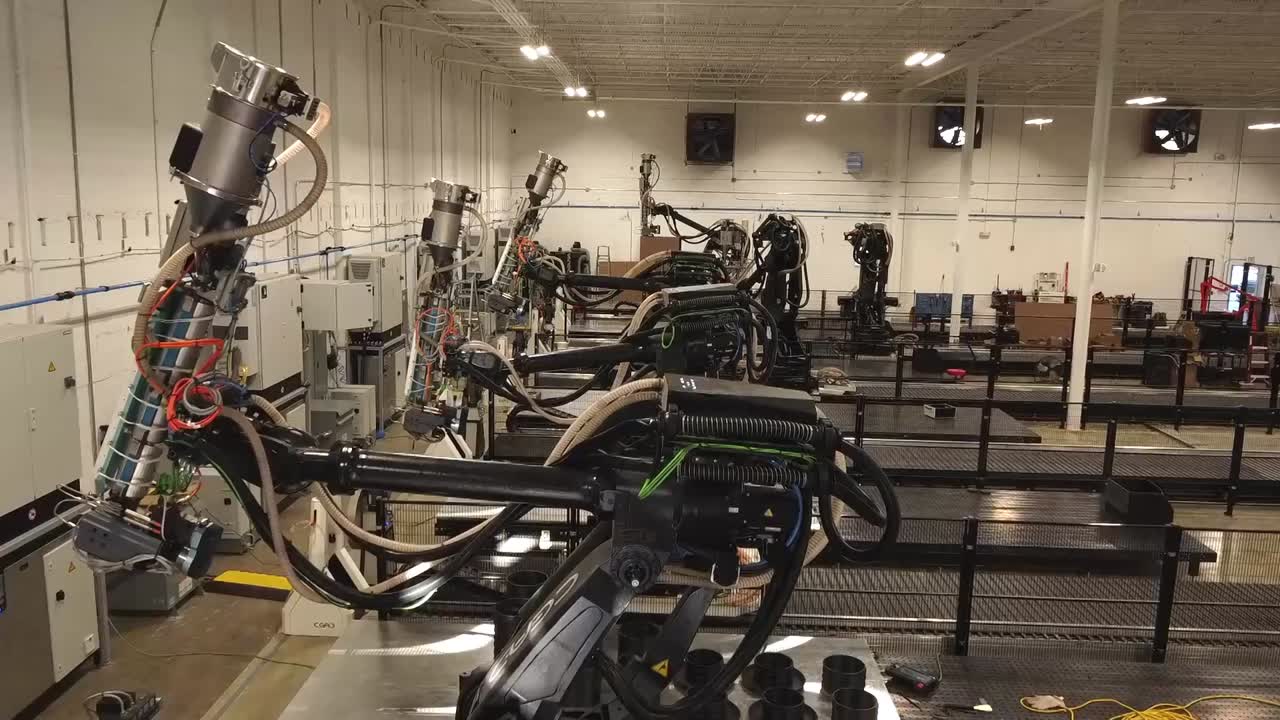
HADDY’s St. Petersburg facility. Image courtesy of HADDY
In the press release, Blue Ops’ president also noted that cybersecurity was a factor in the company’s decision to select HADDY as a partner. It is inevitable that IP protection and overall OpSec will play an increasingly primary role in how companies leveraging AM choose their partners.
With that in mind, it has probably gone under-appreciated, the extent to which cybersecurity considerations may, on their own, accelerate interest in reshoring. Even as all stages of contemporary manufacturing workflow become more digitalized — on the one hand, opening up the potential for more far-flung supplier relationships than ever before — on the other hand, manufacturers are obviously going to want to establish close-knit relationships with any partner that has comprehensive access to their data.
Thus, in the early phases of distributed manufacturing, it’s probable that we’ll see more and more partnerships like the one between HADDY and Red Cat/Blue Ops, where manufacturing relationships become both more localized and more distributed simultaneously. This is particularly likely given that the sectors most responsible for driving reshoring interest are already the most strategically critical.
In the same vein, the next five years of demand drivers for manufactured goods in a nation like the US will go a long way towards defining the interests of the next generation of US manufacturing personnel. That is, in the same way that a nation experiencing an automotive boom in the 1950s had a broader manufacturing sector for the rest of the 20th century that was disproportionately shaped by the auto sector, the minds currently getting started in manufacturing by making drones with 3D printers could shape US manufacturing for the rest of the 21st century.
Featured image courtesy of Red Cat