
Associate Professor Hang Yu, along with researchers Donnie Erb and Nikhil Gotawala, has used Additive Friction Stir Deposition (AFSD) to make shape-memory ceramics. Published in Materials Science and Engineering R: Reports, the paper “Solid-State additive manufacturing of shape memory ceramic reinforced composites” details the making of a solid-state shape memory composite.
Based on friction stir welding, AFSD, also called Friction Stir-based Additive Manufacturing (FSAM), Friction Stir Deposition, and Additive Friction Stir Deposition, uses bar stock to deposit fully dense parts with little in the way of residual stress. Like cold spray and ultrasonic processes, this is a solid-state process and usually requires post-processing in the form of milling or other surface treatment, while the microstructure is good. Raw material cost is low, build rates and part sizes are high, while part complexity and detail are low. You can make gradient parts and use different alloys together in this process, which is very under hyped. Due to a lack of startup champions and extensive use in super-secret things like armor, not to mention the lack of a coherent naming standard, this process is being worked on extensively in research and in end-use products without being talked about much.
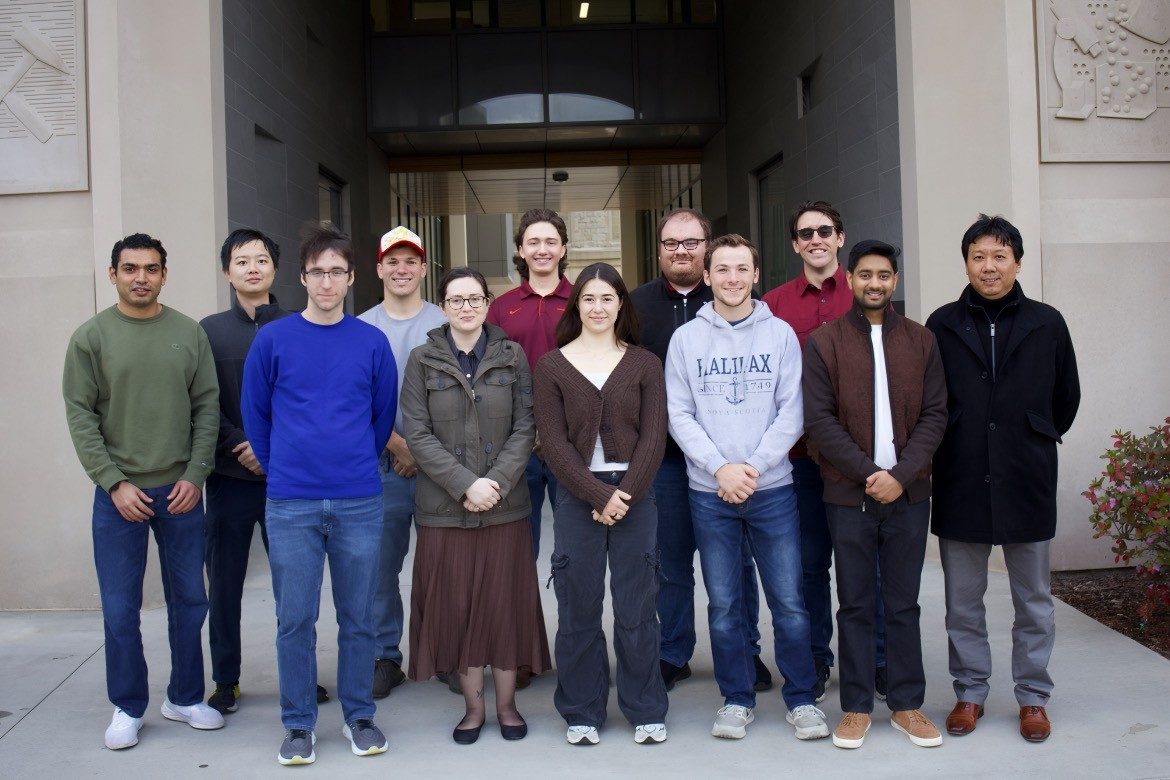
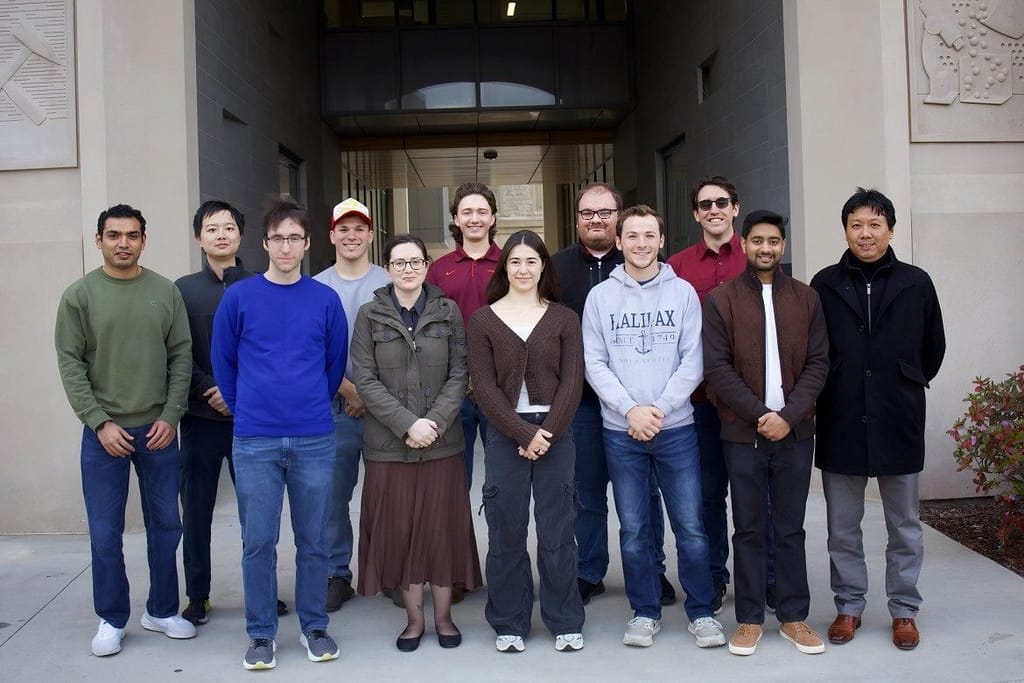
Associate Professor Hang Yu (at right) poses with members of his lab, including Nikhil Gotawala (at left) and Donnie Erb (third from left), Yu’s co-authors. Image courtesy of Hang Yu.
Meld has commercialized this process, while Mazak is also active in deploying it, and indeed, the two work together. Friction stir could make for large-scale repairs, large parts for the Navy, but also could lead to cost-effective components for land forces. Coupled with gradient parts, this could bring additive into meter-sized parts in critical applications. When coupled with evenly embedded ceramic particles, this process could produce parts with very interesting properties. Furthermore, “melding” materials like this could produce a whole family of composite materials with wholly new properties. Melding could be a simple way of creating a new variant of a material for a particular purpose without going through the costs of making a new alloy. Can we call it a Malloy?
The Virginia Tech team has made “defect-free material that can phase-shift under stress to dissipate energy and, unlike normally brittle ceramics, can be 3D-printed in bulk with full density in the as-printed state, opening up possibilities for practical applications in defense, infrastructure, aerospace, and even high-performance sporting equipment.”
Or as Yu says it, “This composite can afford tension, bending, compression, and absorb energy through stress-induced martensitic transformation. In that sense, it’s multifunctional. That allows us to move toward making big things with the potential for real applications. For the first time, this research creates bulk shape-memory ceramic–metal matrix composites using a scalable, solid-state 3D-printing process.”
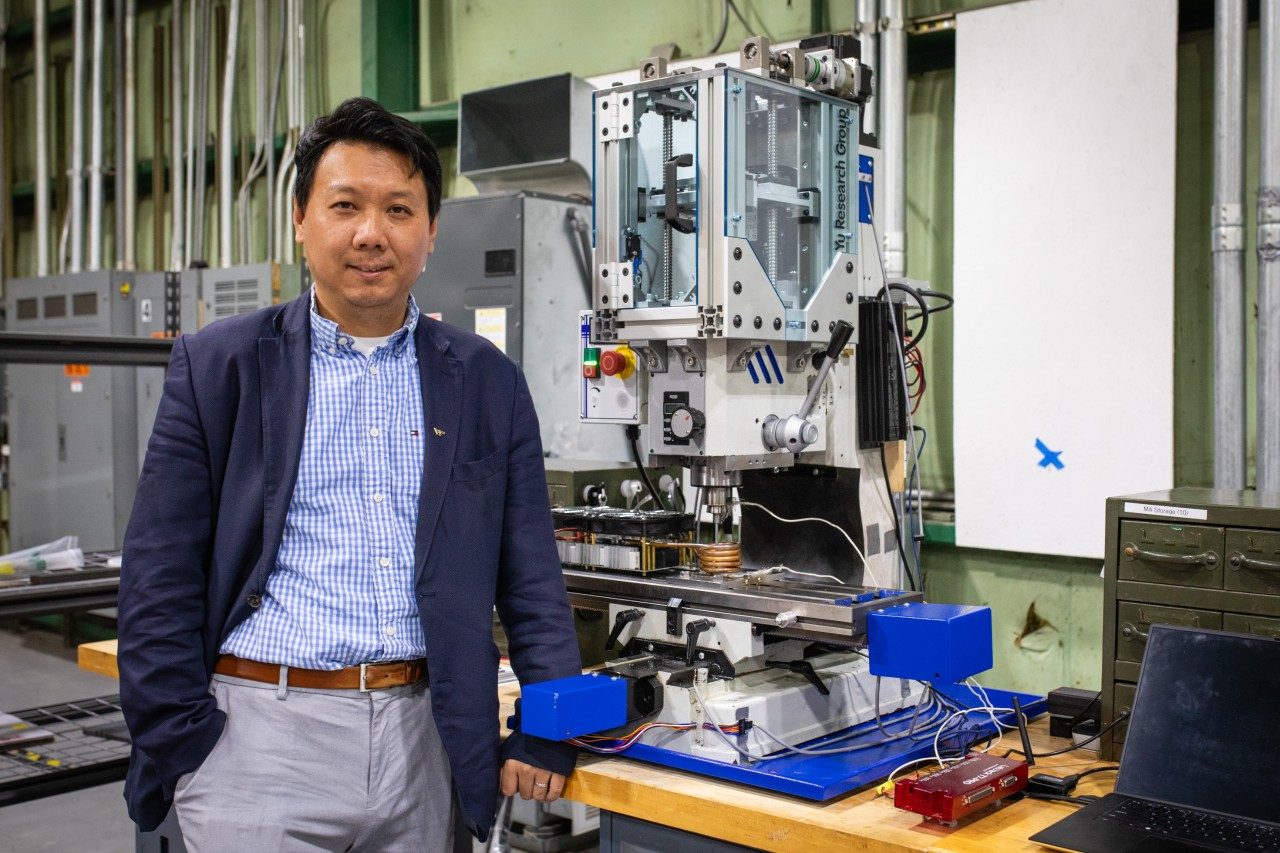
Hang Yu, associate professor of materials science and engineering, uses a miniaturized additive friction stir deposition machine in his advanced manufacturing research. Image courtesy of Peter Means for Virginia Tech.
I find it a little difficult to get my head around this at the moment, but this could be a new frontier. The team says that it could find uses in vibration-dampening or impact-absorbing materials and sporting goods. Radar, antenna, and missile seekers would be more expedient applications in my view, but feel free to put this into tennis rackets if you wish. I’m sure that Airbus, Boeing, NASA, the NSF, the Army, Northrop Grumman, EWI, the DoE, Lockheed Martin, and Bechtel‘s extensive work on this, since the early 2000’s, is driven by their strong desire to make better tennis rackets.
In this research, the ((Zr0.88Ce0.12)O2) shape memory material is used in a 20% mix with either copper or Al-Mg-Si alloys. Tougher materials that can be predetermined to transform in specific ways could find their way into a range of aerospace and defense applications. An easier way to make custom materials for such applications with many different properties would also lead to specialized composites that could advance a myriad of conductive, RF, turbo machinery, and seawater usage applications. This is a notable advance in letting additive make new materials for cutting-edge new uses.