The hottest toy in 2017 was undoubtedly the fidget spinner, which initially began as a tool to help students with ADHD and special needs relieve anxiety and refocus their energy. But they’ve grown in popularity since then, and the market is massive, with millions of self-soothing fidgets owned by children and adults alike. Singaporean product designer Jennifer Ang is one of the many people using 3D printing to create fidget toys.
“As a product designer, I found it so amazing that 3D printers can turn ideas into reality almost instantly,” said Ang, solopreneur of Heyo.makers, a gift shop for customized 3D printing. “You can do testing within hours, without sending it to a supplier for mock-ups and waiting a week.”
Ang first used 3D printing when she was an Industrial Design student at Nanyang Polytechnic, and continued to do so at her first job as an industrial designer for a design consultancy firm. At the same time, she was also teaching classes on product design and 3D printing, and eventually left her full-time role for a part-time one to pursue a bachelor’s degree in design from the Singapore Institute of Management (SIM) and Royal Melbourne Institute of Technology (RMIT).
At her own business, Ang offered product design services and taught courses, and in 2017 purchased her first 3D printer, from Taobao, which was the opposite of a plug and play system. At first, it was just a personal hobby, but like so many others, Ang had to pivot during the pandemic, and started selling customized 3D printed keychains, coasters, phone stands, and bag tags on Shopee. She eventually invested in some better printers, like the Bambu Lab A1, which enabled her to eventually sell her products on Carousell, Lazada, and TikTok.
Ang wanted to expand into pop-ups, but realized that her custom 3D printed offerings weren’t conducive to that kind of business; not everyone has the time to wait an hour or more for a product to be fabricated. That’s when she had the idea to sell fidget toys, specifically fidget clickers, at a pop-up.
“Many of us fidget as a way of emotional self-regulation. We may click on a pen, twirl our hair, play with jewellery or tap on the table to soothe anxiety,” Ang explained.
“That is how fidget clickers work. And in some ways, they can be a habit replacement – to fidget in a nicer way.”
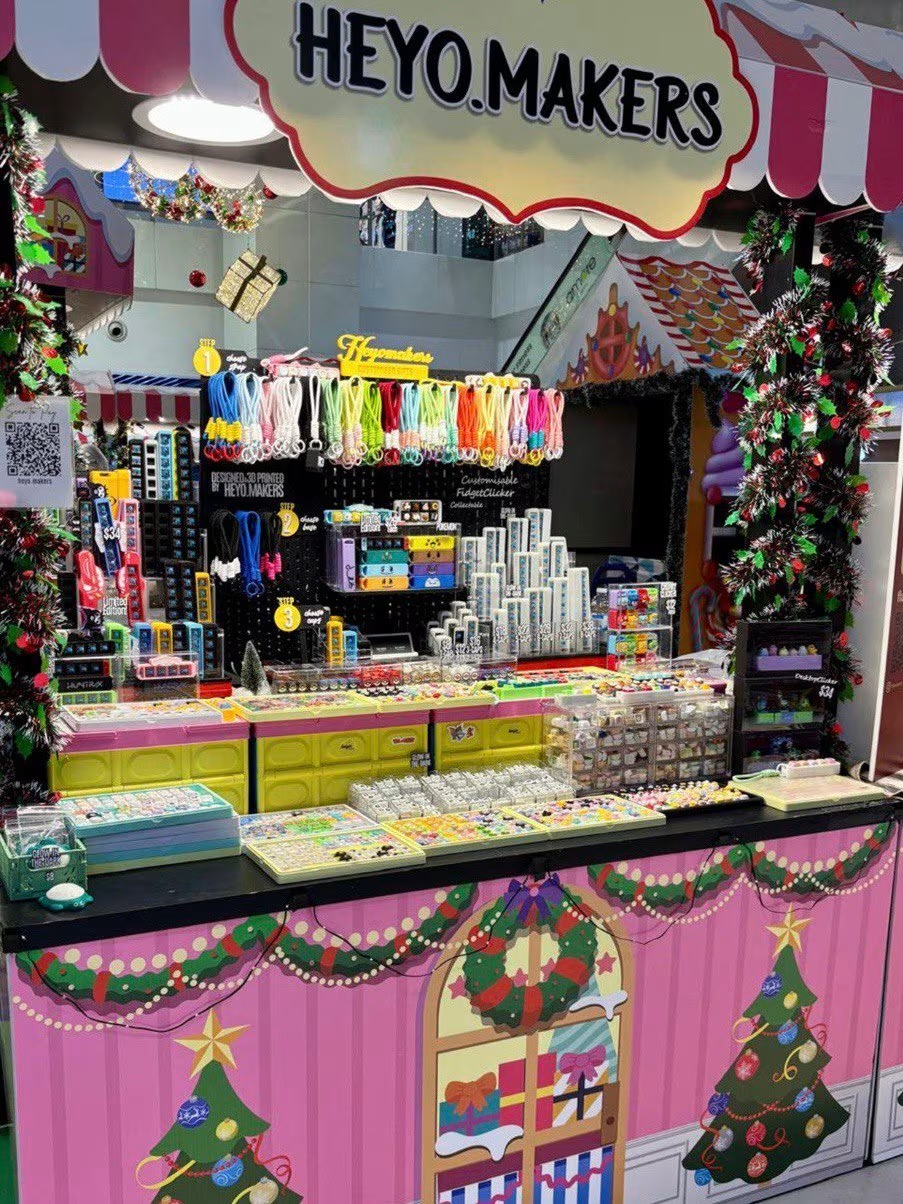
These fidget clickers are exclusively available at heyo.makers’ pop-up stores. (Photo: heyo.makers)
Ang, like me, is a pen clicker, noting that she finds “the click and bump therapeutic” and that it helps her focus. She realized she could get the same feeling from her computer’s mechanical keyboard, and decided the products at her pop-up shop would be fidget clicker keychains, with customizable keycaps she designs and prints at home.
The Heyo.makers keycaps feature designs like cursive fonts, smiley faces, cute characters, and Singaporean snacks. While they can be used on a custom keyboard, they’re actually meant to go on a keypad-like keychain base that you can attach to your bag and click to your heart’s desire.
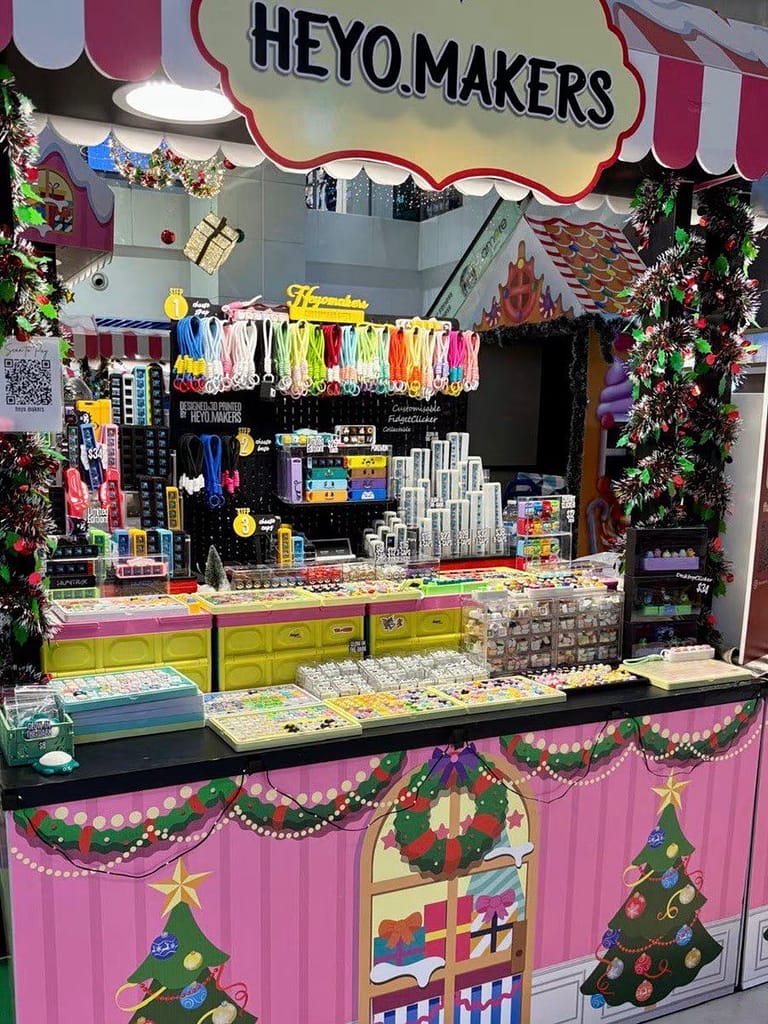
Ang ran her first pop-up in the fall of 2025, and 3D printed about 200 keycaps to sell at PLQ Mall in Paya Lebar. While she was initially worried that they might not sell, customers ended up buying around 30 fidget clickers with 120 keycaps on her very first day.
She said, “I thought that fidget clickers would appeal more to kids, but it turns out that adults like them as well, especially women.”
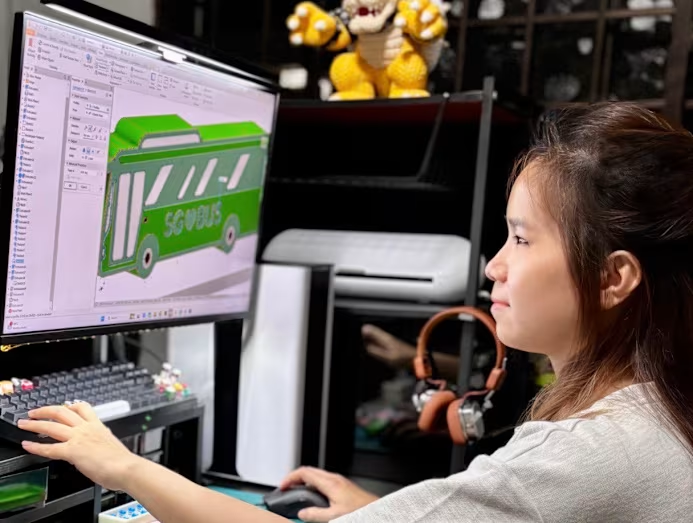
The design and printing of fidget clickers are very precise. “0.02mm off and the keycaps may not fit well in the base,” says Ang. (Photo: heyo.makers)
The clicker base comes in different sizes, holding anywhere from one to nine keycaps. Customers can choose from more than 400 different keycap designs, and three types of clickers: one with a loud click and bump, another with just a bump, and one that’s very quiet. Prices for the fidget clickers and keycaps range from S$8 to S$48.
Ang’s first pop-up did so well, she’s since offered four additional ones at other locations, and has sold over 1,000 fidget clickers since October of 2025. She only offers the clickers at her pop-ups, but still sells her other 3D printed products on e-commerce platforms.
“What I love most is the chance to bring my own ideas to life while connecting directly with customers,” Ang said. “Seeing people enjoy what I create is incredibly rewarding.”
She may even expand to creating custom keyboards or other kinds of fidget toys, noting that “once you know how to do 3D design, the possibilities are endless.” This is yet another example of how 3D printing can be a really great tool for small businesses!