
The US-Israel war on Iran is already catalyzing the sorts of major shifts to global supply chains that will effectively amount to permanent economic changes. In this context, the nations that were already on a course towards localizing production in response to the disruptive developments of the first half of the 2020s can be expected to accelerate that trajectory.
That acceleration effect should lead to market conditions that push the additive manufacturing (AM) industry’s overall agenda in a direction primarily set not by the industry itself, but by which verticals find themselves in most urgent need of an agility boost. Long before the world’s latest war started, we were already seeing this happen with the defense sector: this helps explain why Hannover Messe 2026 (April 20-24), “the world’s largest industrial trade fair”, will feature a ‘Defence Production Area’ for the first time in the show’s history.
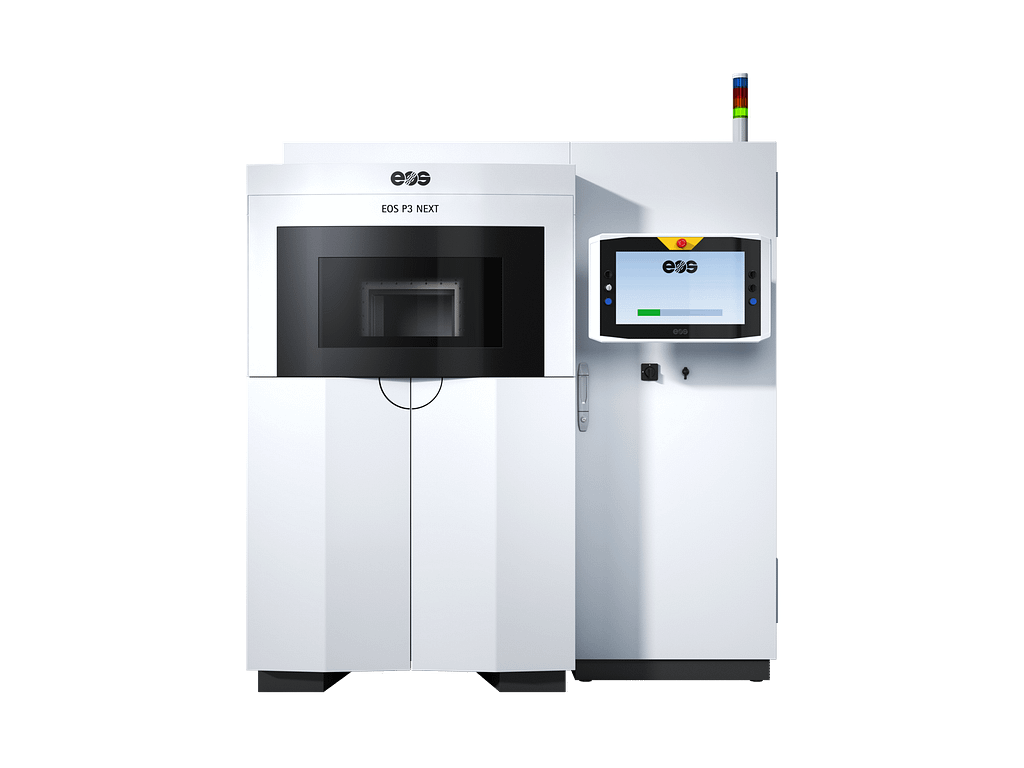
The German-US company EOS will be one of the participants in that exhibit, but there are multiple other elements to the company’s overall presentation that align with the most relevant themes at the intersection between AM and international industrial transformation. One of the themes involves the Siemens Innovation Hub, where EOS and the multinational giant will emphasize how combining AI with the P3 NEXT polymer printer supports strategies for adaptive manufacturing, the defining concept of last year’s America Makes’ MMX event.
Specifically, in terms of reshoring, arguably the most immediately practical solutions on display from EOS are also those with the most tried-and-true record of aiding industrial resilience: tooling. Hannover Messe attendees can visit the EOS booth, G44 in Hall 26, to find out more about applications, including robot grippers, tooling for fiber packaging molds, and vibratory bowl feeders, which are used to move small parts in uniform directions on assembly lines.
In a press release about EOS’s participation in Hannover Messe 2026, Nikolai Zaepernick, CSO at EOS, said, “EOS has been a pioneer in industrial 3D printing for metals and polymers for more than 30 years. We integrate systems, materials, and digital processes into exactly the solution customers need for futureproof manufacturing — and we’ll be showcasing this in full force at the Hannover Messe.”
Meanwhile, Davide Iacovelli, Regional Director, EMEA, for EOS, noted, “In the mid-volume range, the EOS P3 NEXT enables individualized series production. At the Siemens booth, visitors will see the concrete customer value this provides. Specifically, this means shorter development and manufacturing cycles, greater flexibility in product design, and significantly higher process reliability across the entire production chain.”
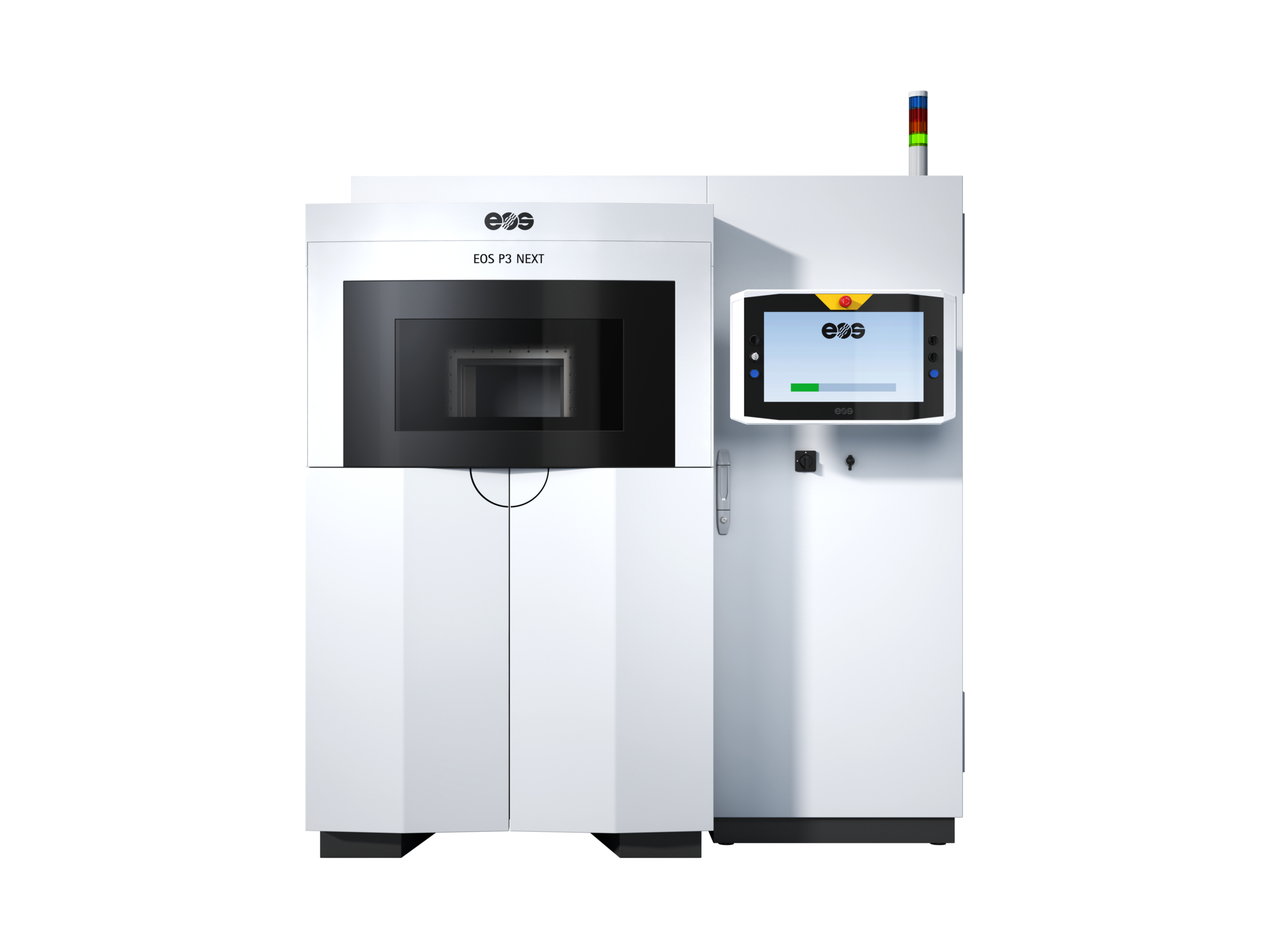
The EOS P3 NEXT.
Perhaps reality will play out differently, but as of right now, EOS is better positioned than virtually any other original equipment manufacturer (OEM) in the AM space to capitalize on the epochal changes currently imminent in the global economic order. A large part of this is indeed about defense, but only because of the precise dual-use framework that EOS has cultivated for its ecosystem.
We’re entering a period in which new, unexpected shortfalls will arise on a regular basis, and contract manufacturers will need to pivot as painlessly as possible from one product category to another, and from one sector to another. The decision-making process about which country is optimal or even permissible to obtain one’s supplies from is going to preside over supply chain choices more acutely than ever before. A company with equal footing in the US and EU, which has just signed a major trade deal with the other, has an opening for outsized growth compared to its peers.
Above all, it is those boring parts, like robotic grippers, that might give an OEM the edge, because they provide a baseline level of industrial versatility across the most diverse range of industries. You don’t even have to be able to provide the solutions that can directly create the most end-use parts; you might just have to provide the solutions that can indirectly ensure that the least number of orders arrive late or incomplete.
Most AM companies that are currently succeeding are doing so by finding a single niche and perfecting it. That will continue to be a viable strategy, but I think we’re on the cusp of a moment when a select number of AM companies can also find success by maximizing versatility, and that is an opportunity where EOS has a real chance to thrive.
Images courtesy of EOS