I was surprised by just how many 3D printing companies and 3D printing projects there were at Ceramitec this year. I came away from the show convinced that the ceramics industry needs to pay even more attention to 3D printing, and that the 3D printing industry needs to pay more attention to ceramics. Ceramics work when all other materials stop. But due to a lack of familiarity, engineers and companies often underutilize them. Additive manufacturing is a relatively new path from file to part that opens new avenues for high-performance ceramics. This can help grow our industry and the ceramics industry. High-value, specific geometries in semiconductor, electronics, defense, medical, and industrial applications can really make a difference in millions of parts. Unlocking these new applications will not be easy, but that’s not stopping firms from paving the way.
I really like the work of the Friedrich-Alexander-Universität Erlangen-Nürnberg (FAU Erlangen-Nürnberg): their glass and ceramics department, by way of Professor Kyle Webber, showed off some nice research. Their Glass and Ceramics Institute is looking at several different methods used to 3D print ceramics. From robocasting to material extrusion, they seemed to be doing interesting research. Work on tailored microstructures seemed promising, but I was most intrigued by their work on ceramic-doped resins for use on low-cost 3D printers. That could really make ceramics much more accessible.
Durst subsidiary D3 showcased progress on micro particle jetting. The company has sold its first LAB II 400 x 480 x 160 mm MPJ machine, and touts dense ceramic components. In contrast to many light-driven processes, the firm hopes that they will make working with dark ceramics easier. The machine currently works with aluminum oxide (Al₂O₃) and sintered silicon carbide (SSiC), which could really be of interest to many firms.
Another firm working in material jetting, Amarea, makes the MMJ ProX Series. This is a hybrid 3D printer that combines jetting and a laser to get the best of additive and subtractive manufacturing. There’s a pulsed fiber laser that can also use up to six jetting heads. The maximum build volume is 530 x 300 x 200 mm. The inline laser processing remelts, smooths build layers, and lets you selectively ablate sections. Surface roughness in Ra can be less than 0.5 microns, and this process can also produce functionally graded parts. I’d never heard of this firm, and it blew me away.
Chinese firm Ten Dimensions showcased its line of top-down and bottom-up vat polymerization systems. The company has small desktop research machines, as well as 600 x 600 x 350 mm DLP machines. Ten Dimensions can make you a custom line for your production application.
Lithoz showed off a semiconductor gas injector component with 62 small holes and a 0.2 mm wall thickness. The company showcased many emerging applications across semiconductors, medical devices, electronics, and industry. Lithoz seems to be moving further into large-scale production. The company also showed off some multimaterial parts, as well as ever finer parts. It was nice to see Lithoz partners such as Steinbach, Kyocera, and Sinto expanding their operations in serial production through increased production volumes and larger series. Sinto showcased quick-connect fittings, gears, and medical parts on its stand.
Sinto’s 3D Ceram unit, meanwhile, showed off some impressive space parts, as well as medical parts, made with HAP (Hydroxyapatite), TCP (Tricalcium Phosphate), and Alumina Toughened Zirconia (ATZ) for CMF and orthopedics. The company seems to be moving forward in this hard-to-penetrate field of implantable medical devices.
I am quietly falling in love with Schaeffler Special Machinery‘s OmniForm 3D. OmnifFusion is, of course, their multiple recoater multiple material LPBF solution. With OmniForm, three recoaters mix materials in a die. That die is then pressed manually or fused through HIP or other processes. The machines are so accessible, and this is potentially such a low-cost technology that I cannot stop thinking about them.
Exentis groups showed their stacking screen print additive technology. The firm reported headway in selling more machines and expanding into new use cases.
French firm Prodways was at the show with a renewed focus on ceramics 3D printing. The firm is now focused on DLP and with it, dental and ceramics. The Ceram PRO works with TETHON 3D SILICA SICAST 1200 and ALUMINA A100 resins and was built from the ground up for production. With dual-head light units, these highly productive systems are available for R&D and production.
Korean industrial 3D printing firm MADDE showed us some beautiful parts, including a wafer carrier (which they had with them at AMS), mirrors with mirror finish, and liquid-handling components made with its binder jetting technology.
Dutch firm Concre3de also showed off its Armadillo open binder jetting machine. That company was focusing, on the one hand, on making it easier for new market participants to use binder jet and develop new binder jet materials, while letting others move into manufacturing. The company has several SiSiC materials on offer and, with infrared heating and higher-speed printing, is now offering more production systems to clients.
French firm 3D Minerals showed off its large-scale gantry and robot-arm ceramic 3D printers. Using its Slurry Deposition Modeling technique, the firm adds a binder to the slurry as it is deposited. The company says this allows it to print large parts continuously. Rather than focusing on technical ceramics, this firm was pursuing architectural applications and ornamental work.
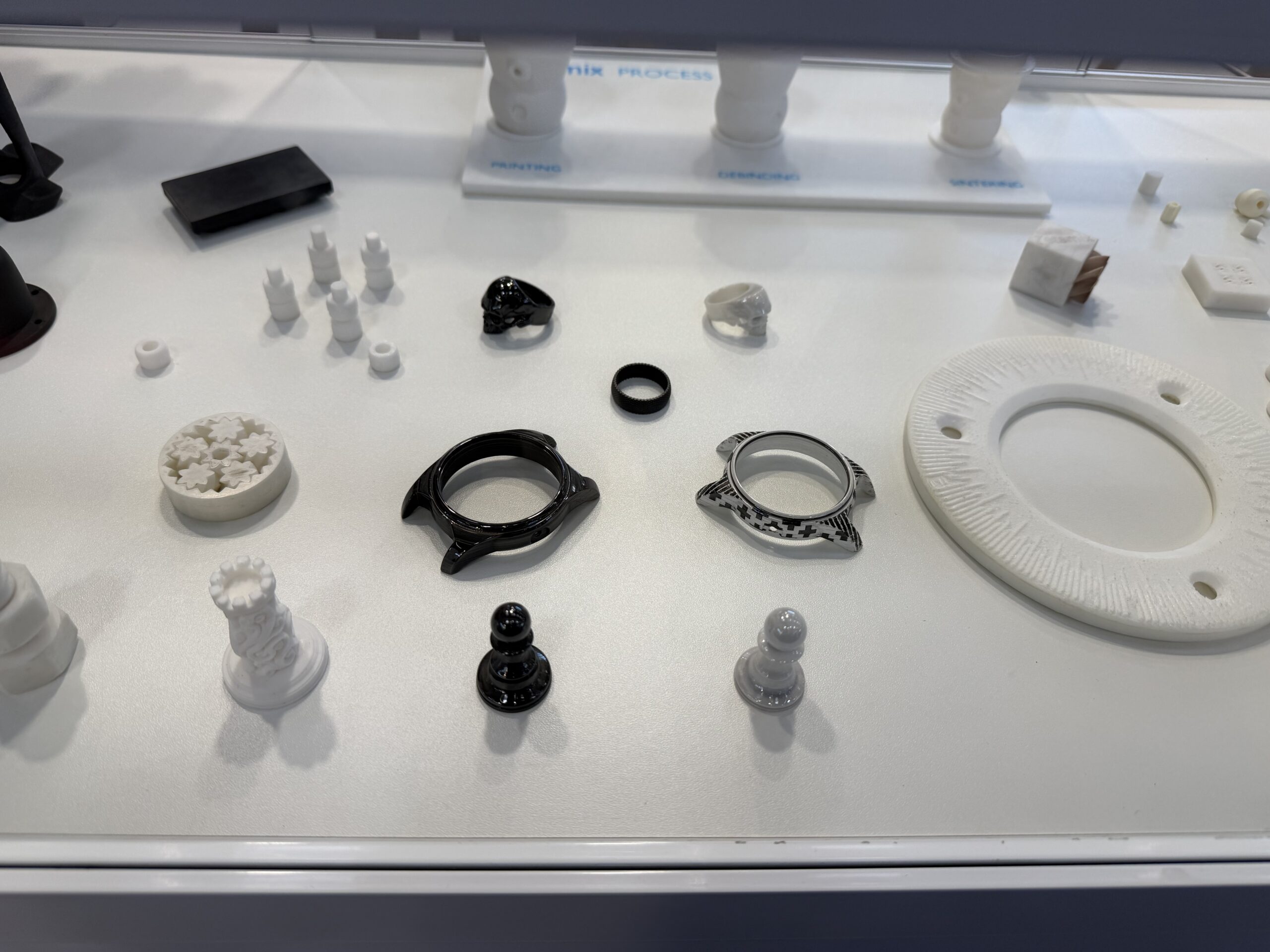
Nanoe brought Zetamix filaments to the show. Their stand demonstrated how a Bambu machine could 3D print complex ceramic components. The company showcased a ton of research parts across many industries. It was really staggering to see just how many researchers were using their process to make cutting-edge work, from RF antennas to satellite components. Meanwhile, they, too, are moving into ever-larger production volumes.
On the whole, we can see that there is real progress being made in 3D printed ceramics. Multiple players are moving from the lab into factories in multiple industries. The volumes are mostly modest to date, but the ramp-up is impressive, and we expect many millions of parts to be 3D printed in the future.