
For years, a lot of the discussion around China and additive manufacturing has focused on industrial competition. Can Chinese companies move into higher-end markets? Can they challenge Western machine makers in the metals industry? Can they become bigger players in high-end manufacturing?
While those questions might still be relevant, right now, China’s biggest impact in 3D printing is at the desktop level.
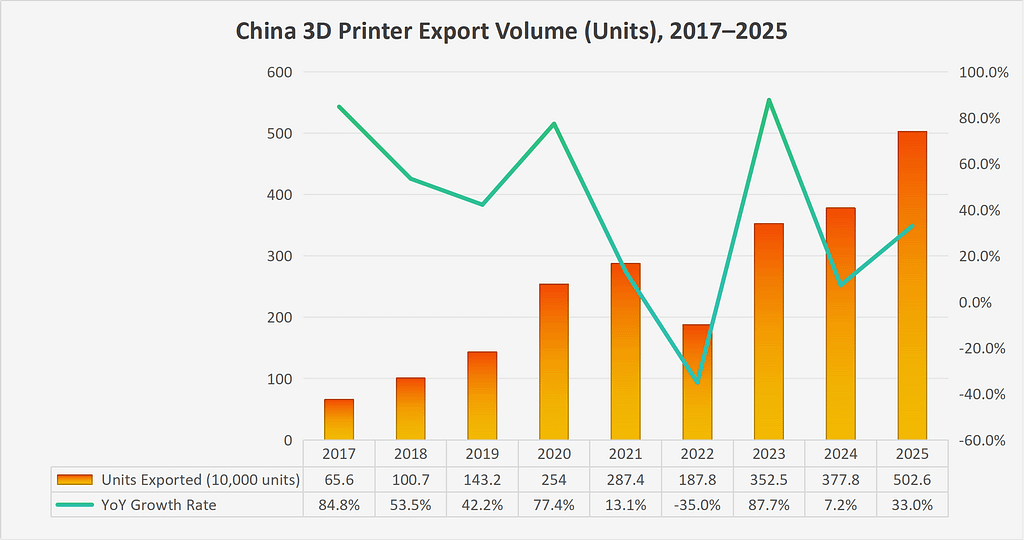
According to data shared by CBD Technology, China exported more than 5 million 3D printers in 2025. The total reached 5.03 million units, up 33% year over year, while export value rose to 11.36 billion RMB ($1.6 billion), up 39.1%. These figures are based on official data from the General Administration of Customs of China, with analysis from Nanjixiong (南极熊), one of the country’s leading 3D printing media outlets.

China’s 3D printer export volume. Image courtesy of CBD Technology/General Administration of Customs of China/Nanjixiong.
The broader dataset behind these numbers shows this is not a one-year jump, but part of a much longer climb. Based on the customs data, China’s 3D printer exports have grown from roughly 535,000 units in 2017 to about 5 million in 2025. Exports surged in 2020 and 2021, fell back in 2022, then rebounded sharply in 2023 and kept rising through 2025. Of course, the market has had ups and downs, but the broader direction over the last eight years is clearly upward.
CBD Technology said the vast majority of these exports are desktop and consumer 3D printers, especially plastic-based systems, with industrial machines accounting for only a small share of total volume.
What this really shows is that China is not just making machines; it is increasingly building the global installed base of desktop 3D printers.
What’s more, the export data shows how large that footprint has become. The United States was the top destination in 2025, taking close to 2 million units. Germany followed at roughly 1 million. Brazil, the United Kingdom, Canada, Australia, Poland, the Netherlands, Japan, and India also ranked among the leading markets, as shown in the graph below.
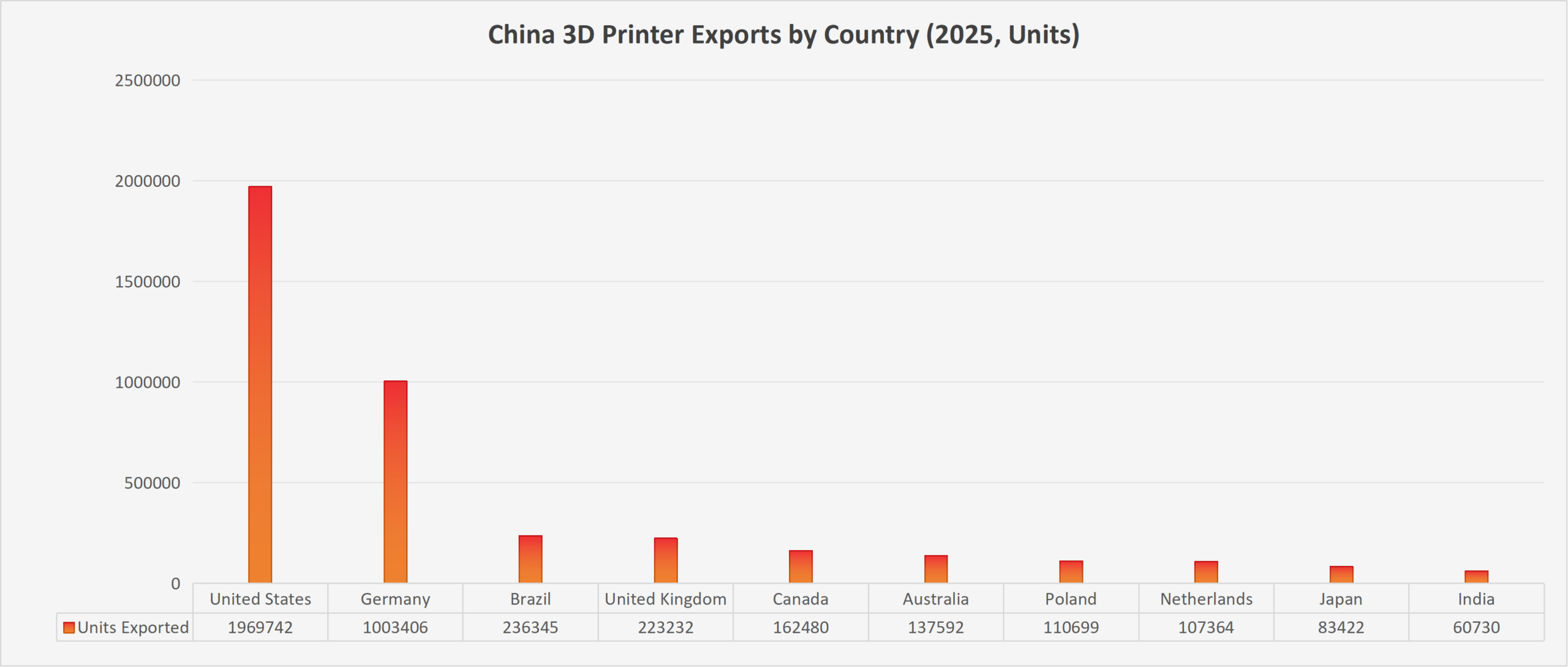
China 3D printer exports by country 2025 (Units). Image courtesy of CBD Technology/General Administration of Customs of China/Nanjixiong.
What CBD Technology told 3DPrint.com is that the growth is driven by a mix of rising global demand, improving technology, and cost advantages. According to the company, demand is growing across home use, education, and maker communities, particularly in the U.S., Germany, and Brazil. In 2025, the United States remained the largest destination by a wide margin at about 1.95 million units, followed by Germany at just under 1 million. After that came a much wider mix of markets, including the United Kingdom, Brazil, Canada, Australia, the Netherlands, Poland, Japan, and India. This is quite important because it suggests China’s desktop 3D printer boom is not tied to just one region or one type of buyer. It is spreading across multiple mature and emerging markets at the same time.
The exporter-location data also shows how concentrated this trade is inside China. Guangdong accounts for the vast majority of exports, at roughly 85% of 2025 volume, with Zhejiang far behind at around 9%. In total, Guangdong exported about 4.08 million units in 2025, compared to roughly 416,000 from Zhejiang. Other provinces contribute much smaller volumes, including Jiangsu (about 70,000 units), Shandong (about 60,000), Hubei (about 57,000), and Shanghai (about 39,000).
Visualization courtesy of 3DPrint.com.
This data, in particular, is quite interesting because it’s not random; it truly reflects where much of the industry is based. Guangdong, particularly Shenzhen, is home to many of China’s leading desktop 3D printer manufacturers, including companies like Creality and Bambu Lab, along with a massive network of suppliers, assembly, and electronics production. It’s a true hardware manufacturing cluster. The region also benefits from a highly integrated hardware ecosystem that supports design, manufacturing, and export at scale.
Zhejiang plays a smaller but still important role. Companies like Flashforge operate production facilities there, producing roughly 140,000 printers per year, and contributing to a secondary manufacturing base focused on export-oriented hardware and mid-scale production.
This kind of manufacturing base also helps explain how quickly the products themselves are improving. Desktop printers are getting faster, more reliable, and easier to use, driving wider adoption.
Consumer and prosumer 3D printers today are easier to use, more stable, and work right out of the box in a way they didn’t before. Features like multi-color printing and simpler software have made them more accessible to a much wider group of users.
And we’re starting to see that show up in real use. Just this week, we reported how Bambu Lab printers were used on the set of Superman (2025) to produce parts that went straight onto the screen. What started as a test quickly became part of the core workflow, with some printed parts used as final components, not just prototypes.
This is not just happening in film. H+R Drone Racing, for example, used Creality desktop 3D printers to design and produce parts for a fully functional drone, creating components that didn’t exist before and bringing them into real use.
This is all a big part of what’s driving this growth. China’s export rise is not just about low-cost printers. It’s about better printers now used to make real parts, not just to test them.
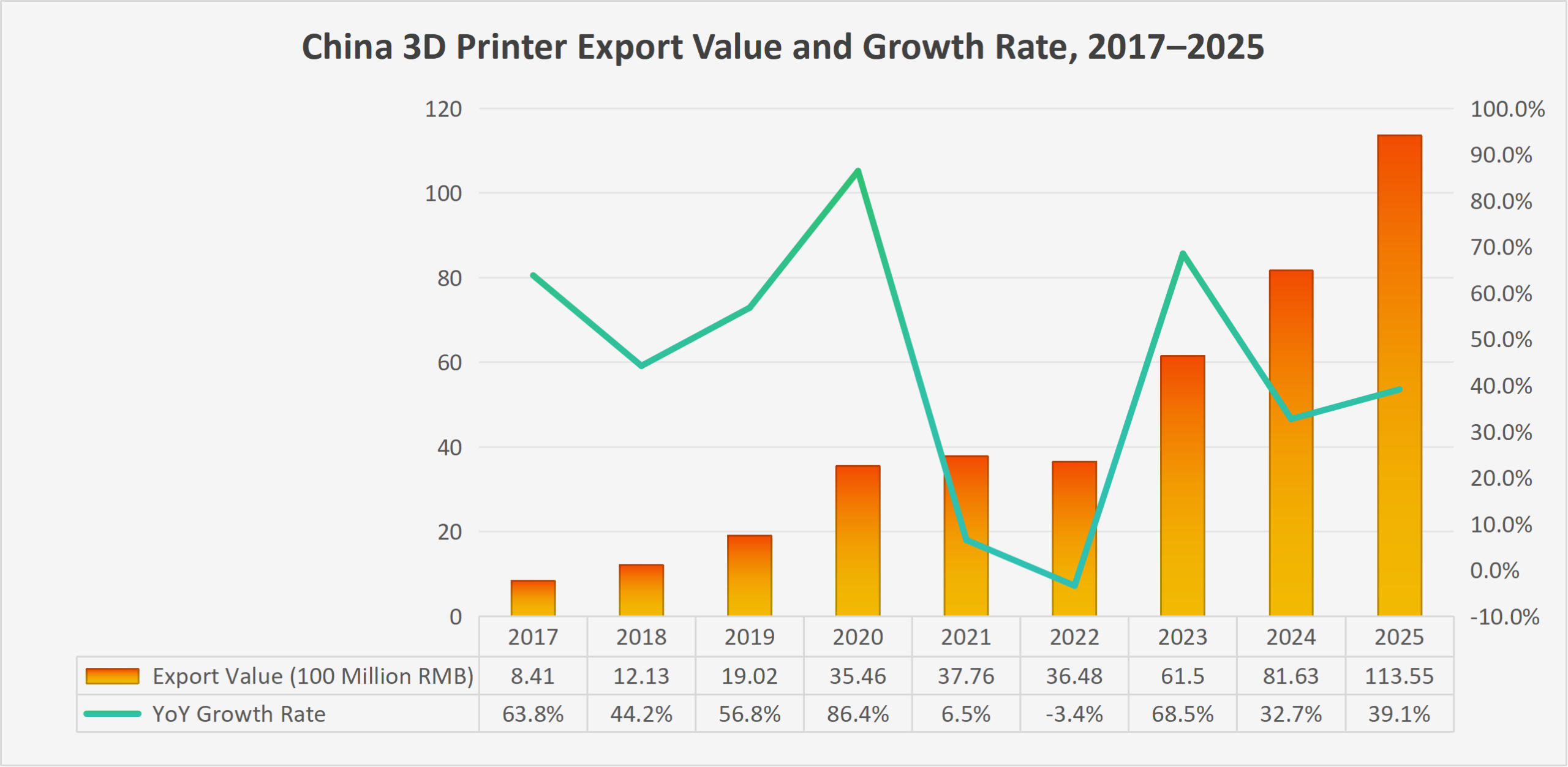
China’s 3D printer export value and growth rate. Image courtesy of CBD Technology/General Administration of Customs of China/Nanjixiong.
CBD Technology also pointed to what it sees as the next major trends in consumer 3D printing: multi-color printing, AI tools, and desktop SLS. According to the company, multi-color printing is becoming more common, AI tools are making design easier for new users, and desktop SLS could bring more advanced capabilities into the desktop segment.
The company said these features are helping make printers easier to use and expand what they can do, particularly for new users and small-scale production. They are also shaping what the next generation of desktop 3D printing looks like.
CBD Technology also said companies like Creality, Anycubic, and Bambu Lab account for the majority of China’s 3D printer exports. These are clearly the largest and most representative exporters.
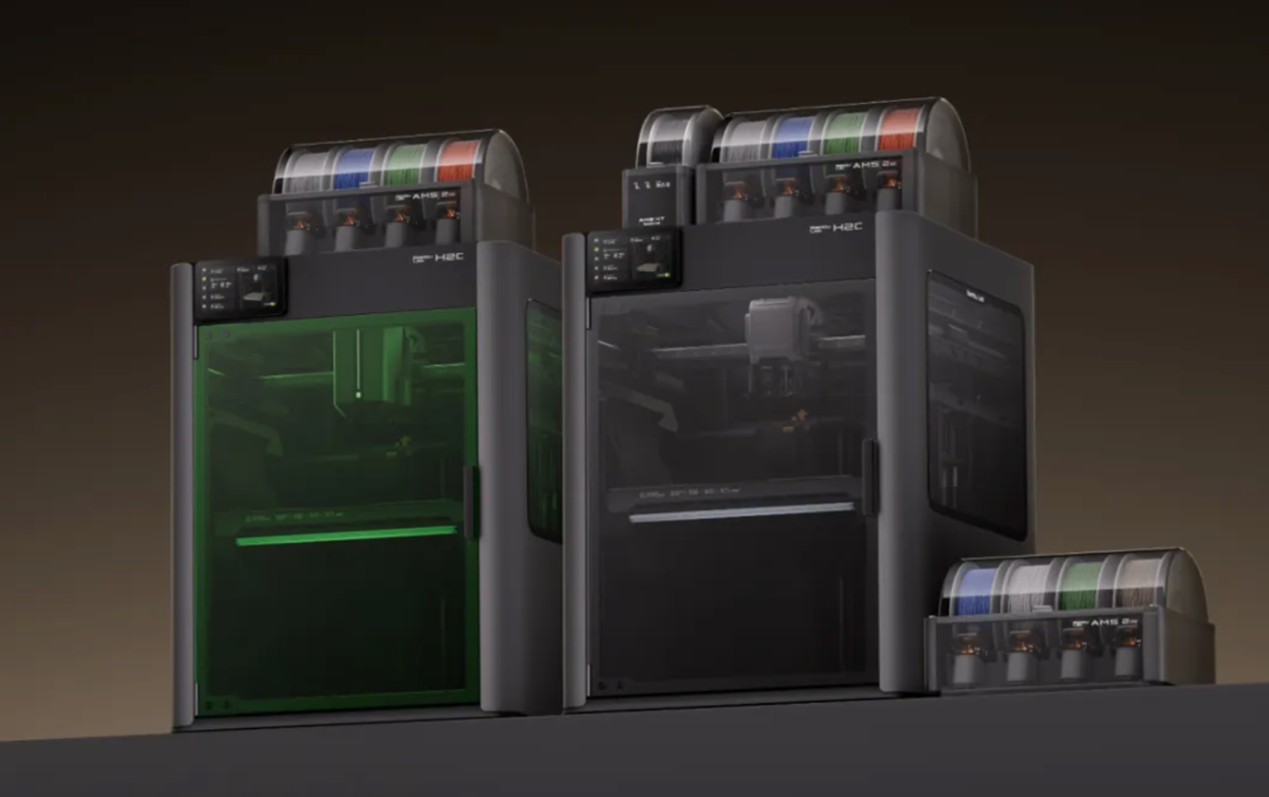
Bambu Lab H2C. Image courtesy of Bambu Lab.
This kind of scale changes the market as well. Millions of desktop 3D printers entering homes, schools, workshops, and small businesses expand the user base, increase demand for materials and software, and make the technology more familiar and accessible.
It also shifts where growth is happening. Instead of being driven only by large industrial systems, adoption is increasingly happening at the desktop level, across a much broader group of users. That may be the most important takeaway from the data. China is not just exporting more 3D printers. It is putting them into use at scale.