

Apple’s Apple Watch implementation is a shining example of additive manufacturing at scale. Apple now makes two watch cases and a port using additive. Now Bloomberg’s Mark Gurman has stated that,
“The company’s manufacturing design team along with its operations department is working on ways to 3D-print aluminum, which would bring more efficiency to the production of Apple Watch casings and potentially one day iPhone enclosures.”
That kind of move by Apple would be sensible if it wants to reduce material usage. Reportedly, this is the goal of the engagement. Summed up, the advantages may include “reduced waste, lower manufacturing costs, improved design flexibility, better structural bonding, and thinner components.” At this current juncture, these goals are, of course, hilarious. Despite adventurous forays into dreamland by current stage suppliers, the economics of Apple’s current 3D printing efforts don’t make sense, right now. But, if we look into a probable future, they may become true and give the company a lasting advantage.
Far Off Logic
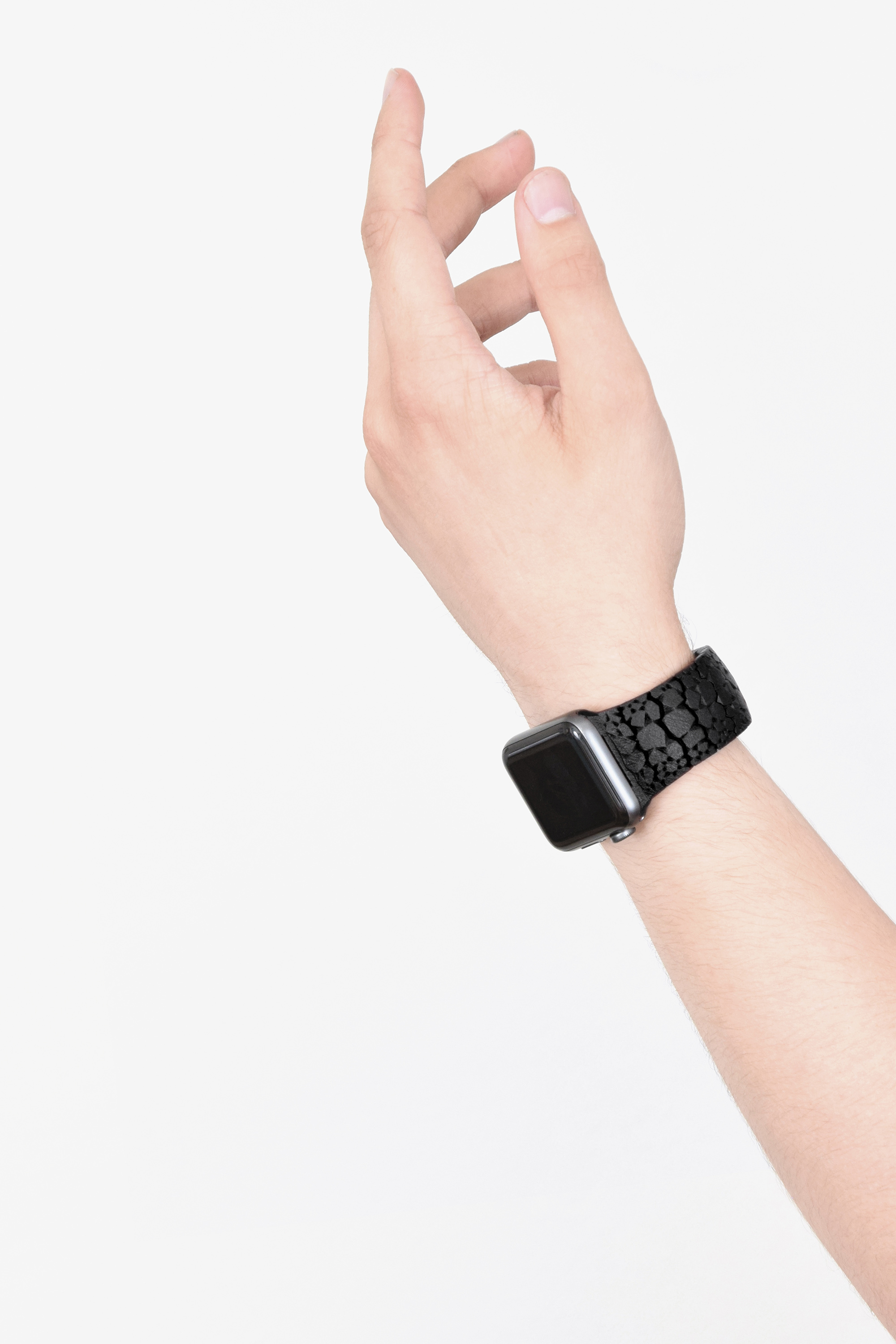
Apple makes around 40 million watches, over 220 million phones, and over 20 million MacBooks a year. The scale at which the company operates is unsurpassed. At the same time, the firm commands a premium. Not only is Apple selling premium devices, but it also offers a premium experience overall. Committed to excellence and innovation, Apple has to deploy both at scale. This is incredibly difficult to do. Apple is additionally remarkable at how seamless the overall experience is, with objects looking exactly how they feel, for example, and feeling exactly as the tactile response to them. Design at Apple is not skin deep, and the firm has pioneered a total design that is difficult to replicate. With revenues of $416 billion in 2025, Apple dwarfs not only other firms but many sectors and whole economies. So Apple is difficult to compare to other companies; it’s a bit like comparing a galaxy to a planet. So Apple’s logic is not the same as the logic that makes sense for other firms, even very large ones with which it directly competes.
For Apple to industrialize 3D printing across several metals for handset and wearable production was not an easy decision. At the same time, when Apple industrializes a new material, process, or device, it is the production system that makes the parts (and costs) add up. Apple can’t really place an order at a contract manufacturer or just turn on some machines. Its scale needs to be replicated; there are multiple vendors, and there is an interplay of systems. At the same time, for any effort to make sense, the firm can’t just introduce a new color for a new color’s sake, but rather it needs to make meaningful change happen in its supply chain in order to derive lasting advantage from this change. Pursuant to the effort at the scale and precision that the company demands, changes must be meaningful.
In the long run, reducing material use is a lasting change that can give the company a lasting advantage. Apple will be able to use metals that others cannot because of cost. This will make Apple products feel more premium while lasting longer. If someone tries to best them in using metals, Apple will have a better-feeling part, which simultaneously would have less material in it. This, in and of itself, explains the firm’s attraction to aluminum. Aluminum’s ubiquity, familiarity, and high production costs, but high reusability make it an ideal material. If Apple can sufficiently elevate this material, it could produce a better experience at comparably lower cost. If it masters this material, then it can make better devices overall. If its production system investment further optimizes its use, then it will reap economies of scale.
Thinner
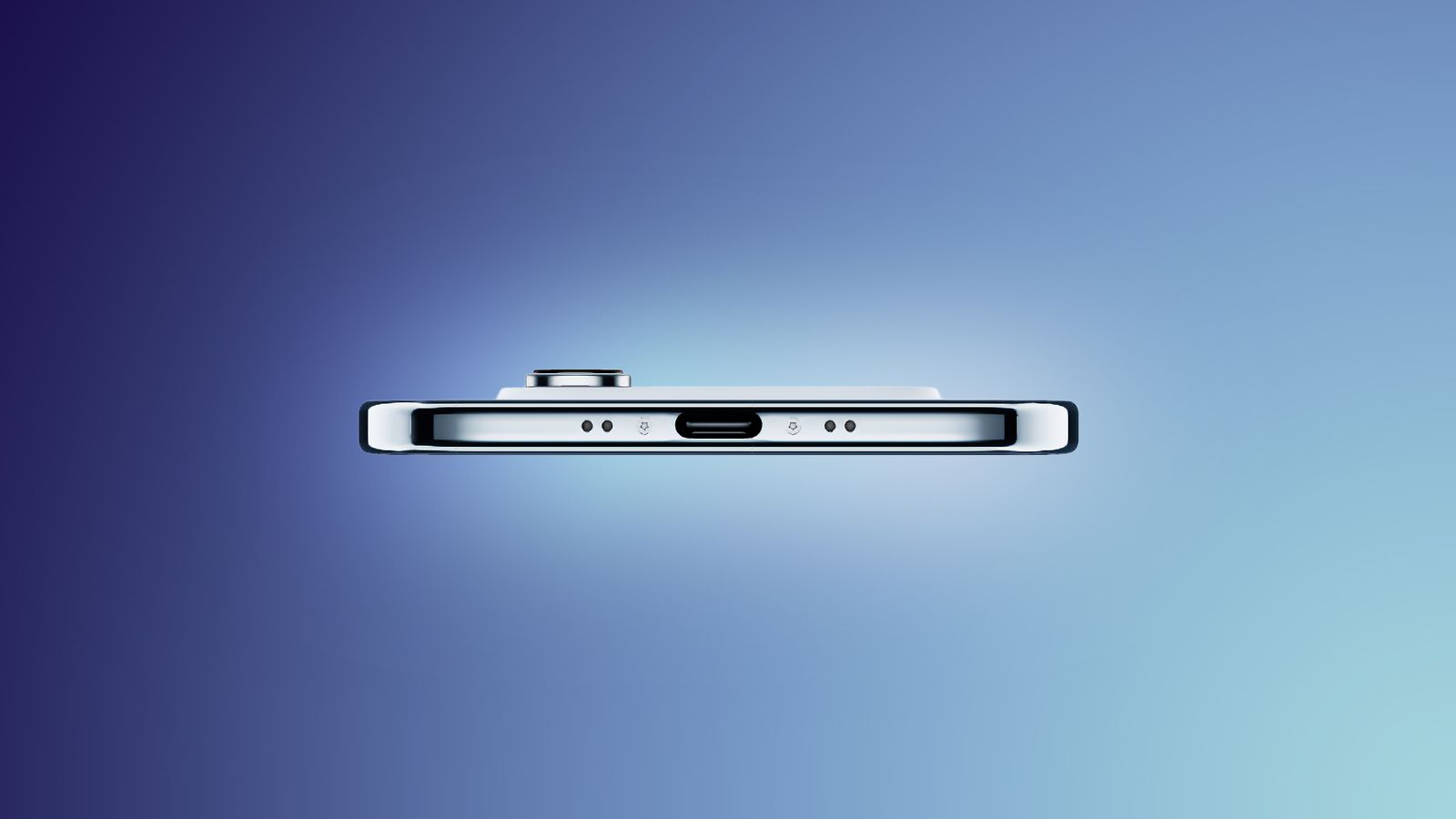
iPhone Air 3D printed USB-C feature. Image courtesy of Apple.
Hand in glove with this is the idea of thinner components, which could add up to additional weight savings. Thinner components make for lighter devices that use less material. But, especially in the crowded space of a phone or anything with an antenna, really, more antenna and battery space lead to better devices. With battery life and connectivity being of paramount importance to consumers, thinner other components mean more space for Apple to cram in more functionality. At the same time, by integrating functionality, Apple will reap greater rewards from components made with additive manufacturing. On top of this, making these components conformal or fit into very specific spaces will also bring more benefits to the firm. This can cumulatively add up to huge savings and durable advantages for Apple.
What’s more, Apple could apply IP to making certain components thinner that could let it gain an advantage over rivals. It could patent certain geometries that would be the most compact battery shape, or the most accordion-like USB-C plug, or the best way to shape a sensor. This would be an IP advantage that the firm could not get with CNC, for example. Thinner is also interesting in that, if it could use metal more efficiently and make devices thinner, it could make it harder for competitors to match devices that contain more polymers.
Bonding
One of the advantages of “better structural bonding,” an article explains, is that different textures “create textured internal surfaces that improve bonding between plastic and metal around the antenna housing.” Better bonding is nice, and it may add up to benefits for users and longevity. But if Apple could just change a texture and then use a few drops less of glue or solder, the cost savings would be immense. To me, the material savings are more compelling. But, additionally, there are more things to consider here. Imagine if we could reduce a few soldering or assembly steps by making things easier to join together. Or imagine if we could include a texture that would let a screen drop into place more securely, saving a second on an assembly step? Or could we add a texture that would reduce error rates when placing said screens? Now that would be a huge cost and time saving for Foxconn and Apple. Again, at Apple scale, something like better textures can have profound advantages. To me, however, cycle time and material savings will be meaningful here.
Improved Flexibility
So when we look at the idea of “improved design flexibility,” it is not exactly like the geometric flexibility or design freedom that we normally associate with additive. In an Apple context, the big win here is not simply the ability to make a “better” design. What this creates is the ability to optimize overall performance in the cramped interior and, at the same time, create areas of outperformance within the total production system. And we may be able to create a better device. More freedom to create a new shape for an antenna may therefore not only improve the reception of a phone model’s Wifi but also could free up more space for further battery life, translating into lower battery acquisition costs and more margin while allowing for the reduction of several hundred million fasteners because we eliminated one through the new design, which will make the phone thinner. For an Additive application to make sense, we often look for cumulative advantages. In this sense, the total production system that Apple will deploy will reap rewards from multiple effects through seemingly infinitesimal improvements. Combine this with the firm’s waste reduction strategy, and we can see this in the light of remaining competitive at scale.
Lower Costs
Now, of course, the lower costs thing is hilarious, especially given the high scrap rates we’re currently seeing. But let’s do a thought experiment. What could Apple do to cost out the process? How would it work?
If we stick to LPBF, we can see that the case part is problematic, with support needing to be removed and walls and some features being in peril at the time of build plate removal and later. Ports, slots, and the like will continue to be problematic, and we can see why the company has worked hard to eliminate these from its designs. Yes, it’s silly to buy a $900 laptop with one USB port, but it saves a few hundred millionths of an operation. So fewer holes would be nice. Thinner walls would be especially desirable, as they could deliver a better buy-to-fly ratio. At the same time, the case or internal components could become heatsinks, “fasteners,” or be further optimized.
But if we look at the sheer volume of cases for ports, plugs, speakers, rare-earth magnets, and fasteners, we can see that we could be freeing up a lot of internal real estate. And we could do this with lower-cost components that have big impacts. Again, binder jet or MIM would be the way to go here, but Apple seems to love lasers more than Scan Lab, so who knows. The quicker, easier, and more fundamental win would be to optimize these components over the case, in my opinion. Imagine just removing two screws through an optimized assembly so that the screw fits onto a lower layer! I’d focus on this before working more on larger cases for phones, since the win could be easier and lead to a bigger performance improvement. Also, then maybe I can make a smaller phone?
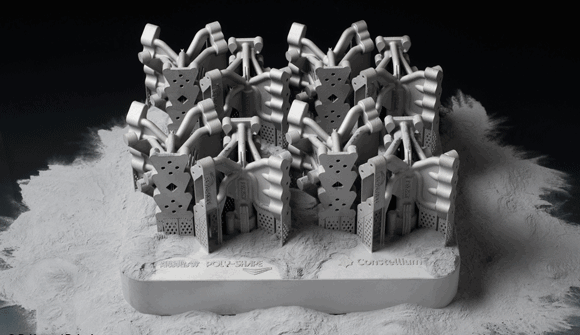
Constellium’s Aheadd CP1 aluminium powder. Image courtesy of Constellium.
Assuming that we’d then take this to another level and then tackle phone cases, we’d be dealing with a huge increase in build times, part volume, number of parts, object size, and post-processing time. And risk, risk too. Failure too. Let’s ignore for a second that we would need 2,400 machines. Breathe, let’s talk about the volume, talking 146mm by 72mm to 166mm by 76mm. Depending on the metric, the phone case is three to four times bigger than the watch case. Binder jet would be more limited here; weirdly, e-beam may make more sense than LPBF, given you could pack better and may have less support removal and residual stress. Of course, ebeam sucks for aluminum, so we’d assume that LPBF would win. Personally, I’d use bound filament material extrusion and then mill the ever-living everything out of it for a while. But maybe we want it to have a thin wall thickness and for the case to be a heatsink with hollow parts? Maybe we can make some recessed 3D printed buttons and mount them on some walls to snap the Taptic Engine and other parts into place? There are over 100 fasteners in the latest iPhones. Eliminating some of these through dovetails and other smart ways to slide things into snap-fit elements on the 3D printed case could maybe work?
Let’s assume we’d do everything with three vendors, each replicating each other’s efforts. We would need completely automated part removal, depowdering, distressing, hipping, all that jazz, including automated build plate resurfacing, CNC milling, and laser marking for recesses/ports. We’d need automated filling with an Azo or similar system and a quite automated build removal process. This is straight out of some German mid-2010 Industrie 4.0 fever dream and seems well within the bounds of what Apple could do and what key suppliers could do. Had they had a laser-based QA system at every major step, maybe to save time? Glidewell implemented a Micro-CT scanning workflow for itself so that Apple could do this too. Just given the turnings Apple already produces and the amount of support and scrap that will be created, even if they are efficient, I’d get a couple of Eigas. Or maybe a Metalworks or two? If they could use residual heat from the factory or some kind of efficient power source to locally make and recycle powder, they could have some interesting gains.
If I was them I would have bought Incodema3D and told them about a world beyond Inconel, then I’d buy Metal Powder Works for my turnings, a system to recycle aluminum generally into smaller components, Metalysis to make powder more efficiently than anyone else, some kind of solar/waste energy system to power it and made my own Aheadd CP1 kind of thing to save on heat treatment steps. I’d focus on something that could anodize really nicely, so I can give my phones some nice colors quickly. Then they’d need a pulsed-current anodizing process that provides a superior surface finish while anodizing more quickly. Ideally, I could do all of this to achieve thinner wall thicknesses. I’d engineer an aluminum that fits my process, my goals, and the process steps I can eliminate. I’d probably develop my own alloy, what the hell, I’m Apple.
Alternatively, I’d develop an LPBF machine that could run on MIM powder. Or I’d come up with a process that uses HIP powder in a kind of new-fangled powdered-metallurgy way, letting me make more delicate shapes. Generally, I’d turn to green or blue lasers over regular old fiber. Green lasers would really speed up build times, and this would also go far in explaining why it’s so hard to get powerful green lasers that work well now. On the whole, a standard machine could suffice, but one thing that Apple would really want was paths to create thinner walls and features than are usually possible.
Now Apple has an interesting patent, this is a kind of dual case comprising two metal materials, one perhaps being preformed and the other an additive part that has a lot of the features that we described above, including “preformed recesses” and also some interesting things like, “micro-features on the scale of 10’s of microns or less to form hydrophobic surfaces, surfaces that feel like glass, or other surface micro-features that promote chemical etching of the surface.” Other parts of the patent talk about adding electrical components or building the part within the volume. Helpfully, I found the patent after writing this article, but you can see that there are different roads, all leading to Rome.
Unexpectedly, perhaps we can conclude that whereas Apple’s initial foray into 3D printing has not been economically viable (for its suppliers mainly), a further path deeper into 3D printing does make a lot of sense. Also, if we look at the challenges to be overcome here, there is a lot of hard work, engineering, automation, and process control. But there’s no magic leap needed in physics or technology. Apple could do this with current-stage technology optimized for this purpose. And it could, at Apple’s scale, make sense for the company to do so.