
The Additive Manufacturing CRC (Additive Manufacturing Cooperative Research Centre, or AMCRC) is a cooperative research and implementation organization dedicated to making additive happen in Australia. Headed by Simon Marriott, it aims to encourage more research, startups, collaboration, implementation, and work in additive. The AMCRC has $57 million in government funding, and spreads it to research and firms in the country. Their work is topical now that Australia is in the midst of adopting US submarines and the immense industrial movement needed to be able to make them. At the same time, the country’s industrial base is declining, while dismay at their loss of a local automotive industry is still palpable. And Australia’s manufacturing industry and productivity continue to decline.
This week, the AMCRC hosted its 2026 Additive Manufacturing Forum. There were around 200 people in attendance, and the audience was at times rapt, and at least always interested. The venue was the National Wine Centre in Adelaide. This was a very practical venue with a lovely entrance and beautiful main hall used for presentations. There was a lot of mingling, mixing, and conversations as well. Simon opened the event by looking back at the first year of the AMCRC. Since its founding, the organization has worked hard to find 70 partners in industry and 12 universities. It has funded its first projects and is working on things like wear-resistant coatings, anatomical replicas of teeth, and local titanium powder production. For the anatomical replicas, Fusetec 3D is working with Adelaide University to turn CT scans into realistic 3D printed dental models to let dentists train for better molar removal. The company already uses Stratasys J750 systems to make enhanced surgical models for training.
The keynote was done by yours truly, and I must say it was fantastic. Fantastic to present, I mean, since the audience was very appreciative. I spoke about the DeHavilland Mosquito, building Prusa Research 3D printers in Australia, manufacturing resilience, networks of manufacturing nodes, Finnish Motti ambush tactics, and suppressors. Next, I led a panel with Dr Laura Brooks of Australia’s submarine builder ASC; Adelaide University’s Professor Mark Hutchinson; Professor Roy Green of ARM Hub and UTS; and Mel Slater, Director Maritime of Defense SA, Southern Australia’s defense promotion agency. The conversation was about building capacity in Australia for additive. The panelists were in agreement that the country does research very well, but it needs to commercialize more. There was a need for clearer demand signals from government to industry, especially smaller firms. The country also needs to do more to build up industrial capacity in the form of things like making powder.

Dr Daniel East
Next was a presentation of Australia Makes, a map of Australia’s capabilities in AM. Simon Bartlett, EVOK3D, guided everyone through presentations and a panel about what the country’s capabilities actually are. Adelaide University’s Professor Shruti Sardeshmukh spoke first about sustainability She made a very good point when she said that we need to move away from old claims of additive’s supposed environmental friendliness. Rather than saying that additive is somehow intrinsically sustainable without evidence, with claims like “AM uses less material,” we need to say, “here is the lifecycle evidence.” That’s an important point to make: we have to deliver on real world value now, rather than repeat empty claims.
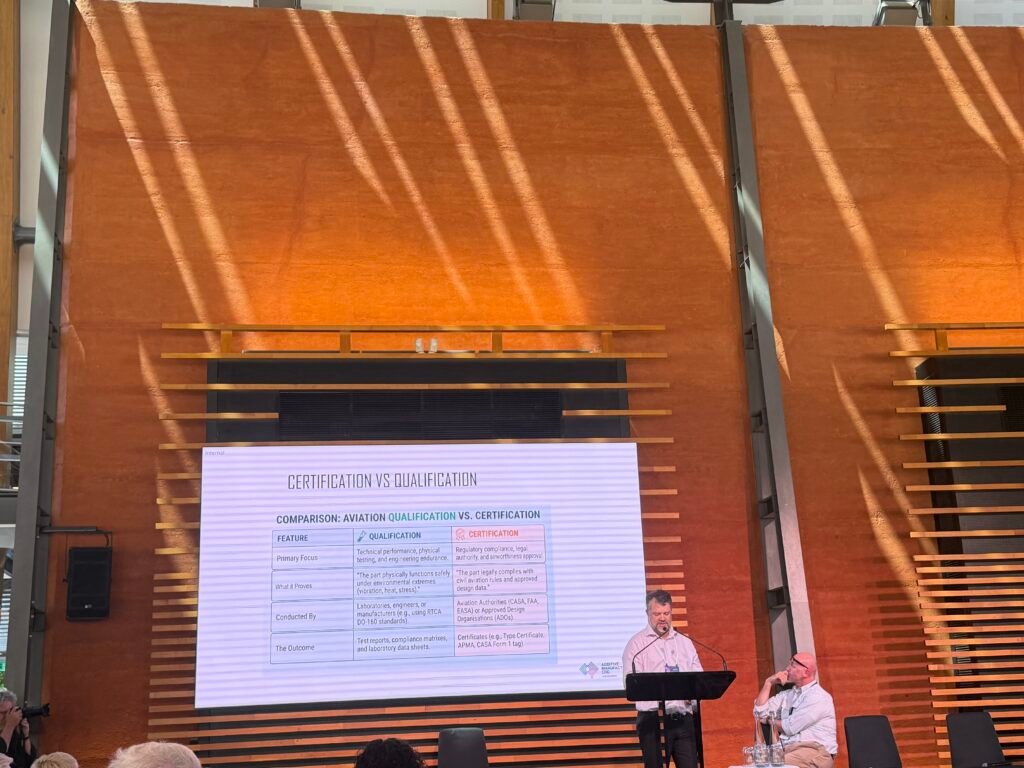
RMIT’s Professor Milan Brandt was next, and pointed out that it’s the “pathway not the printer.” For him, that’s knowing if a part can be inspected, cleaned, qualified, repeated, and if someone will buy. it He also spoke of chances for Australia in 3D printing feedstock production. Then Dr Daniel East talked about the differences between qualification and certification, often confabulated. Professor Andrew Ang spoke about the valley of death. For him, testing, qualification, and supply chain is where Australian AM projects go to die.

Professor Andrew Ang
It was a very nice show, and very well-organized. Preceding it, there was a drinks event, and a day-long DfAM training by Materialise and Fraunhofer IAPT. Later, there were different workshops on Defense, Healthcare, and Aerospace. All in all, the mood seems upbeat. People are enthusiastic about what additive can bring to Australia, and what Australia can do in additive. That’s one thing, but there was also a lot of realism in the room. Australia needs to improve some things, but doesn’t have unlimited money, so it must make choices. I walk away enthused and upbeat about Australia’s chances in deploying additive more widely. The country seems aware of the opportunities and pitfalls of additive and determined to grow the industry there.