

Editor’s note: This is Part 2 of a two-part series by Xu Fanglei examining the technology and patent issues behind the Stratasys-Bambu Lab dispute. Part 1 looked at the $27.6 million U.S. verdict and the purge-tower technology at the center of the case. Part 2 examines the related European proceeding, the continuing U.S. patent challenges, and what the dispute could mean for the broader 3D printing industry.
The Same Technology, a Different Outcome in Europe
On April 24, 2026, the Hague Local Division of the Unified Patent Court (UPC) heard Stratasys’ request for a preliminary injunction against Bambu Lab’s H2C printer. The European patent involved was EP2964450, which belongs to the same patent family as the U.S. patent US 9,421,713. And this is where the story becomes especially interesting. The European court did not grant Stratasys’ request for a preliminary injunction.
Based on the evidence available at that stage, the court found Bambu Lab’s H2C purge-tower implementation more likely to fall outside the patent’s scope. One key issue was again the meaning of “layer by layer.”
The court interpreted the relevant patent language as requiring each horizontal layer of the purge tower to be formed using a single material. But Bambu Lab’s H2C can create a purge tower in which different materials appear within the same horizontal layer. And while that distinction may sound small, technically, it can be very important.
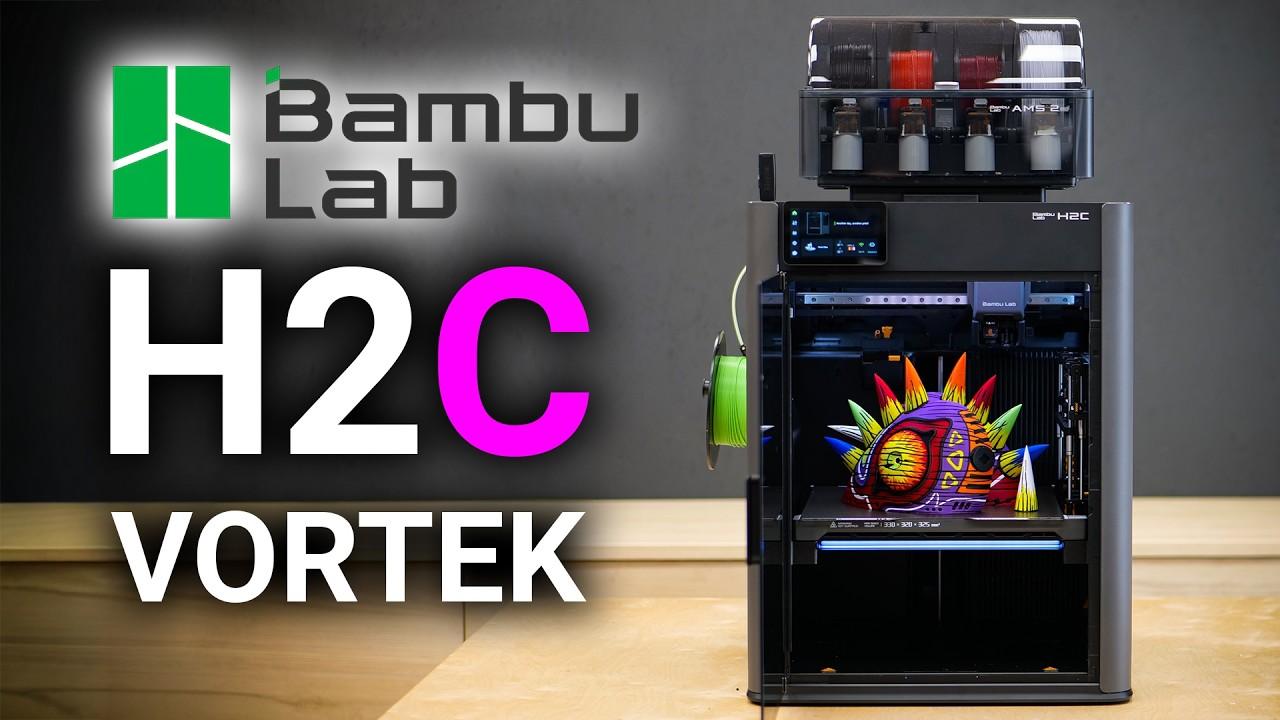
Bambu Lab H2C. Image courtesy of Bambu Lab.
This brings us back to the diagram from Part 1. If a purge tower is built like this:
Layer 1 = Material A
Layer 2 = Material B
Layer 3 = Material A
That differs from a purge tower where a single horizontal layer contains both Material A and Material B. To a user looking at the finished purge tower, the difference may be almost invisible. From a patent perspective, it may matter a great deal.
Another important point to keep in mind: the UPC proceeding concerned preliminary measures. It was not a final judgment on the merits of the entire patent dispute. That distinction matters because different courts, procedural stages, evidence, and interpretations of patent claims can produce different outcomes.
So Why Did the U.S. Jury Reach a Different Result?
Several months later, the U.S. case reached a very different result. In September 2026, a jury in the Eastern District of Texas found that Bambu Lab infringed the four Stratasys patents at issue and awarded approximately $27.6 million in damages. The court entered judgment the following day.
At first glance, the European and U.S. outcomes may seem contradictory. But they were different proceedings. The European case involved a request for preliminary measures concerning a European patent and Bambu Lab’s H2C printer. The U.S. case involved a jury trial on four U.S. patents and the accused products and technologies at issue.
The legal standards and procedural stages were also different. That makes it difficult to reduce the two proceedings to a simple statement that one court “agreed” with Stratasys while another “agreed” with Bambu Lab.
The more useful question is what each court was asked to decide, which patent claims were involved, which products were examined, and what evidence was available at that stage. That is why the technical details discussed in Part 1 matter so much. A phrase like “layer by layer” can seem almost insignificant at first. But when a court has to determine whether a real machine falls within the scope of a patent claim, a few words can become extremely important.
The Verdict Isn’t Necessarily the End
The U.S. jury verdict is also not necessarily the final step in the dispute. Bambu Lab has said it disagrees with the verdict and intends to seek post-trial review and appeal. There are also separate proceedings involving the validity of Stratasys patents before the U.S. Patent Trial and Appeal Board (PTAB). Those proceedings add another layer to an already complicated dispute.
For example, U.S. Patent No. 9,421,713 — the purge-tower patent discussed extensively in Part 1 — survived Bambu Lab’s challenge before the PTAB. Bambu Lab has appealed that decision to the U.S. Court of Appeals for the Federal Circuit. Other Stratasys patents have faced separate PTAB challenges, with different results.
In other words, several legal processes can move at the same time. A district court can consider infringement. The PTAB can consider patent validity. An appeals court can later review decisions. And European courts can separately interpret related European patents. For anyone outside the patent world, this can seem confusing. But it also reminds us that a single jury verdict does not necessarily resolve every question in a patent dispute.
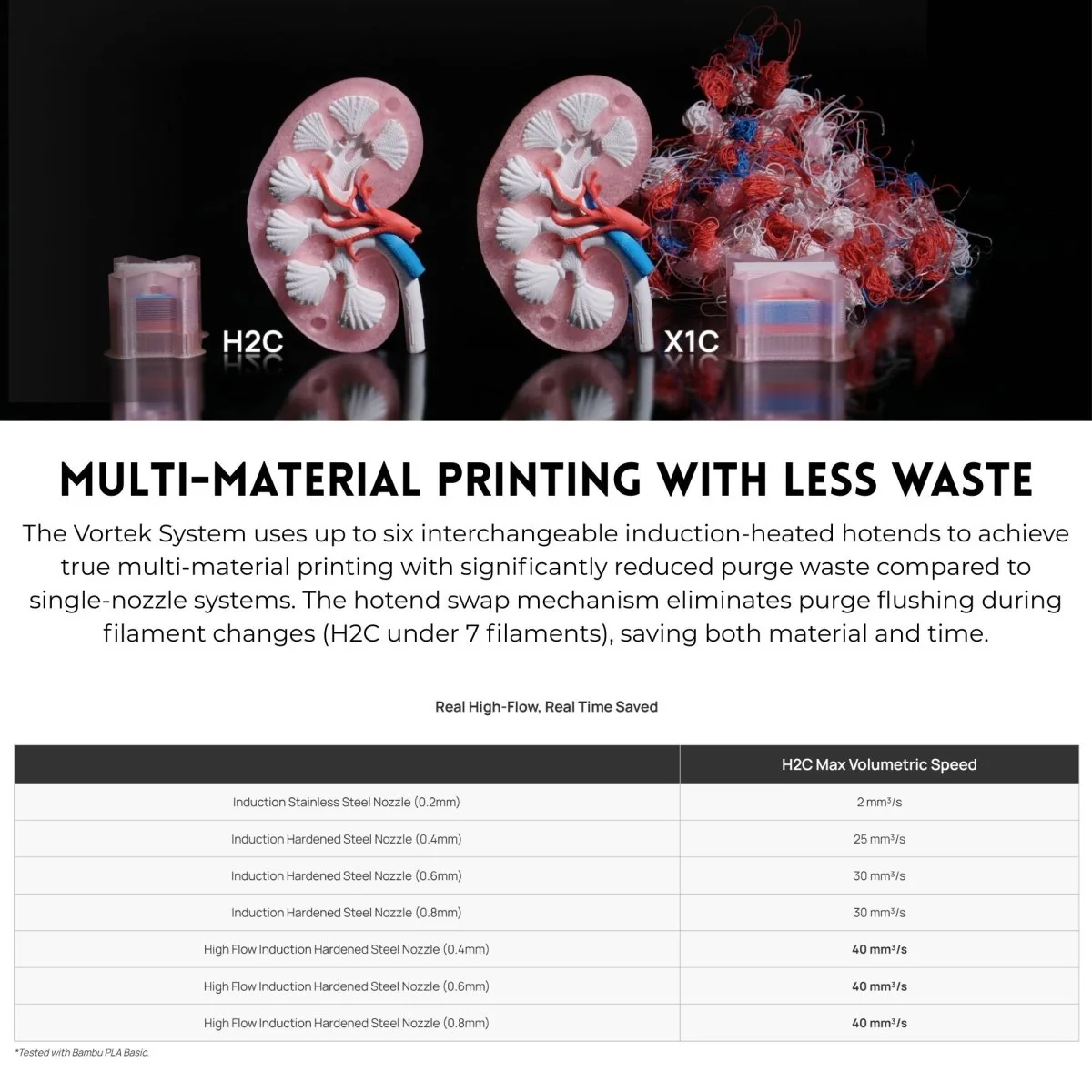
A purge tower / multi-material print from the H2C. Image courtesy of Bambu Lab.
Looking at the Case as a Designer
Before desktop 3D printing became widely accessible, turning an idea into a physical object could be complicated. You might need machining equipment, molds, specialized tools, or access to a workshop. Then desktop 3D printing became much more accessible. With a mature machine like those made by Bambu Lab, we gained a remarkably direct ability: you think of something and then make it. Whether it’s a structure or a new product form, even a way of using something that you haven’t seen before, you can print it and see what happens. That’s one of the things I’ve always found fascinating about 3D printing.
But after going through the Stratasys and Bambu Lab patent documents, I’ve also come away with a stronger feeling about another question: Where should the boundary be between protecting innovation and leaving room for continued innovation?
The patent system needs to protect inventions that have already been developed and legally protected. But in a rapidly evolving industry, another equally important question is: How do we protect existing innovation while still leaving enough room for the next generation of technical improvements?
That’s something worth thinking about, at least from my own experience using these technologies and watching how the industry develops around me.
The Bigger Question Is Where the Patent Boundary Should Be
I don’t want to say who is right or wrong. As I stated before, I’m a designer, not a lawyer. And when you look at the case from both sides, each has its own legal logic.
From Stratasys’ perspective, we hold granted patents. If another product falls within the scope of our patent claims, we have the right to enforce our intellectual property. And that’s a normal part of the patent system.
From Bambu Lab’s perspective, if the technical implementation doesn’t fall within the scope of the patent claims—or if the patent itself has validity problems—the company should be able to challenge those issues through the legal process. That is also a normal part of the patent system.
So I don’t think the most useful question for the industry is: “Who’s the good guy and who’s the bad guy?” In fact, the more important question is: Where exactly should the boundary of a patent be drawn?
For technology companies, that’s the question that really matters.
This Patent Battle Is Far From Over
There are two extreme ways to interpret this case. One is that Bambu Lab was ordered to pay $27.6 million, so the company is finished. The other is that the European court previously sided with Bambu Lab, so the U.S. verdict doesn’t really matter. Neither interpretation tells the whole story. The jury in the Eastern District of Texas found the four patents at issue valid and infringed and awarded approximately $27.6 million in damages. The court subsequently entered judgment.
Meanwhile, in the earlier UPC preliminary-injunction proceedings concerning the H2C, the Hague Local Division did not find a sufficient likelihood of infringement and considered the H2C’s purge-tower implementation more likely to fall outside the scope of EP2964450. With PTAB proceedings and subsequent appeals also moving through the U.S. patent system, the broader dispute remains ongoing. For now, the U.S. district-court trial has produced an unfavorable result for Bambu Lab, but it is not necessarily the final chapter in the broader patent dispute.
So What Does This Mean for the 3D Printing Industry?
3D printing grew out of open-source communities. Even today, we regularly hear stories about people building their own 3D printers from scratch. For a long time, when we talked about 3D printing, we focused mostly on the product itself: print speed, accuracy, materials, software, and user experience. But as the industry becomes increasingly global, the dimensions of competition have broadened. It’s no longer just about the product. It is also about supply chains, software, ecosystems, brand, patents, standards, and the legal systems behind them.
For Chinese 3D printing companies in particular, I think this case offers a very practical reminder. Once a product enters overseas markets, you’re no longer dealing only with users and competitors. You’re also dealing with local patent systems, courts, intellectual-property rules, and an entire set of global rules that may work differently from what you’re used to at home. On the surface, this is a patent lawsuit. But at a deeper level, it reflects something much broader: when Chinese 3D printing companies go global, the game is no longer just about making a good product. It’s also about understanding the patents, standards, and legal systems that surround that product. And as for this particular patent battle? It’s far too early to write the ending.
Sources
This article was prepared based on publicly available court records, patent documents, and related reporting, including FabScene, CourtListener, Law360, Unified Patent Court documents, USPTO/PTAB records, and other publicly available industry sources.