
The Federal Communications Commission (FCC) recently banned the sale in the US of “almost all” new mobile robots sourced from foreign countries. IEEE Spectrum (the link in the first sentence) notes that there are certain exceptions, “…including systems weighing under 2 kilograms and any system that communicates at less than 200 kilobits per second…” The ban is set to go into effect on January 1, 2028.
Additionally, IEEE Spectrum points out that the FCC ban doesn’t apply to drones, which have their own ban to deal with, nor to connected vehicles, since the man in the US who makes the most of those put the president in office (that is my own analysis). Meanwhile, according to the International Federation of Robotics, US robotics installations rebounded slightly last year, growing 11 percent in 2025, and installations are expected to grow further this year. China, on the other hand, still installed nearly eight times more robots last year than did the US.
In terms of production, China makes around 70 percent of the world’s supply of mobile robots, and in the first half of this year produced 97 percent of all humanoid robots sold. So if the US sticks to its ban, then by 2028, companies that haven’t received special approval to import new robots will either have to rely on the poor-man’s robot (a human worker) or buy their robots from US-based companies. Presumably, some deal will also be struck by the deadline with a European country, Japan, etc. (if not China itself) that enables US companies to source a prescribed quantity of parts from overseas.
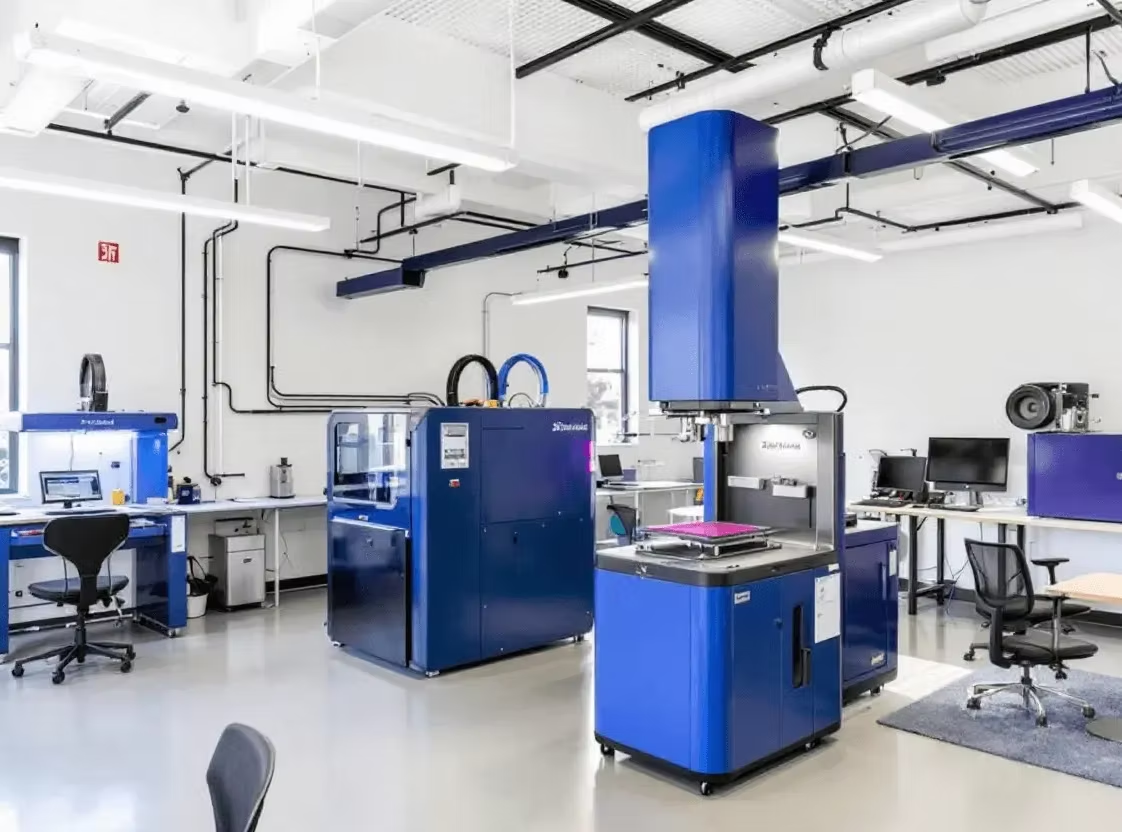
Additive manufacturing equipment at Upside Parts’ Littleton, Massachusetts facility.
But this still suggests an opportunity for reshoring, and an AM service in the Boston area, Upside Parts, has provided some insight into that opportunity. Upside Parts analyzed hundreds of customer orders across all the markets it serves, representing a total of 30,000 parts, and found that robotics customers are five times more likely to opt for rush delivery: 37 percent of components produced by Upside Parts for robotics customers were rush orders, compared to 7 percent of parts for all other industries.
Now, 82 percent of the parts that Upside Parts analyzed were for the robotics industry, so there is certainly the possibility that the company’s data could be skewed by the composition of its customer base. But first of all, it’s noteworthy in itself that such a large percentage of the company’s orders are for the robotics industry, and secondly, it would align with another report, based on feedback from attendees of Automate 2026, that “Reliability, deployment readiness, serviceability, component availability, and supply chain resilience ranked ahead of headline performance specs in many conversations.” As that article rightly notes, “A robot that cannot be serviced because replacement parts carry 20-week lead times is not production-ready, regardless of its autonomy capabilities.”
Even without the ban, then, it would seem rather difficult to even start a robotics company in the US in 2026 unless you have some significant supplier relationship with a domestic AM service or with a domestic contract manufacturer that uses AM. With that in mind, consider that US startups accounted for 52 percent ($4.9 billion) of the nearly $10 billion in global VC money last year that went to robotics firms. That alone suggests we should expect robotics components for domestic companies to represent a growing share of parts printed in the US, given the prioritization of fast delivery.
Upside Parts also finds that this is unlikely to be a phenomenon purely associated with the urgency of the prototyping phase, as larger orders — 100 parts or more — were more likely to be rush deliveries than were orders of less than 100 parts. That’s a very positive sign for the 3D printing industry’s chances in the robotics supply chain: we should expect robotics companies to keep relying on AM, and perhaps rely on it even more, as they scale.
It was an interview I did back in 2023 with Davide Marini, CEO of another AM company based in the Boston area, Inkbit, which really sold me on the opportunity for AM in the robotics industry. Marini told me that, beyond the good fit between the scale AM works at and the typical order sizes in the robotics industry, the agility advantages in material science should push robotics firms to become more and more aggressive about leveraging AM. When Vanesa Listek visited Inkbit a year later, robotics components were again chief among the applications Marini touted.
Since then, the consensus in the relevant literature seems to reinforce precisely what Marini explained to me, which again points to the robotics industry developing an even greater dependence on the iterative speed that AM can deliver. In the same way that robotics companies should become more important customers for the AM services market, we should also expect them to become more important customers for OEMs and material suppliers, as robot manufacturers ramp up their in-house 3D printing capacity.
Thus, while the FCC ban should indeed accelerate the use of 3D printing to supply the domestic US robotics market, this may have happened regardless. The ban merely alerts US robotics companies and US-based AM services to the future that they should have already been readying themselves for.
Images courtesy of Upside Parts