
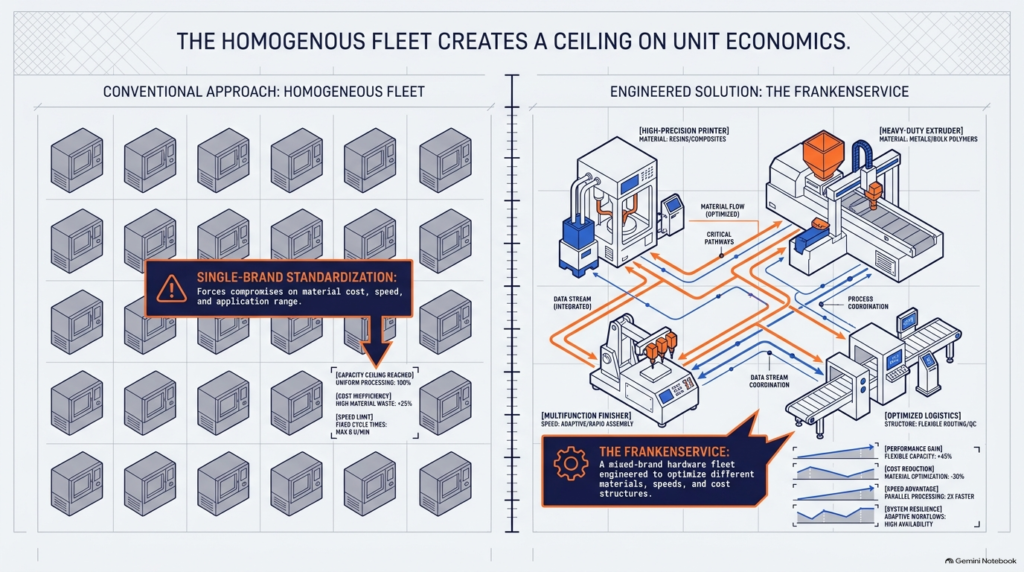
So far, most service bureaus and manufacturing companies stick to what they know. Not only for OCD reasons, but gleaming lines of identical LPBF machines are also arrayed on impossibly clean floors, equidistant. It looks lovely, of course; everything feels in order, in its place. And by following one general machine architecture and one company’s logic, everything is easier, of course. There are some economies of scale, like discounts on powder and reusing certain equipment and software across the fleet. Training and operations are easier too. But, of course, we know why people stick to one vendor or one system. Trauma. It’s a trauma bond. Implementing AM was so incredibly difficult and traumatic way back when that people are loath to go beyond what works. But now products have improved, and knowledge has spread as evenly as your powder. Best practices have evolved, and our happy tribe is more experienced and knowledgeable overall. What’s more, we have better products from the established vendors. And we have new vendors who want to provide us with new machines and capabilities.
So what if we looked beyond what is most often practiced to what may be more logical? What if we dive into the manuals once again and embrace variety? Now I’m not saying that this isn’t going to be a headache. But, in the end, it could be a much more profitable thing to do. You could meet more client needs and produce more parts profitably by using the right machines for each job.
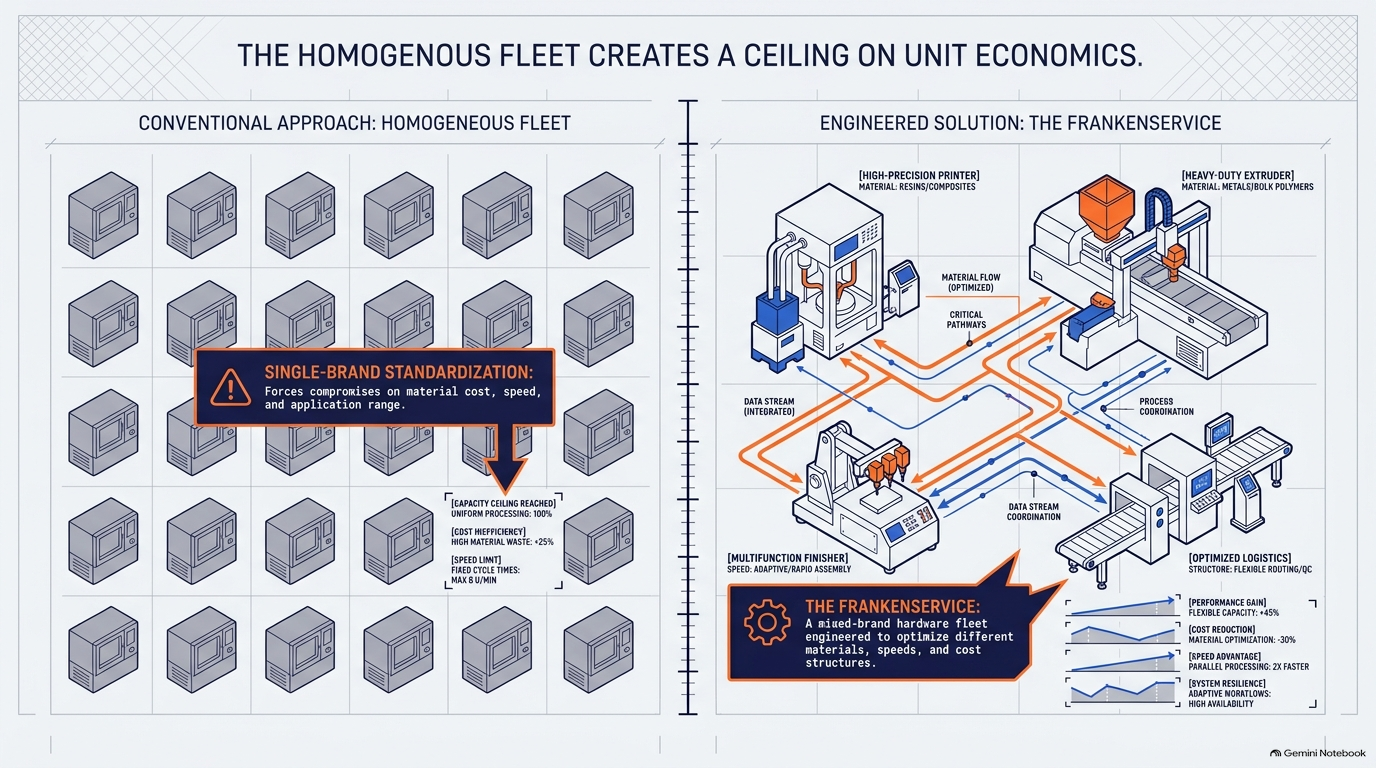
A single-brand printer fleet compared with the proposed multi-vendor “Frankenservice.”
So what if we focus our effort on PA 11 with HP MJF? That is our main go-to, and we have 5 5600s to do most of our work. We will use their unpacking stations, their complete powder-handling solution, and the Automation Accessory, which will push out and switch builds. I’ll go into more positioning and marketing in the second post to explain why PA 11 may be a better bet than the default PA 12. This is our main offering, and much of our workflow is built around it. But, additionally, we have an EOS P3 set up to do PA 11 for eyeglasses and other colored parts.
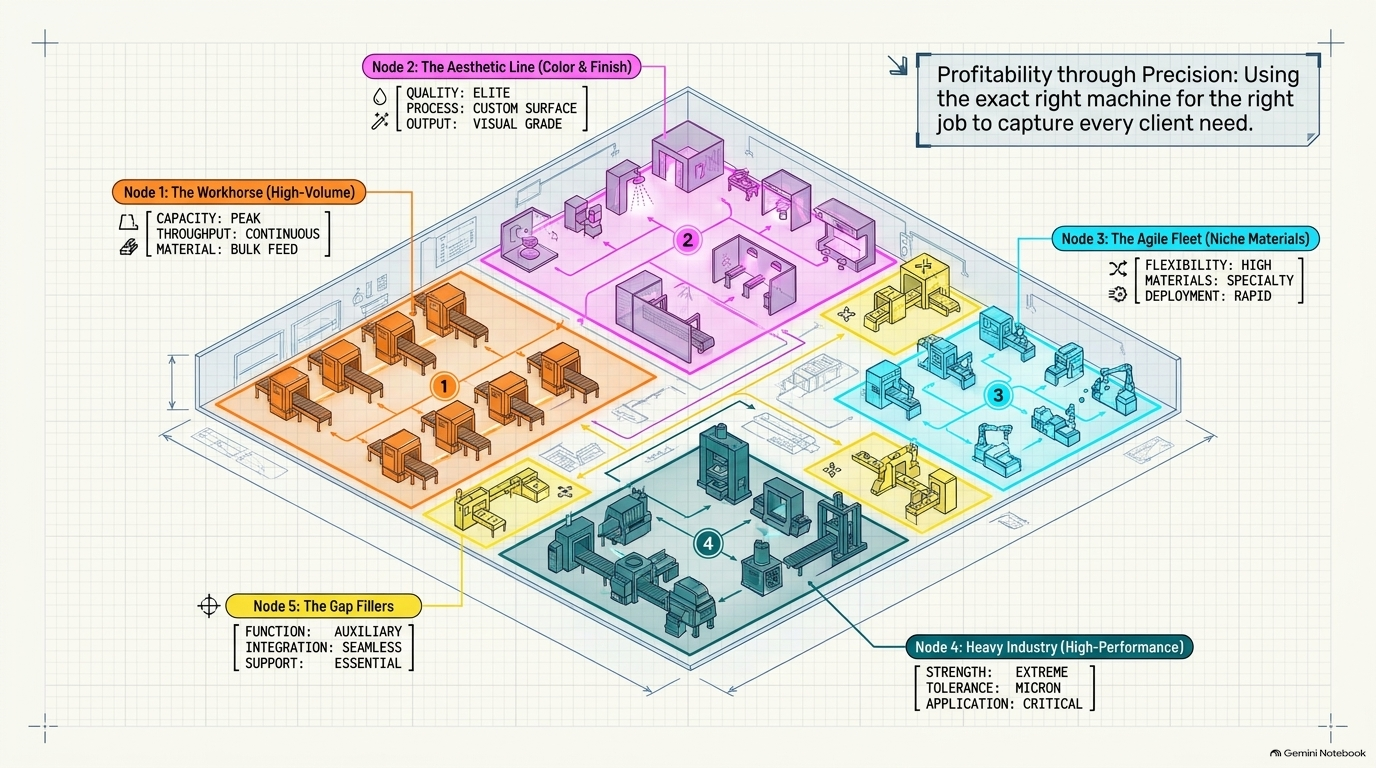
A proposed 3D printing factory using different machines for different jobs.
That line works mostly with a DyeMansion setup of a Power Shot S, Powerfuse S, and DM 60 dying unit. This is for colored parts, and we get better results when we run it. Meanwhile, everything else is cleaned and resurfaced before being sent onward. Here we’re implementing three different lines for most of our parts. We use Ossenberger for most of our powder handling, with their Spinners and other units turning everything around quickly. Because the powder handling and unpacking are optimized for specific machines, we will need far more equipment than others do. Furthermore, we don’t want our materials to mix; this adds complexity and means that we will need even more equipment to ensure good turnaround. Just because of this, managing all of this and the floorspace will be annoying.
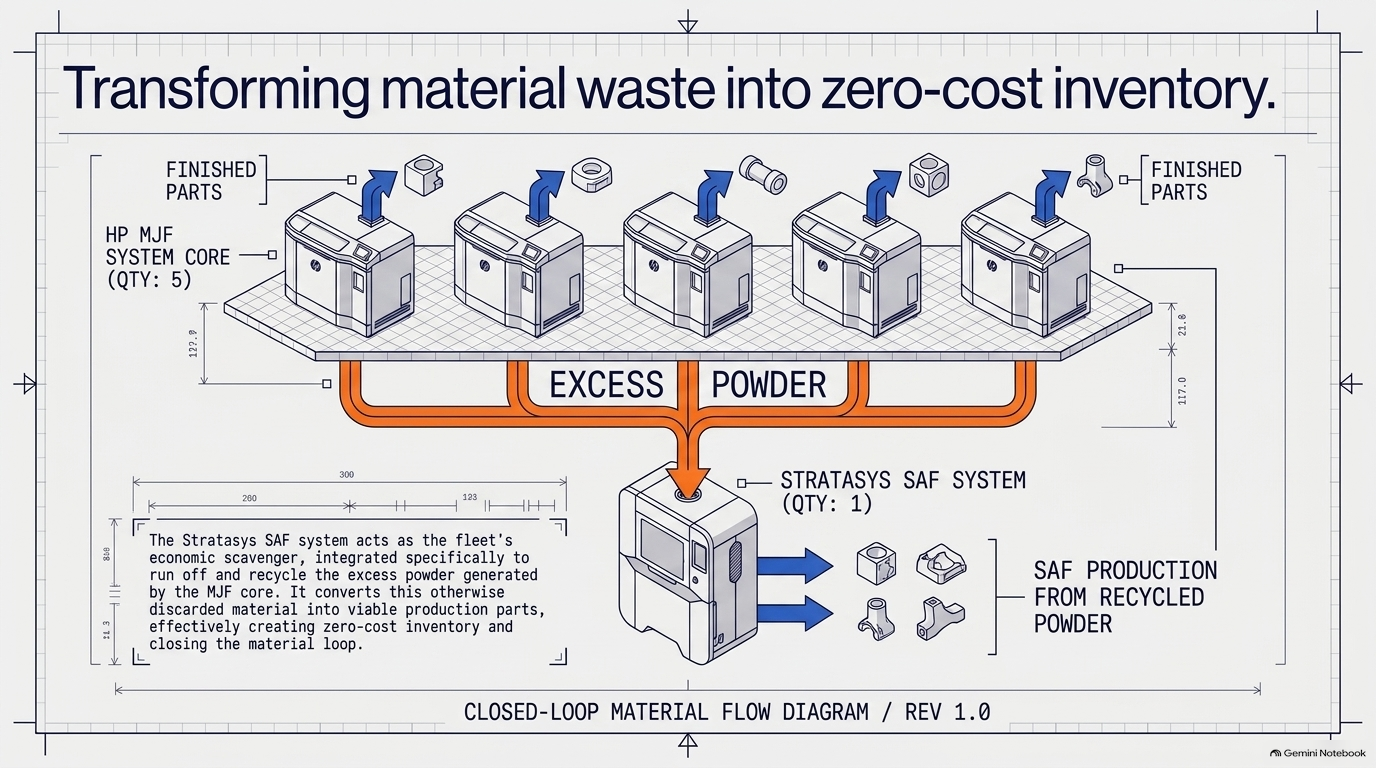
Unused powder from HP printers is reused for production on a Stratasys SAF system.
Then all the recycling we run goes to a Stratasys SAF machine, which lets us use the powder we’d otherwise have to ship out to be rejuvenated or thrown away. Through using this material directly in-house, our environmental bona fides are strengthened. But it’s also very efficient, and it gives you a new recycled material to pitch to customers.
Then we put in 14 Sinterit Bianco units that run all sorts of niche materials we don’t normally use. We run new and emerging materials on the machines, including very specific grades such as LUVOCOM PPS for rail use. These machines are open so we can easily make new materials work for them. We can have one on standby in black for our car company friends, while another has an ESD-grade for a tool manufacturer. Additionally, we run 8 HP 1200s to offer the different MJF materials (assuming that HP releases lots for the 1200?). On the HP’s (and I don’t know if they’ll ever do this), we will run PA 12 GB, PA 12 FR, PA 12S, PP, TPA & TPU. On the Sinterit systems, we run Natural, White & Black TPU, black PP, TPE (with different shore), different shore TPA, PA CF, PA CF 33, GF PA, PA 11 ESD, PA 11 FR, PA 12 GS, Alumide, and a PA 12 with FAR 25.853 60 from ALM for aircraft interiors.
For a few industrial clients, we need a rigid, high-performance material that withstands gasoline and high temperatures and is self-lubricating. We can’t use the PAs due to heat buildup in these wear-resistant parts, so we’re going to use PK 5000 on two larger machines from Farsoon, since they need large parts. We’re going to get two 403P series for the PK 5000. These will be able to productively make these industrial parts. But one of our clients uses PPS 9268 BK, which is conformal for their rail 3D printing MRO needs which will take up the third machine. Meanwhile, another defense client wants PK 5000 for their housings but is a bit nervous about the Chinese 3D printer. So for them, we’re going to set up PK 5000 with the EOS P3.
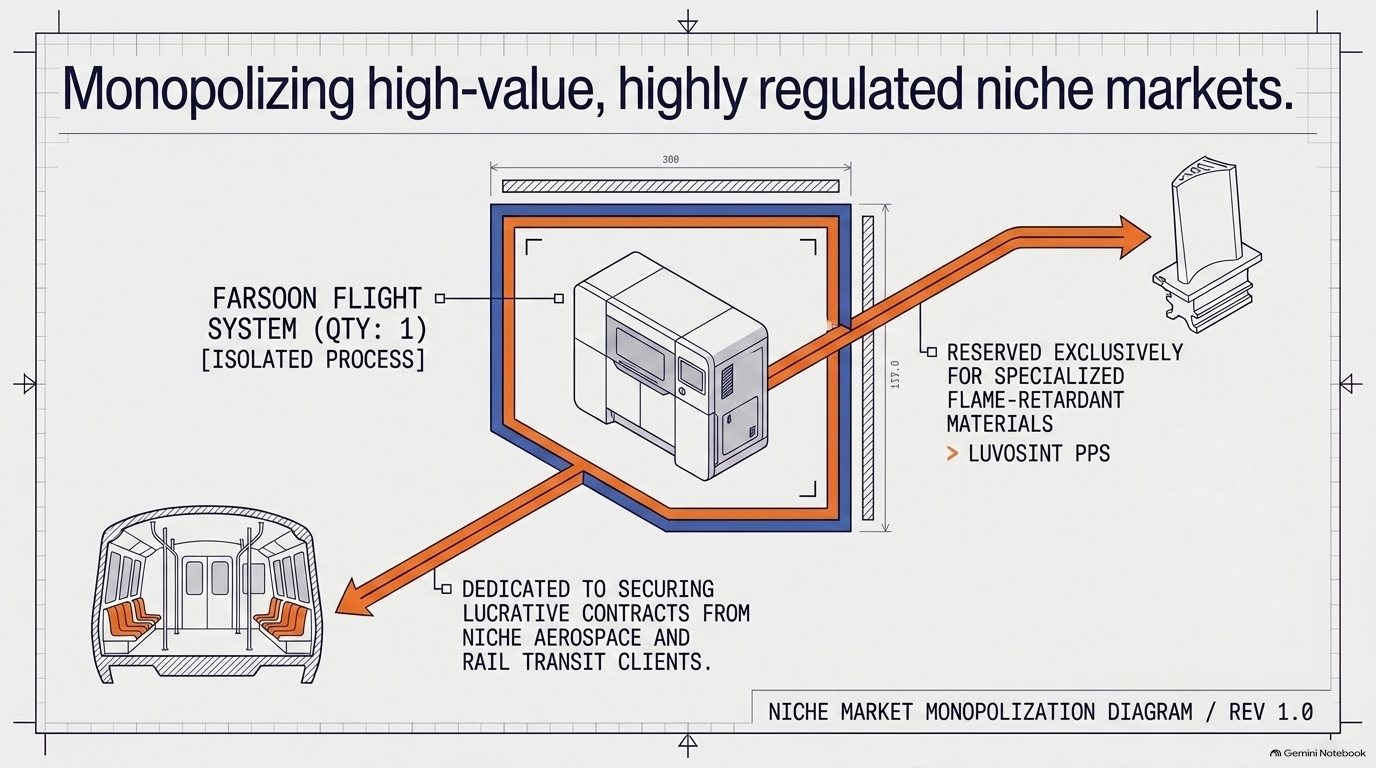
A dedicated Farsoon system is used for specialized materials and applications.
Now I know you’re a little worried about floor space. But don’t worry. And maybe about mixing all these powders during post-processing. Now we’re going to Zhejiang Top, DyeMansion, and Ossberger and ask them for a dedicated unpacking, powder handling, and recycling unit for each material. Now this is not going to be cheap. But once it exists, it will allow many more people to use many more materials efficiently. It wouldn’t have to be as productive as our main equipment, but it should still give each a relatively easy path to unpacking, sieving, and reusing the powder without having to clean everything out.
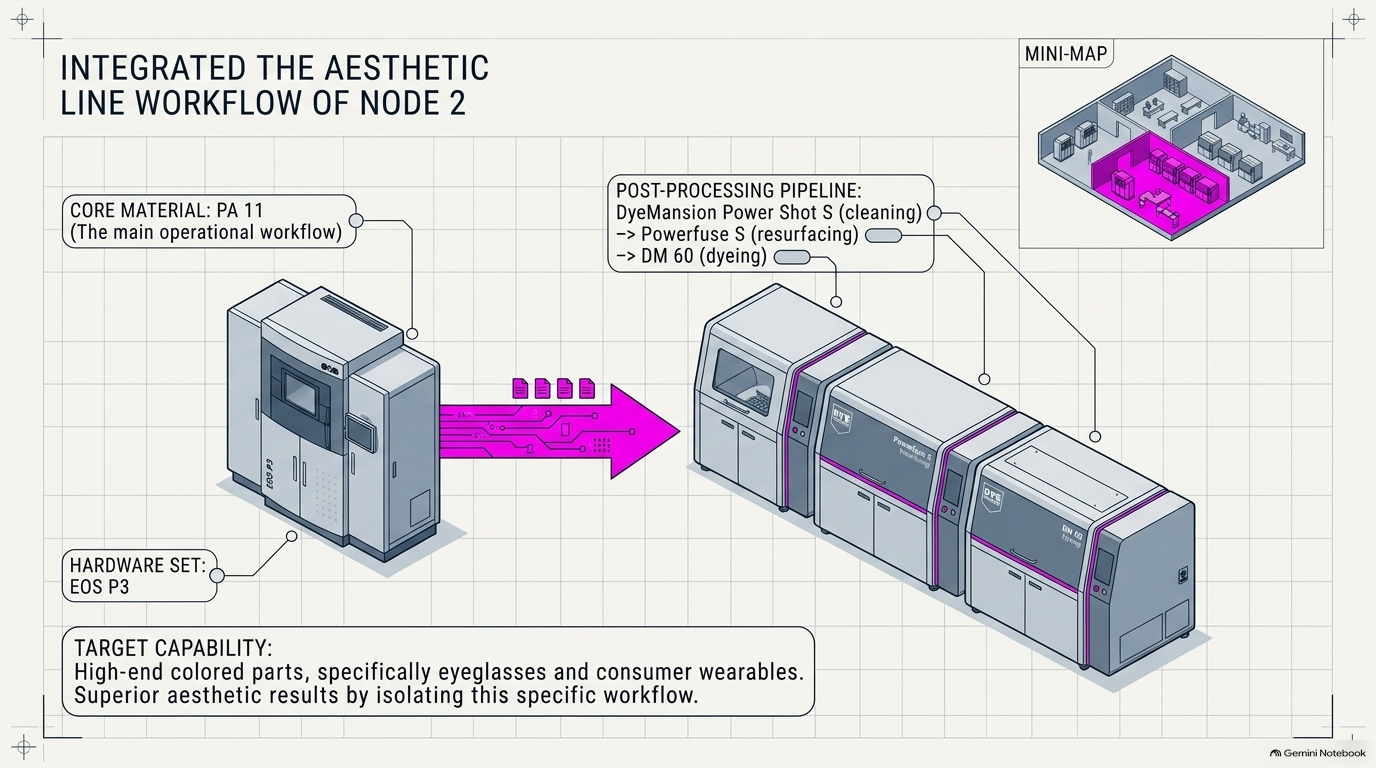
An EOS printer and DyeMansion systems create and finish colored parts.
Then we’d have three Formlabs X1 printers to do weekend builds of PA 12, PA 11, and TPU. These systems would be used for later builds if we can’t fill a build on our other printers, or if the parts are larger than the 1200s and Sinterits can handle. They’re meant for efficient over-the-weekend builds. They plug a gap, allowing you to do things earlier or later depending on how you look at it, or run things that wouldn’t make sense on some of the bigger units.
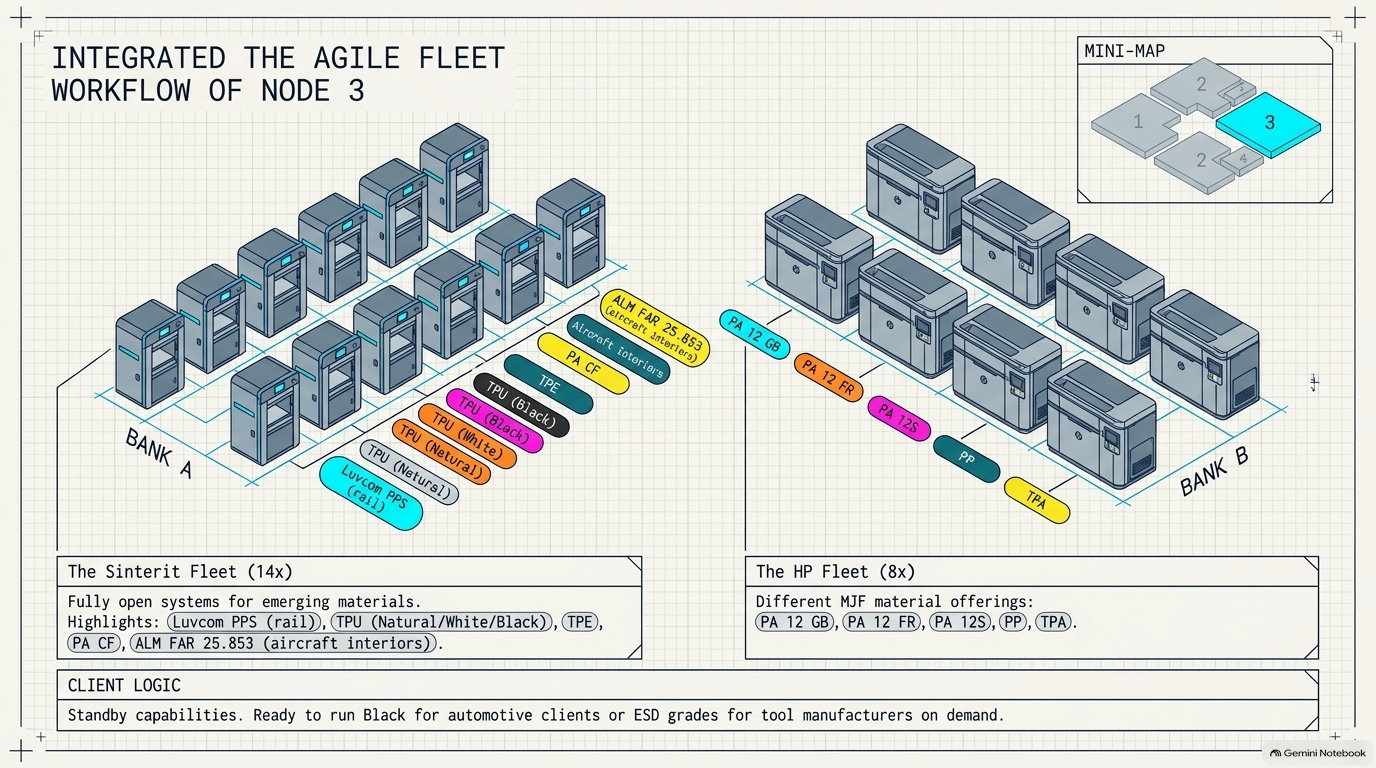
Sinterit and HP printers handle different materials and production needs.
So what are we doing here? We’re introducing a tonne of complexity and a tonne of equipment. Overall, equipment utilization will be horrible for a lot of the post-processing work. And we’ll have to tailor a lot of stuff specifically for our materials in terms of the workflow. And we’d need a lot of handling and tracking for the powder overall. We’ve gone from an essentially one-powder, one-vendor setup towards a many-vendor, many-materials setup where parts and builds are optimized, but the entire operation will be significantly more complex. So we would be able to cater to more customers with specific machines and specific offerings.
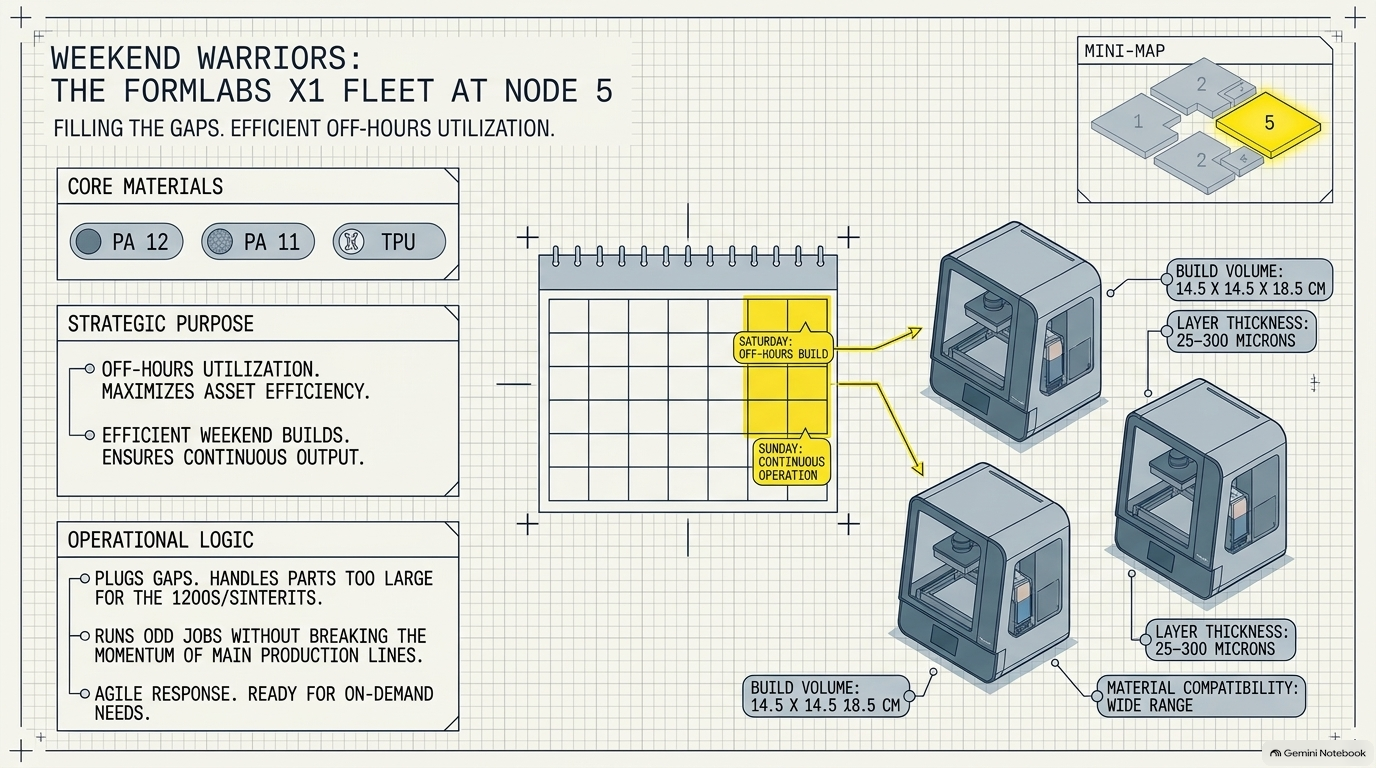
Formlabs printers are used to handle extra jobs and weekend production.
Now, if we added a kind of super-nesting tool that would look at every part and determine the best nesting option over several days across all machines, then we could make everything much more efficient. We could offer pricing and say, look, can we do Tuesday instead of Monday for 20% less? Or would you mind PA 12 but for 10% less? If we could optimize all these machines all the time, we could really optimize all our assets. At the same time, with operators, shifts, machines, and turnarounds, we would need far more complex tools to optimize our work. We’d need new software to further optimize the entire fleet and the people who manage it. If we get efficient software to optimize pricing and keep our printers full then this system will work. Without this software there is no hope that this will work.
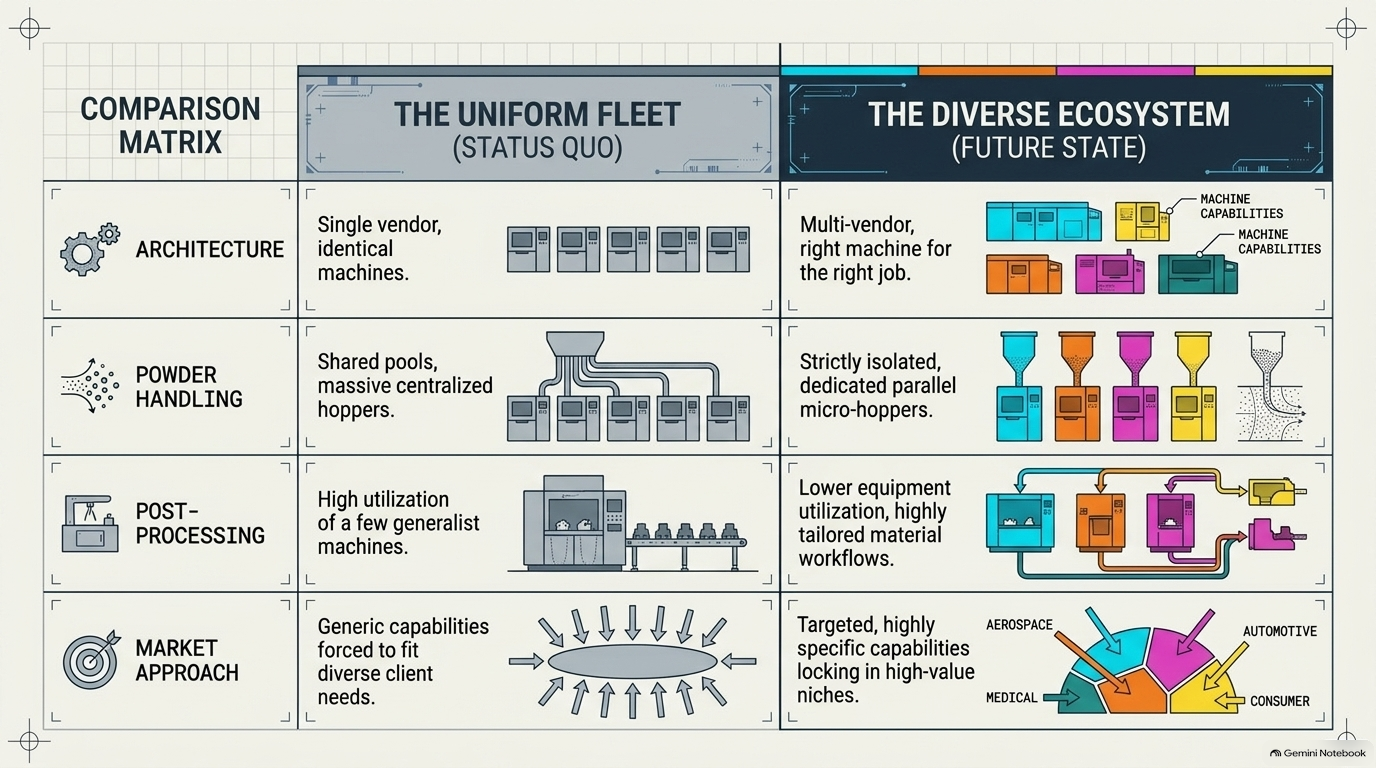
A single-vendor printer fleet compared with a multi-vendor setup.
To me, the key thing to making this work is in pricing. If you can offer the one-rail customer on the Sinterit a good deal for monthly parts on the machine and look at it as a path to filling the machine, it would all make more sense. If we can then get a good, cheap contract to fill the Farsoon rail machine, then we can fill that bucket too. To me, entering into long-term capacity contracts will help us protect ourselves financially while offering more products at the right prices. To me, the right prices are not some mythical volume calculation for everyone. Rather, it’s specific incentives to fill every machine continually at excellent prices for customers. Will all of this extra equipment and complexity pay for itself? Or do you think you’ll end up with a far too complicated business with much too much money riding on it?
Images courtesy of Joris Peels, generated with Google NotebookLM