

We’re kicking things off today with software news, as the new Meshy 7 is now live. Then we’ll move on to business, with ExOne and voxeljet now operating as a single legal entity. We’ll finish with custom 4D printed implants from the University of Wisconsin-Madison and Mass General Brigham, and 3D printed guns in Australia.
Meshy AI Launches New Meshy 7 Image-to-3D Foundation Model
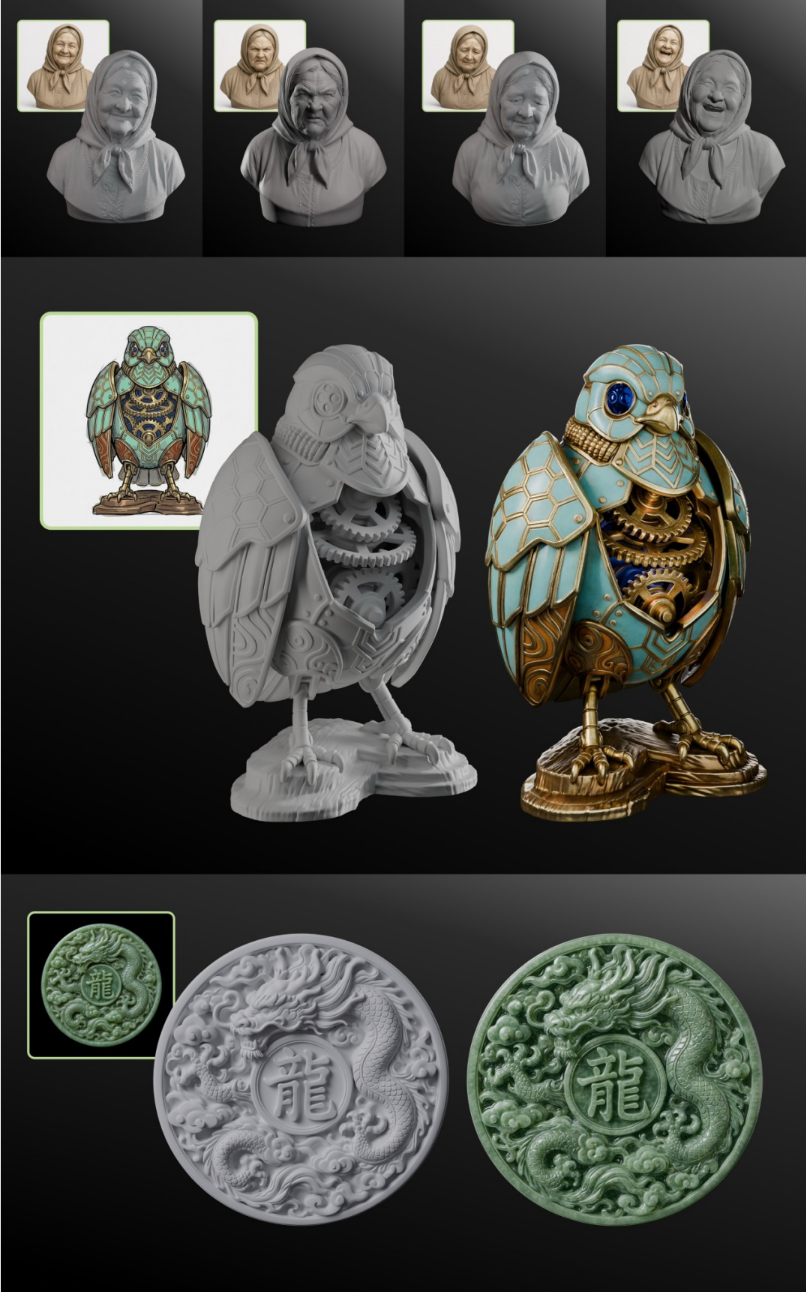
Meshy 7 image-to-3D results: from a single reference image to detailed geometry and PBR textures
across facial expressions, hard-surface mechanics, and relief carving.
Earlier this month, Meshy went live with Meshy 7, its new Image-to-3D foundation model. Meshy 7 is the new default model on Meshy Ai, and is built around alignment, which is how closely a generated 3D model matches the image it came from (input image). Additionally, Meshy published how it measures alignment. It’s based on three metrics: overall proportion (right shape and scale), spatial distribution (parts in the right places), and surface details (fine details match). Why is this important? Ideas and concept iterations typically happen in 2D, and creators are looking for a 3D asset that will closely match the 2D idea. If the proportions are wrong, details are missing, or output is inaccurate, things have to be reworked, which costs time and money. Meshy 7 improves alignment with both single-view and multi-view input, i.e. one reference image or several views and additional angles. It’s not CAD; instead, it creates “visually faithful 3D,” matching how an object looks. It also upgrades texture alignment, and style fidelity is improved as well.
Meshy 7 is strongest when used for organic characters, like miniatures with expressive faces; text and patterns; and hard-surface and mechanical parts. Each generation exports to STL, OBJ, 3MF, GLB, FBX, DXF, USDZ, and BLEND, with one-click import plugins available for Blender, Maya, 3ds Max, Unity, Godot, and Unreal Engine. The pricing has stayed the same, even with the improvements, costing 20 credits for a standard Meshy 7 generation. Here’s how it works: first, you start an image-to-3D generation in the Meshy workspace. Upload either one reference image, or multiple views of the same object, and then generate the model. Finally, export it to any major 3D tool. Meshy 7 is now open to all Meshy subscription users, but you’ll need the Pro tier or above to download any generated models.
ExOne & voxeljet Operating as Single Legal Entity
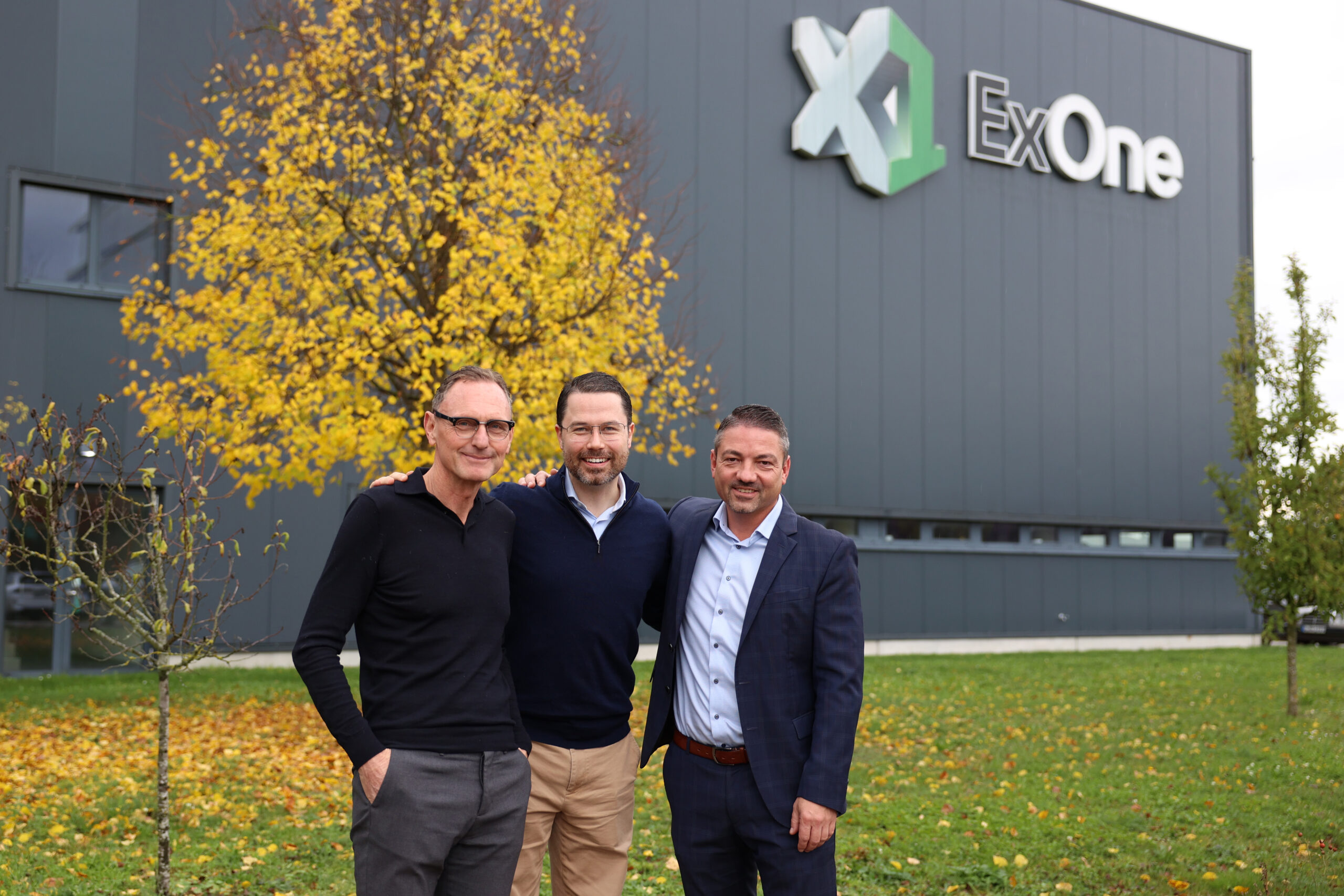
Rudolf Franz, Whitney Haring-Smith, and Eric Bader. Image courtesy of ExOne Global Holdings.
It’s been almost one year since Anzu Partners brought together two of the biggest names in the industrial 3D printing industry. After a lot of turbulence, the venture capital firm acquired assets of both voxeljet GmbH and ExOne Gmbh in late 2025, and combined them under one new parent company called ExOne Global Holdings. Now, the two firms have officially become one, and are operating as a single legal entity—ExOne GmbH—that’s been entered in the German commercial register. While it’s called ExOne, the voxeljet brand will be in use for the company’s PMMA and High Speed Sintering products. Headquartered in Gersthofen in Bavaria, the company combines both voxeljet’s and ExOne’s sand 3D printing technologies and teams. Additionally, ExOne says that established contracts remain available to customers, and that all existing contracts, non-disclosure agreements (NDAs), and quotations are still valid. There should be no interruption in spare parts supply, maintenance, or support.
“A step of this scale does not succeed through contracts and notary appointments. It succeeds through people who learn new things and take on the work together. No other team worldwide brings this much binder jetting expertise under one roof, and that is something our customers will notice in their production,” said Eric Bader, the CEO of ExOne Global Holdings.
4D Printed Implants Could Make Tissue Reconstruction Less Painful
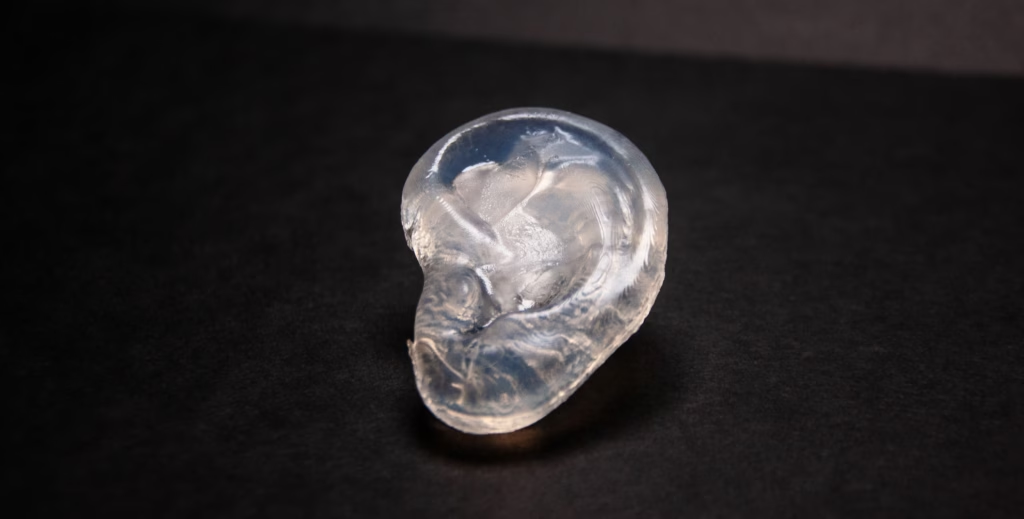
The researchers’ new 4D printed hydrogel tissue expanders can be fabricated into personalized ear- and breast-shaped geometries and achieve large-volume expansion while supporting natural tissue growth. Pictured above is an ear-shaped hydrogel tissue expander in its original, shrunken state before swelling. It was fabricated by mechanical engineering graduate student Vince Wang in Assistant Professor Xiao Kuang’s lab at UW-Madison. Photo courtesy of Xiao Kuang.
4D printing uses smart materials that respond to external or environmental stimuli like sound, light, heat, and chemicals, and dynamically change their shape over time. A multi-institution research team, led by Mass General Brigham, developed a 4D printed hydrogel device for tissue expansion that could give patients a much less painful path to tissue reconstruction. Surgeons often use tissue expansion in reconstructive surgery, and this technique involves slowly stretching nearby skin to grow extra tissue that can is used to reconstruct areas like the nose, ear, or breast. But the most common device for this is an implanted silicone balloon that’s frequently injected with saltwater, and it can be painful for patients, as well as require multiple clinic visits and maybe even extra surgery to remove excess skin. The team’s 4D printed hydrogel tissue expanders can be custom-made to match a patient’s anatomy, and gradually expand within the body without repeated injections, while also supporting natural tissue growth and staying in place better.
“Importantly, we can control the device’s expansion speed and final size. The new devices can expand to 10 to 30 times their original volume while staying strong, and the expansion happens slowly and steadily in weeks, allowing the skin to stretch naturally,” explained Xiao Kuang, an assistant professor of mechanical engineering at the University of Wisconsin-Madison, which is also part of the research team.
“These new devices could enable surgeons to make smaller incisions to implant the device, which can then grow slowly, reducing the surgery burden for the patient.”
Aussie Solicitor Charged After 3D Printed Firearms Investigation
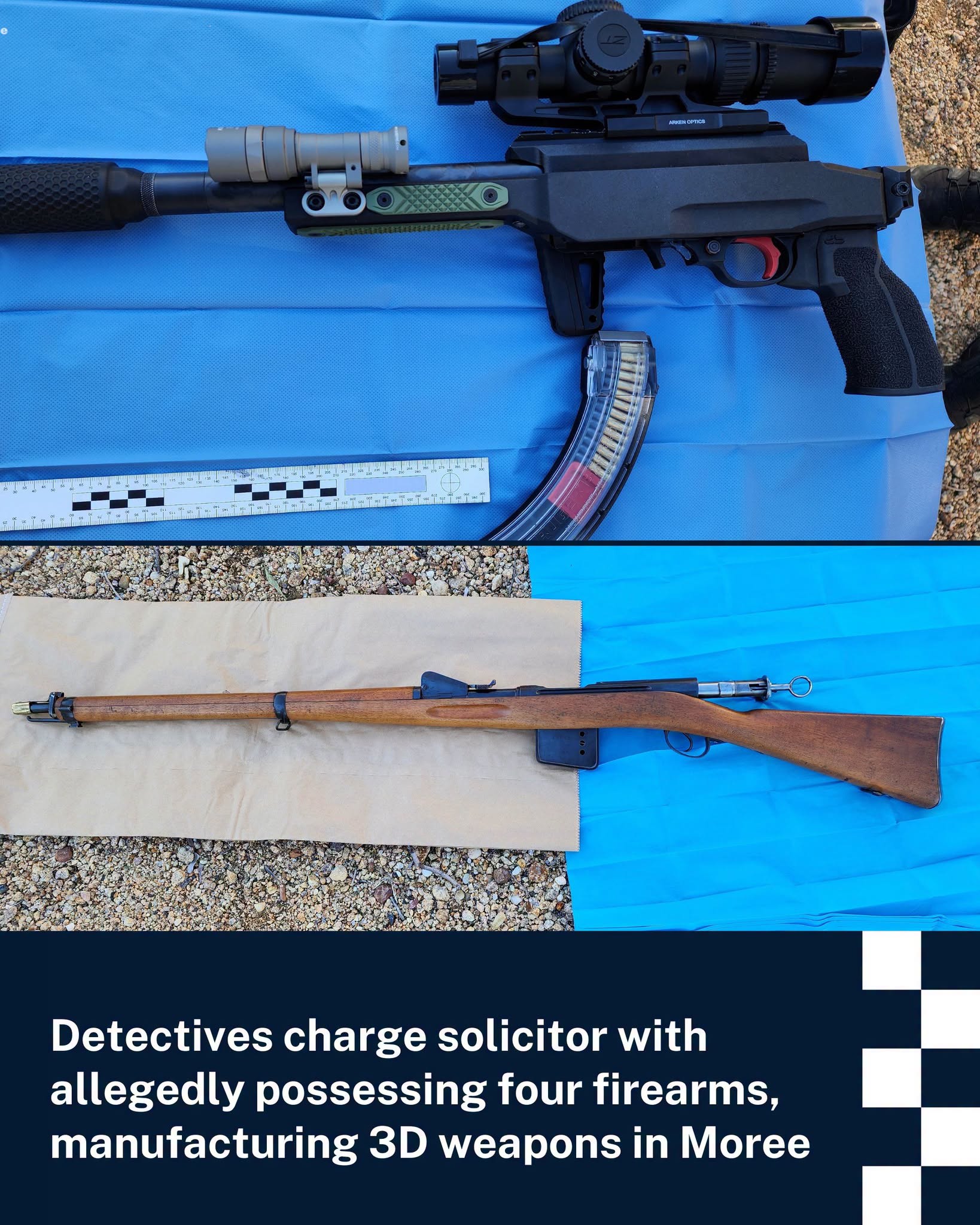
Image: NSW Police Force via Facebook.
As part of an investigation into illegal 3D printed firearms, the New South Wales (NSW) Police raided the office of the Aboriginal Legal Service in Moree in Northern NSW. First, law enforcement completed a firearm prohibition order (FPO) compliance check at a home in Moree, where police say they seized a bolt action rifle, two pistols, a semi-automatic privately manufactured firearm, firearm parts, hundreds of rounds of ammunition, and equipment related to fabricating ammunition. A search warrant was also executed at the Aboriginal Legal Service office, where police say they seized a 3D printer, blueprints to make firearms, and electronic devices. This was all related to alleged 3D printing of guns by 32-year-old Joshua David Gale, a solicitor employed by the service; Gale was arrested at the home, not the office. He will next face the court in October.
Gale was charged with 16 offenses, including manufacturing prohibited firearms. He applied for bail because of concerns for his safety due to being employed as a criminal defense solicitor, but bail was denied. As the court learned, Gale had previously been sentenced to an intensive corrections order, and was under a firearm prohibition order for offenses dating all the way back to 2019. He also told the court that he has severe PTSD, and will need to access care for his mental health issues while in custody. Detective Superintendent John Watson from the NSW Drug and Firearms Squad said the charges Gale faces are “extremely serious,” and that illegal manufacturing of guns is “something we’re seeing more of.” Australia has long been cracking down on 3D printed weapons, and NSW has passed laws making it illegal to possess the digital files used to 3D print a firearm.